
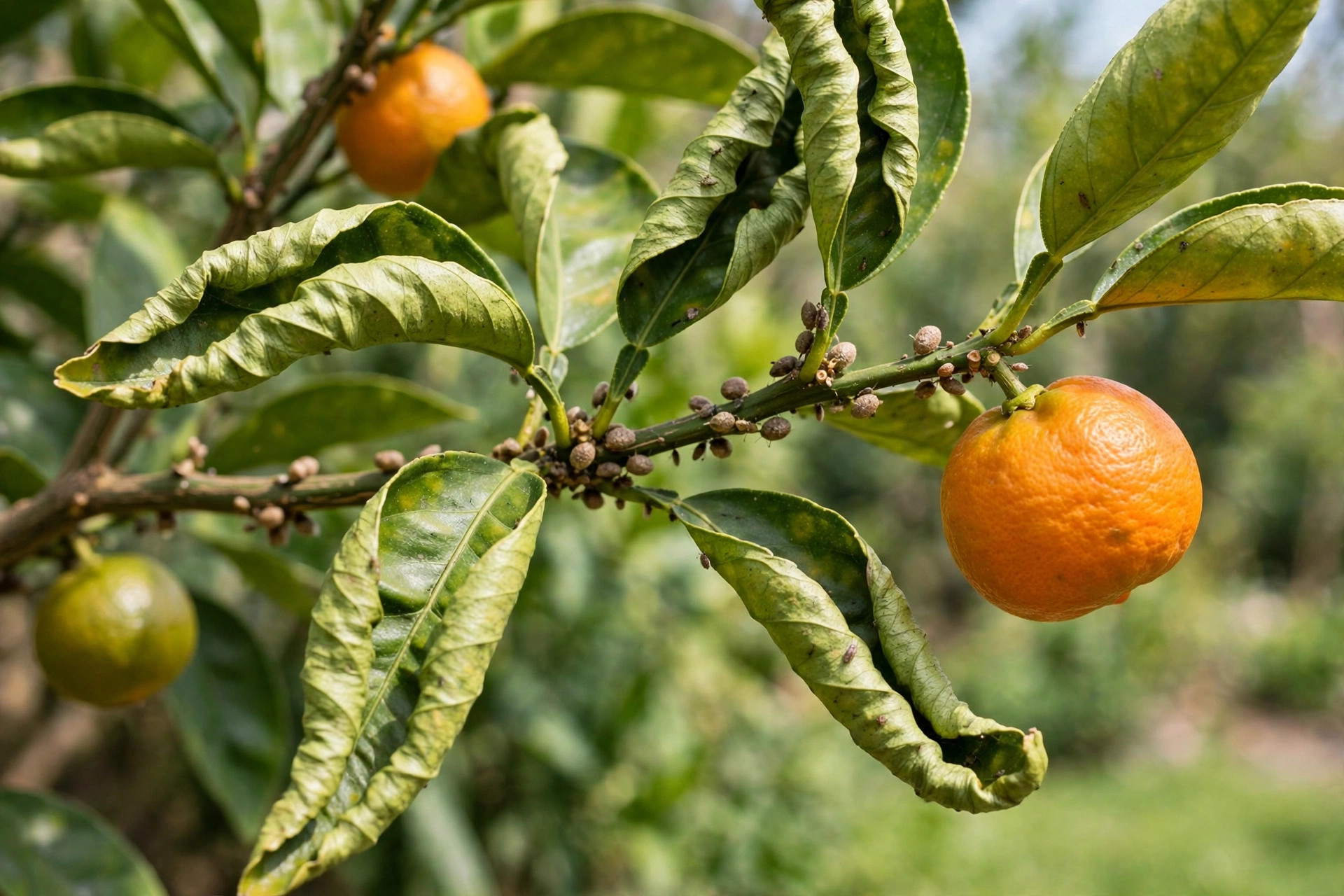
Citrus trees are generous plants. Given sun, warmth and regular water, a lemon, orange or mandarin tree will fruit for decades, filling a garden with scented blossom in spring and bright fruit in winter. Yet citrus trees are also magnets for trouble. Their soft new growth, sweet sap and dense leaves attract pests, and their fruit and foliage show every stress in the soil, water and weather. Three problems appear again and again on garden citrus: leaves that curl and twist, small scale insects that crust the stems, and a black, sooty coating that covers the leaves. This guide explains how to recognise each one, what causes it, and how to treat it safely, so your tree recovers and fruits well again.
Before treating anything, look at the whole tree. Is the problem on new growth only, or on old leaves too? Is it on one branch or the whole tree? Are the leaves yellow, curled, sticky, black, or covered in bumps? The answers narrow the cause quickly. Leaf curl on its own usually points to a pest or water stress. Scale insects are visible if you look closely at stems and leaf undersides. Sooty mould is not a disease of the leaf itself; it is a fungus growing on the sticky honeydew left by sap-sucking insects. Treat the insects, and the sooty mould usually fades on its own.
Leaf Curl: What It Looks Like and What Causes It
Leaf curl on citrus shows as new leaves that roll inward, twist, crinkle or pucker instead of opening flat. The leaves may also be smaller than normal, pale, or distorted along one edge. In severe cases the shoot tip stops growing, the leaves drop, and the young fruit may fall too. The most common cause is the citrus leafminer, a tiny moth whose larvae tunnel inside young leaves, leaving silvery winding trails and causing the leaf to curl as it grows. Leafminer damage is ugly but rarely kills a healthy tree, and it is worst in warm weather when trees are flushing with new growth.
Aphids are another common cause. These small green, black or brown insects cluster on soft shoot tips and suck the sap, which makes leaves curl and distort. Aphids also leave sticky honeydew, which can lead to sooty mould. Other causes include thrips, which rasp young leaves, and simple water stress: a citrus tree that is too dry, or watered unevenly, will curl its leaves to reduce water loss. Over-fertilising with nitrogen can also produce soft, sappy growth that curls easily and attracts pests.
To tell the cause, unroll a curled leaf gently and look inside. Silvery tunnels point to leafminer. Clusters of small insects point to aphids. Tiny, fast-moving insects and silvered leaf surfaces point to thrips. If no insects are visible and the soil is dry, water stress is the likely cause. Do not spray a strong insecticide at the first sign of curl, because that can kill the ladybirds, lacewings and parasitic wasps that keep aphids and leafminers in check.
How to Treat Leaf Curl
For leafminer, the simplest control is to prune off badly curled shoots and put them in the bin, not the compost, so the larvae do not survive. Avoid feeding citrus with high-nitrogen fertiliser in summer, when leafminer is most active, because soft new growth is what the moth lays its eggs on. Healthy, established trees usually tolerate leafminer without treatment, and the damage is mainly cosmetic. Young trees in their first two years are more vulnerable, and protecting their new growth matters more.
Scale Insects: The Crusty Pests on Stems and Leaves
Scale insects are small, immobile pests that look like tiny brown, grey or white bumps stuck to stems, twigs and the undersides of leaves. There are several types on citrus. Soft scale is rounded and brown, and it produces honeydew. Hard or armoured scale is flatter, with a hard cover, and does not produce much honeydew. Mealybug, a close relative, looks like a small white cottony blob. All of them suck sap from the tree, weakening it, causing leaves to yellow and drop, and reducing fruiting. Heavy infestations can kill branches.
Scale is easy to miss at first, because the insects do not move and look like part of the plant. Look for bumps along stems, sticky leaves, ants running up and down the trunk, and black sooty mould. Ants are a useful clue: they farm scale and aphids for their honeydew, and they protect them from predators. If you see ants on your citrus tree, look closely for scale underneath.
How to Treat Scale Safely
On a small tree, the safest treatment is physical removal. Scrub the stems gently with an old toothbrush dipped in soapy water, or wipe the leaves with a damp cloth, and prune out heavily infested twigs. Put the prunings in the bin. This is slow work, but it removes most of the insects without chemicals, and it is the best approach for a tree with fruit you plan to eat.
Horticultural oil, also called white oil, is the standard treatment for scale on citrus. It smothers the insects and is much safer for beneficial insects than a broad-spectrum insecticide, if it is used correctly. Spray in cool weather, in the evening or on a cloudy day, and never when the temperature is above 30 degrees or the tree is stressed by drought, because oil can scorch leaves in heat. Cover all stems and leaf undersides, and repeat after two to three weeks to catch crawlers that hatch after the first spray. Always follow the label, and do not spray oil and sulphur close together.
Sooty Mould: The Black Coating on Leaves
Sooty mould is a black, powdery or crusty fungus that coats leaves, stems and fruit, making the tree look as if it has been dusted with soot. It does not infect the leaf or feed on the plant itself. It grows on honeydew, the sugary waste left by aphids, scale, mealybug and whitefly. Where there is sooty mould, there are almost always sap-sucking insects nearby, even if you cannot see them at first.
Feeding, Watering and Prevention
A healthy citrus tree resists pests much better than a stressed one. Feed citrus in spring and again in late summer with a fertiliser made for citrus, or with a balanced fertiliser plus a little iron if the leaves are yellow between the veins. Do not over-feed with nitrogen, which produces soft growth that attracts aphids and leafminer. Water deeply and regularly, mulch to keep the soil moist, and make sure the tree gets at least six hours of sun a day.
Check your tree every two or three weeks, especially in spring and summer. Look at new shoots, leaf undersides, stems and fruit, and act early when you see the first curled leaf or the first scale bump. A few minutes of checking is worth more than a whole season of spraying, because most citrus problems are easy to fix when they are small and hard to fix when they are large.
Frequently Asked Questions
Is sooty mould dangerous? No, it is not poisonous and it does not infect the plant. It grows on honeydew from sap-sucking insects. Treat the insects, and the mould will fade. Wash fruit before eating it.
Can I eat fruit from a tree with scale? Yes, once the fruit is washed. Scale does not make fruit poisonous, but heavy infestations can reduce fruit size and quality. Avoid spraying close to harvest, and follow the withholding period on any spray label.
Will leafminer kill my tree? Rarely, on a healthy established tree. It is mainly cosmetic. Young trees and trees that are already stressed are more vulnerable, so protect their new growth and keep them watered and fed.
Conclusion
Leaf curl, scale and sooty mould look alarming, but they are common, understandable, and usually fixable. Leaf curl often means leafminer, aphids or uneven watering. Scale is a slow, crusty pest that is best caught early and treated with physical removal and horticultural oil. Sooty mould is a sign, not a cause: find the insects making the honeydew, treat them, and the black coating will fade. Keep your tree fed, watered, pruned for airflow, and checked regularly, and it will stay strong enough to shrug off most attacks and keep fruiting for years.
Try it on aitreeidentier.site — use the Plant Disease Identifier to check a leaf you are unsure about, and the Tree Disease Identifier for a citrus tree with dying branches or trunk problems. Try the disease identifier at aitreeidentier.site
Safety note: Always read the label on any spray, wear gloves, keep sprays away from children and pets, do not spray when bees are active, and observe the withholding period before picking fruit. If you are unsure what a pest or disease is, get it identified before you spray.