
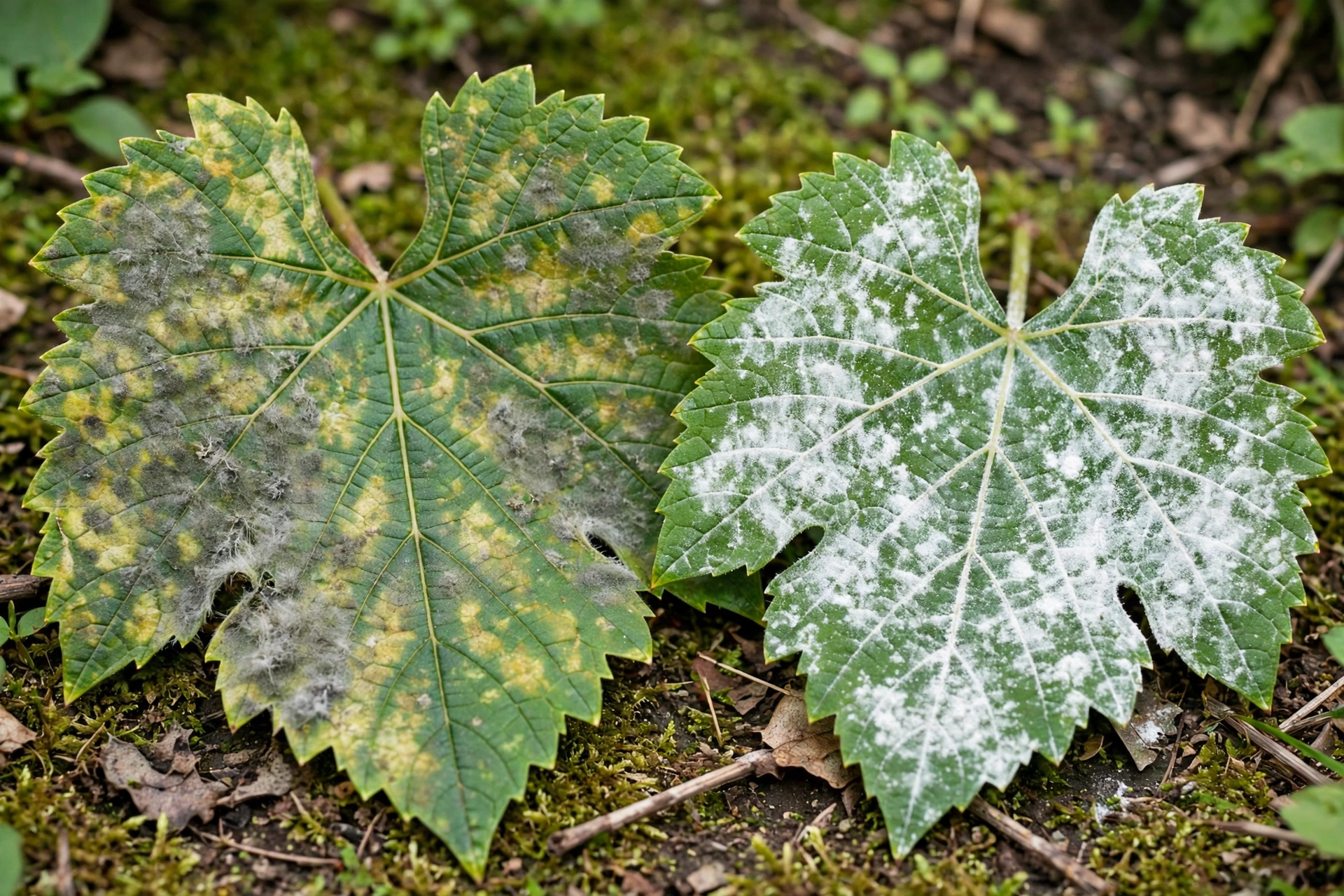
Two of the most common leaf diseases in the garden are downy mildew and powdery mildew, and their names make them sound almost the same. Both cause pale patches and stunted growth, both spread in the growing season, and both can affect roses, cucumbers, grapes, lettuce, and many other plants. Yet they are different diseases, they thrive in different weather, and they need different care.
Getting the identification right matters, because a treatment or habit that helps one can be useless, or even unhelpful, for the other.
What Is Powdery Mildew?
Powdery mildew is the easier of the two to spot. It appears as white or pale grey powdery patches on the upper surface of leaves, stems, and sometimes buds. The patches look as if someone dusted the plant with flour, and you can often rub the powder off with a finger. As the disease advances, the patches spread, leaves yellow, curl, and may drop, and growth slows.
Powdery mildew likes warm, dry days and cool, humid nights. It does not need rain or even leaf wetness to spread; in fact, rain can wash its spores away. It thrives where plants are crowded, shaded, and poorly ventilated, and it often appears in late summer.
What Is Downy Mildew?
Downy mildew is harder to see and often more damaging. On the upper leaf surface, it causes yellow or pale patches, often limited by the leaf veins so they look angular or blocky. Turn the leaf over, and you will find a soft, downy, grey or purple-grey fuzz growing on the underside, directly beneath the yellow patches.
Downy mildew needs wet leaves to spread. It thrives in cool, damp weather, after rain or heavy dew, and in crowded plantings where leaves stay wet for hours. Unlike powdery mildew, the fuzz is mostly underneath the leaf, not on top.
Side-by-Side: Key Differences
The quickest check is where the growth appears. Powdery mildew sits on the upper surface as a white powder you can rub off. Downy mildew shows yellow patches on top and soft grey fuzz underneath, and the patches are often bounded by veins.
Weather is the next clue. Powdery mildew appears in warm, dry conditions with humid nights. Downy mildew appears after rain and wet weather, and it spreads fastest when leaves stay damp. Timing helps too: powdery mildew is common in late summer, while downy mildew often strikes in cool, wet periods earlier in the season, though both can overlap.
Step-by-Step: Identify Which Mildew You Have
Step 1: Look at the upper leaf surface
Photograph the top of an affected leaf in daylight. White powdery patches suggest powdery mildew, while yellow or pale angular patches suggest downy mildew. Note the colour, shape, and whether the patches cross the veins.
Step 2: Turn the leaf over
This is the decisive step. A soft grey or purple fuzz on the underside, under the yellow patches, points to downy mildew. A clean underside with the powder only on top points to powdery mildew. Take a photo of both sides for comparison.
Step 3: Check the weather, the plant, and confirm
Ask when the problem started. Did it follow rain and cool, wet days, or a warm, dry spell with humid nights? Wet-weather outbreaks favour downy mildew, while dry-weather outbreaks favour powdery mildew. Then upload clear photos of both leaf surfaces to an identification tool.
How to Manage Each Mildew
For both diseases, start with the same basics: remove badly affected leaves, avoid overhead watering, space plants for airflow, and clean up fallen leaves. Water at the base in the morning so leaves dry quickly, and avoid crowding plants together.
For powdery mildew, improving airflow and sunlight helps a lot, and removing the worst leaves can slow the spread. For downy mildew, keeping leaves dry is even more important: water at the base, avoid evening watering, and do not handle wet plants, because you can carry spores on your hands and tools.
Common Mistakes Beginners Make
- Only looking at the top of the leaf. Downy mildew hides underneath, so a top-only check leads many people to the wrong diagnosis.
- Assuming all white coating is powdery mildew. Downy mildew fuzz, insect eggs, and dust can all be confused with it at a glance.
- Watering overhead in the evening. Wet leaves overnight favour downy mildew and give it hours to infect.
- Treating both mildews the same way. They respond to different conditions and products, so a correct identification saves time and effort.
Which Plants Get Which Mildew?
Both mildews affect a wide range of plants, but they have favourite hosts, and knowing them helps you check the right plants at the right time. Powdery mildew is common on roses, courgettes, squash, cucumbers, peas, beans, grapes, apples, strawberries, phlox, and lilac. Downy mildew is common on lettuce, cucumbers, grapes, onions, roses, and many brassicas. Some plants, such as cucumbers, grapes, and roses, can get both, which is why checking both leaf surfaces matters so much on those hosts. Different mildew species often specialise in one plant family, so mildew on your roses will not necessarily spread to your lettuce, but mildew on one cucumber plant will very likely spread to the cucumbers beside it. When you find mildew on one plant, check its neighbours in the same family first, and space them out so air can move between them.
Preventing Mildew: A Season-Long Plan
Preventing mildew is a season-long job, not a single spray. In spring, choose resistant varieties where they are available, and give each plant the space its mature size needs — crowding is the single biggest cause of mildew in most gardens. Water at the base in the morning, so leaves dry quickly, and mulch the soil to keep moisture even and reduce splashing. In summer, thin crowded growth, remove the worst-affected leaves promptly, and ventilate greenhouses daily. Avoid excess nitrogen fertiliser, which produces soft, sappy growth that mildew loves. In autumn, clean up fallen leaves and spent plants, because some mildew overwinters in debris and buds. If you follow that plan, you will still see some mildew in a bad year, but it will arrive later, spread more slowly, and do far less damage than it would in a crowded, damp, poorly ventilated garden.
FAQ
Can a plant have both downy and powdery mildew?
Yes, it is possible, especially in changeable weather. Check both leaf surfaces on several leaves, since one disease may dominate on one part of the plant and the other elsewhere.
Is mildew dangerous to people or pets?
Mildew on plants is a plant disease, not a human one, but avoid eating badly affected leaves or fruit
How do I prevent mildew next year?
Choose resistant varieties, space plants for airflow, water at the base in the morning, rotate crops, and clean up fallen leaves in autumn. These habits prevent more mildew than any spray.
Can mildew on cucumbers spread to roses? Usually not, because different mildew species specialise in different plant families. Mildew can, however, spread easily between plants of the same family, so check neighbouring cucumbers, squash, and courgettes when you find it on one of them.
Why does mildew come back every year? Because spores overwinter in fallen leaves, buds, and debris, and the conditions that favour mildew — crowding, shade, still air, and wet or humid leaves — return each year. Autumn clean-up and better spacing break that cycle over time.
Conclusion
Downy mildew and powdery mildew look alike at first glance, but the leaf tells the story: white powder on top means powdery mildew, while yellow patches on top with soft fuzz underneath means downy mildew. Add the weather to the picture — dry and warm for powdery, wet and cool for downy — and you can usually tell them apart with confidence.
Try it: Try the free Plant Disease Identifier on aitreeidentier.site — upload a clear photo of the upper and lower leaf surfaces for instant guidance.
Safety disclaimer: Never eat or use any part of a plant, or treat a disease, based on AI identification alone. AI results are guidance only — consult a local arborist or plant expert before applying treatments, especially near people, pets, food crops, or waterways.