
Introduction
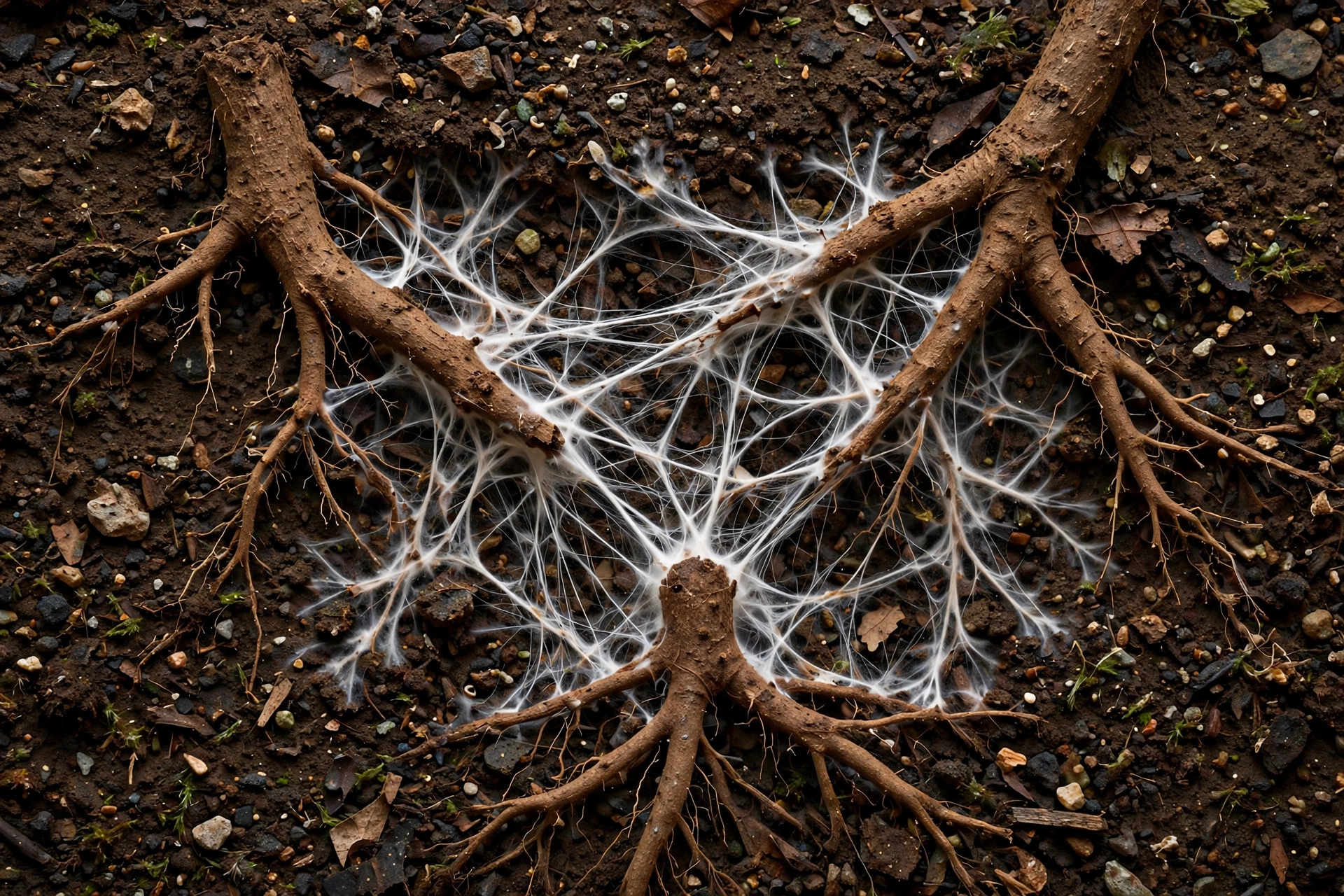
Beneath every healthy tree lies a hidden world: a vast network of fine fungal threads, called mycelium, woven through the soil around the tree's roots. These are mycorrhizal fungi, and they form one of the most important partnerships in nature. The tree feeds the fungus with sugars made in its leaves, and the fungus returns water and nutrients the tree could never reach alone.
Scientists sometimes call this network the "wood wide web," because it can link the roots of many trees together underground, helping them survive drought, disease, and poor soil.
What Mycorrhizal Fungi Are
Mycorrhizal fungi are not the mushrooms you see above ground. Mushrooms are just the fruiting bodies of a much larger organism living in the soil. The main body is the mycelium, thread-like hyphae so fine that one teaspoon of healthy soil can contain metres of them.
There are two main types. Ectomycorrhizal fungi wrap around root tips and partner with oaks, pines, and birches. Arbuscular types grow inside root cells and partner with most garden plants and grasses. Both extend the tree's reach into the soil far beyond its own roots. This partnership is ancient, hundreds of millions of years old, and likely helped the first plants colonise dry land.
Two Kinds of Mycorrhizae: Arbuscular and Ectomycorrhizal
Mycorrhizal fungi come in two main types, and which one your trees use depends on the species. Arbuscular mycorrhizae, often shortened to AM, partner with most herbaceous plants, vegetables, and many tropical trees. Their fungi penetrate the root cells themselves, forming tiny branched structures called arbuscules where nutrients are exchanged. They are ancient, dating back hundreds of millions of years, and they are the reason most garden plants benefit from healthy soil fungi.
Ectomycorrhizal fungi, or EM, partner mainly with temperate and boreal trees such as oaks, pines, birches, and beeches. Instead of entering the cells, they wrap the root tips in a sheath and grow between the root cells, forming a visible mantle. Many of the mushrooms you see in autumn, such as boletes, chanterelles, and fly agarics, are the fruiting bodies of ectomycorrhizal fungi. Orchids have their own special relationship, relying on fungi to germinate at all, since their dust-like seeds carry almost no food reserves. Knowing which type your trees use helps you understand what lives beneath them and why undisturbed soil matters so much.
How the Network Feeds Your Trees
Tree roots absorb water well, but they are thick and limited in reach. Fungal hyphae are far thinner than the finest root hair, so they explore tiny cracks in the soil for water and minerals the tree cannot reach, especially phosphorus, which many soils lack, plus zinc, copper, and other trace minerals.
In exchange, the tree sends the fungus a share of its sugars from photosynthesis, sometimes a fifth of its total production. The fungus cannot make food from sunlight, and the tree cannot mine soil as efficiently as the fungus. The network also links trees: a large tree can pass sugars to a shaded seedling, and linked seedlings grow faster and survive drought better.
What the Network Does for Soil and Health
Fungi do far more than feed trees: their hyphae bind soil particles into stable crumbs, improving structure, drainage, and water holding, so fungal-rich soil stays moist longer in drought and drains better in rain.
The network also helps trees resist disease: fungi outcompete harmful organisms around roots, and better nutrition makes trees stronger. Fungi also lock carbon into the soil, as sugars from trees become fungal tissue and stable organic matter that can stay underground for decades.
How to Protect the Fungal Network in Your Garden
The fungal network is fragile: it takes years to build and can be damaged in an afternoon. Protecting it mostly means doing less, not more.
Step 1: Stop digging around trees
Every spadeful cuts fungal threads, so avoid digging, rototilling, or trenching near tree roots. If you must plant under a tree, use small plants and make the smallest hole possible.
Step 2: Keep the soil covered
Leaf litter, wood chip mulch, and ground cover keep soil cool and moist for fungi. Keep mulch a few centimetres away from the trunk to avoid rot.
Step 3: Go easy on fertiliser and fungicide
Heavy chemical fertiliser, especially phosphorus, can make trees stop feeding their fungi, and fungicides can kill them directly. Use both sparingly, only when genuinely needed.
Step 4: Leave leaves and deadwood, and plant a mix
Leaf litter feeds soil fungi and rotting logs are rich habitat, so leave some leaves in place and keep a log pile in a quiet corner. A diverse garden supports a diverse fungal community.
Common Mistakes Beginners Make
- Thinking mushrooms are a problem. Mushrooms near a tree usually mean a healthy fungal network is present, not a sick tree. Most are beneficial partners.
- Digging and rototilling under trees. This shreds the fungal network and damages fine roots, which can take years to recover.
- Over-fertilising. Excess fertiliser, especially phosphorus, tells the tree it does not need its fungal partners.
- Using fungicide as a routine treatment. Broad-spectrum fungicides kill helpful fungi too. Use them only for a diagnosed problem, not as prevention.
- Removing all leaf litter. Bare soil dries out and loses the organic matter fungi need. A layer of leaves is food and shelter for the network.
Should You Buy Mycorrhizal Products?
Garden centres now sell mycorrhizal powders, granules, and gels, and the honest answer is that they sometimes help and sometimes do nothing. They are most useful when planting into sterile or degraded soil, such as a new build site, a container of fresh compost, or ground that has been heavily dug, fumigated, or treated with fungicide, where native fungi are scarce. In those cases, adding inoculant at planting time, in direct contact with the roots, can speed establishment.
In healthy garden soil, native fungi are usually already present in abundance, and adding a commercial product makes little difference. The fungi in a packet may also be the wrong species for your trees, or may not survive storage. A better investment is usually to protect the fungi you already have: stop digging, mulch the surface, and avoid excess fertiliser. If you do buy a product, choose one that lists the fungal species, check it matches your plants, and use it when planting, not as a sprinkle on the surface afterwards.
FAQ
Can I see the mycorrhizal network?
Not directly: the hyphae are microscopic. Look for its signs: mushrooms near trees, fine white threads in rich dark soil, and trees growing strongly with little fertiliser.
Are the mushrooms under my tree safe to eat?
Never eat a wild mushroom based on appearance or an app result alone, as many edible species have poisonous lookalikes. Use the Mushroom Identifier on aitreeidentier.site to learn about what you found, then confirm with a local expert first.
Can I buy mycorrhizal fungi and add them to my soil?
Products exist, but results vary, and most gardens already have these fungi. Protecting what is there (no digging, mulch, less fertiliser) usually works better than buying inoculants.
Do all trees have mycorrhizal partners?
Nearly all do: around nine in ten land plant species form these partnerships. A few families, such as cabbages, do not, but almost every garden tree is connected.
Can I see mycorrhizal fungi?
Usually not directly, since the network is made of microscopic threads in the soil. But you can see the signs: white, thread-like hyphae in leaf litter and compost, the mushroom fruiting bodies that appear in autumn, and the dense, pale sheath on the root tips of trees such as pines and oaks. Healthy soil often smells earthy and sweet, which is partly the work of these fungi and their microbial partners.
Conclusion
Mycorrhizal fungi are the hidden network under your trees: a living web feeding roots, linking trees, building healthy soil, and storing carbon underground. You cannot see it, but you can protect it by digging less, mulching more, and going easy on chemicals. The next time you see a mushroom at the base of a tree, remember it is only the tip of something vast and ancient, working for your tree every day.
Try it: Try the free Mushroom Identifier on aitreeidentier.site — photograph a mushroom near your trees to learn more about the fungi living in your soil.
Safety disclaimer: Never eat or use any mushroom or fungus based on AI identification alone. AI results are guidance only — many edible species have deadly lookalikes, so always consult a local mushroom expert before eating, touching, or using any wild fungus.