
Introduction
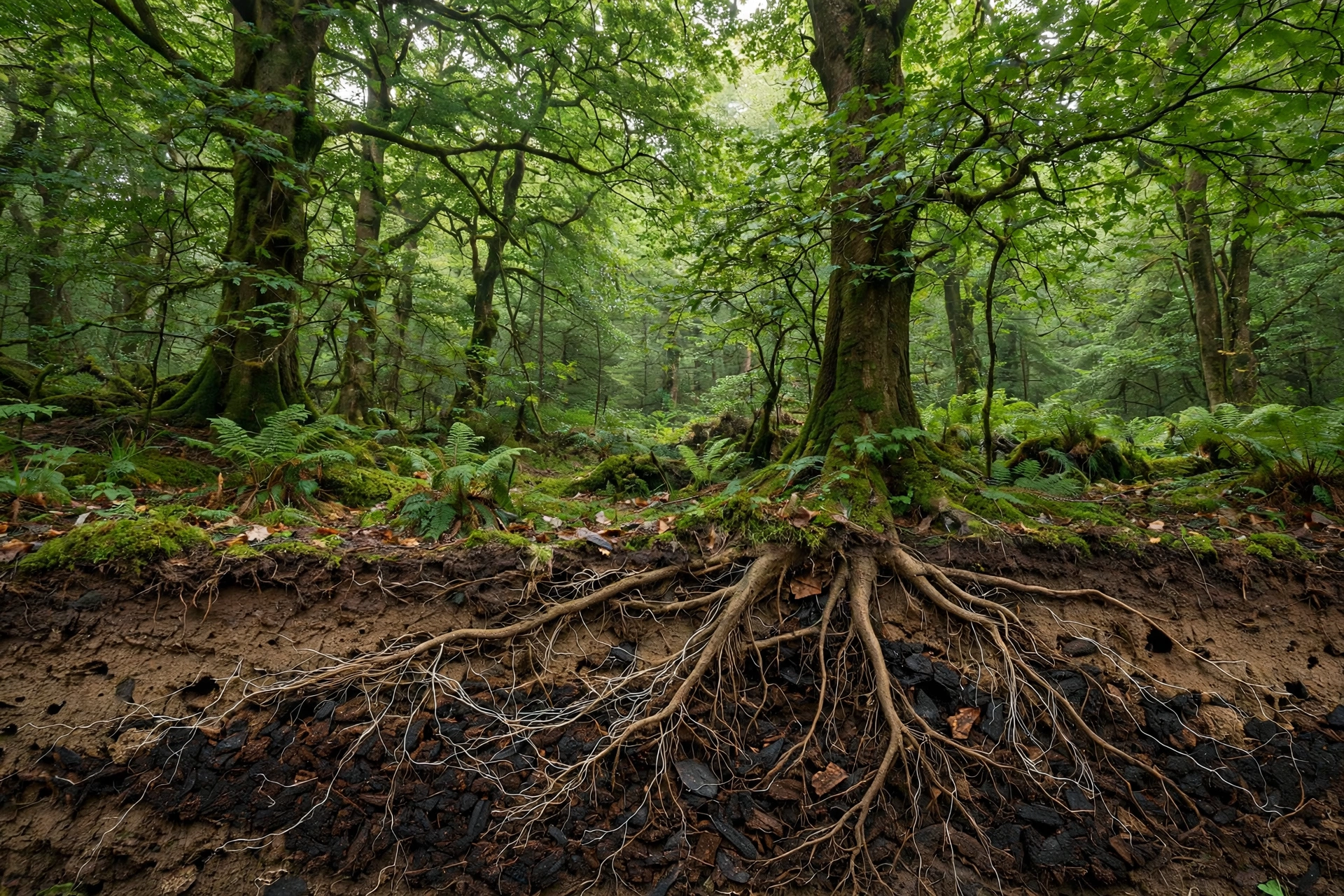
Every tree you see is a quiet carbon storehouse. Its trunk, branches, roots, and the soil beneath it hold carbon once floating in the air as carbon dioxide. Understanding how trees store carbon shows why forests matter against climate change, and why protecting the trees you already have often beats planting new ones.
The process starts with sunlight and ends, years later, deep underground: carbon moves from air into leaves, into wood, and into soil, where some of it stays locked away for centuries.
Photosynthesis: Turning Air into Sugar
Photosynthesis is the engine of the whole process. Inside every leaf, tiny green structures called chloroplasts capture sunlight and use its energy to join carbon dioxide and water into sugars. The tree keeps most of the carbon from those sugars and releases the oxygen back into the air.
A large mature tree can absorb a surprising amount of carbon dioxide over its lifetime, though the exact amount depends on species, climate, and growing conditions. Young, fast-growing trees absorb carbon quickly, while older trees store more in total because of their size, so a forest with trees of many ages stores the most carbon of all.
How Fast Do Different Trees Store Carbon?
Not all trees store carbon at the same speed. Fast-growing species such as willow, poplar, and eucalyptus can absorb carbon quickly in their first decades, adding metres of growth a year in good conditions, but their wood is often light and short-lived, so the carbon may return to the air sooner when the tree dies or is harvested. Slow-growing hardwoods such as oak, beech, and teak add carbon more gradually, but their dense, durable wood locks it away for far longer, and a large old oak can hold several tonnes of carbon in its trunk alone.
Growth also follows a curve: a young tree absorbs carbon rapidly as it builds its canopy, a mature tree stores the most carbon in total because of its size, and a very old tree adds little new wood each year but keeps its huge store intact. This is why the best carbon strategy is a mix: protect old trees that already hold large stores, plant fast growers for quick gains, and include long-lived species that will hold carbon for centuries. A forest with trees of many ages and species stores more carbon, and stores it more safely, than a plantation of a single fast-growing species.
Wood: Carbon Locked into the Trunk and Branches
Once a tree makes sugars, it turns much of them into wood. Wood is roughly half carbon by dry weight, so a heavy trunk is literally a heavy store of carbon. Each year, a layer of new wood forms just under the bark, the annual ring in a cut stump, a record of one year of carbon capture.
The trunk is the biggest store, but roots matter too: a root system can hold a quarter or more of a tree's total carbon. When a tree dies and its wood rots or burns, much of that carbon returns to the air — so long-lived trees, and timber kept in use as buildings or furniture, keep carbon out of the atmosphere far longer.
Soil: The Largest Carbon Store of All
The soil under a tree often holds more carbon than the tree itself. Roots release sugars into the soil, feeding microbes and fungi, and dead roots and fallen leaves become soil organic matter. Over decades and centuries, some of this carbon becomes stable, bound to soil minerals in forms that can persist for hundreds of years.
This is why disturbing soil is so costly: digging or ploughing exposes soil carbon to air, and microbes quickly convert it back into carbon dioxide. Keeping soil covered with leaf litter or mulch protects this hidden store.
How You Can Help Trees Store More Carbon
You do not need a forest to make a difference. A single healthy garden tree, cared for over decades, stores a meaningful amount of carbon.
Step 1: Protect the trees you already have
A mature tree stores far more carbon than a sapling, so before planting anything new, make sure existing trees are healthy, watered in dry spells, and safe from mowers, strimmers, and building work.
Step 2: Plant the right tree in the right place
Choose species suited to your soil, climate, and space — a tree that grows well lives longer and stores more carbon than a struggling one. Use the Tree Researcher on aitreeidentier.site to identify trees already growing nearby; they thrive in your conditions.
Step 3: Keep the soil undisturbed and covered
Mulch around the base, keeping mulch a few centimetres from the trunk, and leave leaf litter in place where you can. Avoid compacting soil with vehicles or constant foot traffic.
Step 4: Water wisely and think long term
Young trees need watering in drought, and deep, occasional watering encourages deep roots. Carbon storage is a slow game: give trees decades of growth where they can reach full size.
Common Mistakes Beginners Make
- Thinking planting alone is enough. A sapling only stores real carbon if it survives for decades; protecting mature trees matters more.
- Removing leaf litter and deadwood. Fallen leaves and branches feed the soil carbon store, and clearing them away starves it.
- Digging and compacting soil around trees. Disturbed soil releases stored carbon and damages the roots that feed the tree.
- Planting the wrong species for the site. A tree that dies young stores almost nothing, so match the species to the soil, light, and space.
- Assuming all trees store carbon equally. Species, age, health, and conditions all change how much carbon a tree captures and keeps.
Carbon Offsets and Tree Planting: What to Know
Many companies now offer to plant trees to offset emissions, and it is worth knowing what makes an offset credible. The first test is additionality: would the trees have been planted anyway? If so, the offset adds nothing. The second is permanence: a tree planted today stores carbon only if it survives for decades, so projects that protect existing forest are often more reliable than new planting, where seedling survival can be low. The third is verification: credible projects are checked by independent auditors, and their results are published.
There are also limits to what tree planting can do. A single person's annual carbon footprint would need dozens of trees growing for decades to absorb, and the world's available land for planting is limited. That does not make planting pointless; it makes it one part of a larger solution. The most useful approach is to combine planting and protecting trees with cutting emissions at the source, and to be sceptical of any claim that a flight or a purchase is fully offset by a handful of seedlings.
FAQ
How much carbon does one tree store?
It varies by species, size, and climate. A large mature tree can store several tonnes of carbon dioxide equivalent over its lifetime, while a young sapling stores very little.
Does a tree release carbon when it dies?
Yes, gradually. As dead wood decays, microbes return much of its carbon to the air. Some stays in the soil, especially if the wood rots slowly, so keeping deadwood on site slows the release.
Do trees store carbon at night or in winter?
Photosynthesis needs light, so trees capture carbon mainly by day and in the growing season. Evergreens photosynthesise on mild winter days, while deciduous trees wait for spring.
Is planting trees the best way to fight climate change?
It helps, but it is not enough alone. Cutting fossil fuel use matters most; planting and protecting trees is a valuable part of the solution.
Do dead trees release their stored carbon?
Yes, but slowly. When a tree dies and decays, fungi and bacteria break down its wood over years or decades, releasing carbon dioxide gradually. If the dead wood is left in place, some of its carbon also enters the soil, where it can stay for much longer. Burning wood releases the carbon quickly, which is why leaving deadwood in a forest is usually better for carbon storage than clearing it away.
Conclusion
Trees store carbon in three connected ways: photosynthesis pulls carbon dioxide from the air, wood locks it into trunks and roots, and soil holds it underground for decades or centuries, all helped by the same simple care: healthy trees, undisturbed soil, and time to grow.
Try it: Try the free Tree Researcher on aitreeidentier.site — identify a tree from a photo and learn how much carbon species like it can store.
Safety disclaimer: Never eat or use any part of a tree based on AI identification alone. AI results are guidance only — consult a local tree expert or arborist before using, harvesting, or treating any tree, especially near people, pets, food crops, or waterways.