
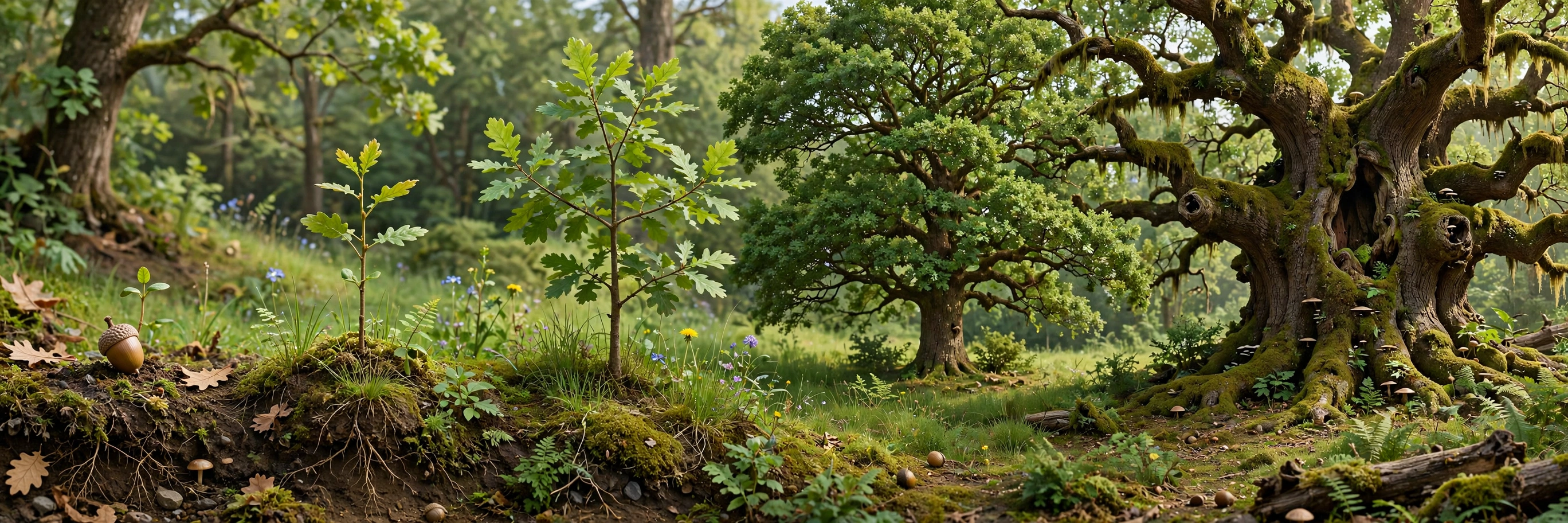
Introduction: A Life Measured in Centuries
A tree's life can span longer than a human lifetime, and in some species, longer than many human generations. An oak can live for hundreds of years, a yew for over a thousand, and a bristlecone pine for several thousand. Yet every ancient giant began as a single seed, small enough to hold between finger and thumb.
This guide follows a tree through its life stages — seed, germination, seedling, sapling, mature tree, and old age — and explains what it needs at each stage, and how you can help a young tree become a healthy mature one.
Stage 1: Seed
A tree seed contains an embryo, a food store, and a protective coat. It is the result of pollination and fertilisation, and it carries genes from both parent trees. Seeds are designed for dispersal: some fly on the wind with wings, some float on water, some are carried by animals, and some are eaten and dropped elsewhere.
How Trees Measure Time: Rings, Growth, and Senescence
A tree records its life in its wood. Each year, the cambium, a thin layer of dividing cells just under the bark, produces a new ring of wood. Spring wood, called earlywood, has wide, thin-walled cells for fast water transport, while summer wood, or latewood, has narrow, thick-walled cells for strength. The boundary between one year's latewood and the next year's earlywood is what we see as a growth ring. Wide rings mean good years with plenty of water and light, while narrow rings record drought, shade, or damage, which is why scientists can read past climates from old timber.
Unlike animals, trees do not have a fixed lifespan programmed into every cell. They grow from meristems, clusters of stem cells at the shoot tips and root tips that stay young throughout the tree's life, so in principle a tree can keep growing indefinitely. What eventually limits a tree is size and damage: as it grows taller, lifting water becomes harder, and accumulated wounds, decay, and storms take their toll. Old trees often survive by retrenchment, letting their crown shrink and their trunk hollow out while the living outer wood keeps working, which is why a hollow ancient oak can be alive and healthy.
Stage 2: Germination and Seedling
Germination begins when a seed takes up water, the embryo grows, and a root emerges, followed by a shoot. The seedling uses stored food first, then begins to photosynthesize once its first true leaves open. This is the most vulnerable stage: seedlings can be killed by drought, frost, slugs, damping-off disease, or being shaded out by faster-growing plants.
Stage 3: Sapling and Young Tree
Stage 4: Mature Tree
A mature tree has reached its full height and canopy size, and it produces flowers, fruit, and seeds regularly. It is at its peak for photosynthesis, shade, wildlife habitat, and carbon storage. A mature tree supports many other species: birds nest in its branches, insects feed on its leaves, fungi live on its roots, and lichens grow on its bark.
Stage 5: Ancient Tree and Decline
How to Help a Tree Through Its Life: Step by Step
1. Choose the right species and place. Use the Tree Age Estimator on aitreeidentier.site to learn about a tree's expected size and lifespan, and plant it where it has room to grow to maturity. 2. Plant correctly. Plant at the right depth, with the root flare visible, in a wide hole, and water well. Stake only if the tree is unstable, and remove stakes after one or two seasons. 3. Water young trees deeply. Water slowly at the drip line during dry periods for the first two to three years, reducing frequency as roots establish. 4. Mulch and protect. Keep mulch away from the trunk, protect the trunk from mowers, and avoid digging or building over roots. 5. Prune for structure, not shape. In the first years, focus on a strong framework. Later, remove only dead, damaged, or hazardous branches, and prune at the right season for the species. 7. Respect old trees. Do not try to make an ancient tree look young again. Manage risk, protect its roots, and value its habitat role.
Common Mistakes
Planting a large tree in a small space. A tree that will grow to 20 metres does not belong under power lines or next to a house foundation. Check mature size before planting.
Planting too deep or too shallow. Burying the root flare causes rot; planting too shallow exposes roots to drying. The flare should sit at soil level.
Topping or heavy pruning. Removing the top of a tree creates weak regrowth, entry points for decay, and a shorter life. Prune selectively instead.
Damaging roots during building work. Cutting roots, changing soil levels, or compacting soil under a tree can kill it slowly over several years. Protect the root zone before work begins.
Veteran Trees: Why Old Trees Are Worth Protecting
A veteran tree is worth far more than its timber. Its hollows, dead branches, and loose bark provide homes for bats, owls, beetles, and fungi, and a single ancient oak can support hundreds of species that cannot live anywhere else. The soil beneath it holds centuries of accumulated organic matter and a rich fungal network that supports younger trees nearby. Because these habitats take centuries to develop, they cannot be replaced by planting new trees.
Managing a veteran tree is different from managing a young one. Heavy pruning can shock it, and removing dead wood destroys habitat, so the usual approach is light, careful work: reducing the weight of overextended limbs, mulching the root zone, and keeping compaction and digging away from its roots. If you have an old tree on your land, treat it as a monument rather than a problem. A professional arborist experienced with veteran trees can help you plan work that keeps it safe while preserving the wildlife it supports.
Frequently Asked Questions
How long does it take for a tree to grow?
It depends on species, climate, and soil. Fast-growing trees such as willow and poplar can grow a metre or more per year, while slow-growing oaks and yews may grow only a few centimetres. Most trees take decades to reach maturity.
How can I tell how old a tree is?
Counting tree rings is accurate but requires cutting or coring. For a living tree, you can estimate age from species, trunk girth, and growth rate, using a tool such as the Tree Age Estimator on aitreeidentier.site. Local records and planting dates help too.
Can an old tree be saved if it is declining?
Sometimes, with root protection, mulching, careful pruning, and removal of stress factors. A qualified arborist can assess whether a tree is retrenching naturally or in serious decline, and advise on safe management.
What is the oldest tree in the world?
The oldest known living tree is a bristlecone pine in California, estimated at more than 4,800 years old. Clonal trees can be far older: a colony of quaking aspen in Utah, known as Pando, shares one root system estimated at tens of thousands of years old, although individual stems live only a century or so.
How fast do trees grow in their first ten years?
It depends on species and conditions, but fast-growing trees such as willow or poplar can reach 5 to 10 metres in a decade, while slow growers such as oak or yew may reach only 2 to 3 metres. Most trees grow fastest in their first few decades, then slow as they approach their mature height.
Conclusion
A tree's life is a long story: seed, seedling, sapling, mature canopy, and ancient giant. Each stage has different needs, and each stage matters. A seedling needs protection and water, a young tree needs structure and space, a mature tree needs root protection, and an ancient tree needs respect and minimal disturbance. If you plant the right tree in the right place, care for it well in its early years, and protect its roots throughout its life, you are not just planting for yourself. You are planting for the next generation, and the one after that, who will sit in its shade.
Try it: Try the free Tree Researcher on aitreeidentier.site — identify a tree from a photo and learn more about the science behind it.
Safety note: This guide is for general learning only. Never eat or use a plant based on AI identification alone. For tree work at height, near buildings, or on a declining tree, hire a qualified arborist and consult a local expert.