
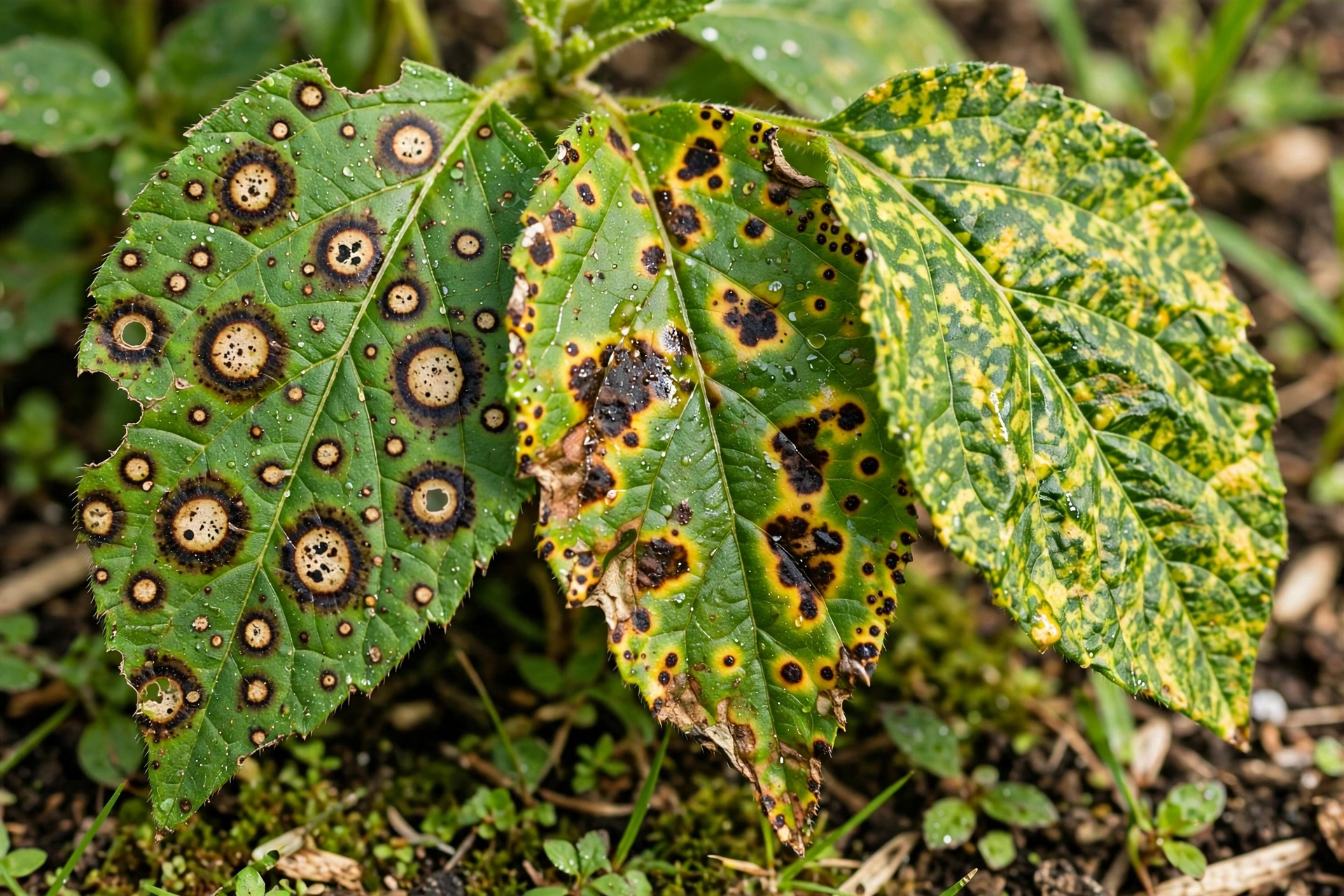
Leaf spots are one of the most common symptoms in the garden, and one of the most confusing. A dark spot on a tomato leaf, a yellow-ringed blotch on a rose, a mosaic pattern on a cucumber — all are called "leaf spot," but they can have very different causes, and very different solutions. Treating a bacterial infection as if it were a fungus, or vice versa, wastes time and rarely helps.
This guide explains how to tell fungal, bacterial, and viral leaf infections apart by looking at the shape, colour, texture, and pattern of the spots, and what to do for each type. You will not need a microscope — careful observation, a good photo, and a few simple checks will take you a long way.
Fungal Leaf Spots
Fungal spots are often circular or oval, with a defined edge and sometimes concentric rings, like a target. The centre may be grey, tan, or brown, and you may see tiny black dots — fungal fruiting bodies — inside the spot. Spots often appear on older leaves first and spread in warm, humid weather.
Examples include early blight on tomatoes, anthracnose on beans and cucumbers, and black spot on roses. Fungal spots tend to grow slowly at first, then expand and merge. Affected leaves may yellow around the spot and drop, but the plant often keeps growing if the infection is controlled.
Bacterial Leaf Spots
Bacterial spots often start as small, dark, water-soaked patches that look wet or greasy, especially when viewed against the light. They may be angular, limited by leaf veins, rather than round. A yellow halo often surrounds the spot. In wet weather, spots may ooze, and leaves may feel slimy or develop a foul smell.
Examples include bacterial spot on tomatoes and peppers, and bacterial blight on beans. Bacterial infections spread rapidly in warm, wet conditions, by splashing water, insects, and contaminated tools or hands. They often appear after rain, overhead watering, or handling wet plants.
Viral Leaf Spots and Patterns
Viral infections rarely cause neat circular spots. Instead, look for mosaic patterns — irregular patches of light and dark green, yellow mottling, streaks, or ring patterns — plus distorted, curled, or stunted growth. Leaves may be smaller than normal, puckered, or oddly shaped. Fruit may be mottled or deformed.
Examples include cucumber mosaic virus, tomato mosaic virus, and rose mosaic. Viruses are spread by sap-feeding insects such as aphids and whitefly, by grafting, and by contaminated tools or seed. There is no chemical cure, and infected plants usually remain infected for life.
Step-by-Step: Tell Them Apart
Step 1: Photograph the spots in daylight
Take a clear close-up of several spots, plus a photo of the whole plant. Note whether spots are round, angular, or irregular, and whether they have rings, dots, halos, or a mosaic pattern.
Step 2: Check the texture and feel
Gently feel a spot. Fungal spots are usually dry and papery. Bacterial spots may feel wet, greasy, or slimy, especially in damp weather. Viral patterns are usually flat, with no raised or sunken texture, but the leaf itself may be distorted.
Step 3: Look at the pattern across the plant
Fungal and bacterial spots often start on lower, older leaves and spread upward by splashing water. Viral symptoms often appear on new growth first, with stunting and distortion across the whole plant.
Common Mistakes
- Treating every spot with fungicide. Fungicides do not work on bacteria or viruses, and overuse can harm soil life and beneficial insects.
- Handling wet plants. Wet foliage spreads bacteria easily from leaf to leaf and plant to plant. Work with dry plants and wash hands afterwards.
- Composting spotted leaves. Fungal and bacterial pathogens can survive in cool compost. Bag and bin infected material.
- Ignoring insect vectors. If aphids or whitefly are present, controlling them is part of controlling viral spread.
A Simple At-Home Test: The Paper Bag Check
One practical check you can do at home helps separate fungal from bacterial spots, though it is not a laboratory test. Pick a badly spotted leaf, place it in a damp paper bag or a sealed container with a damp paper towel, and leave it overnight in a warm place. In the morning, look at the spots with a magnifying glass or phone zoom. Fungal spots often show fine, hair-like growth or tiny black dots in the centre — the fungus fruiting in the damp air. Bacterial spots often look slimier and may show a cloudy ooze, while viral patterns usually look unchanged. This test does not prove anything on its own, and you should still bag and bin the leaf afterwards, but combined with the shape, texture, and weather clues, it can tip the balance when two diagnoses look equally likely. Never use this test as a reason to skip expert advice for a valuable crop or a rapidly spreading problem.
Treating Each Type: What Works and What Does Not
Treatment follows the diagnosis, which is why telling the types apart matters so much. For fungal leaf spots, remove affected leaves, improve airflow, water at the base, and use a fungicide labelled for the problem only if needed and early in the season. For bacterial spots, there is no spray that reliably cures an infected leaf: the work is prevention — avoid wetting foliage, do not handle wet plants, disinfect tools, use clean seed, and remove infected material promptly, because bacteria spread fast in water and on hands. Copper sprays are sometimes used as a protectant for bacterial problems, but only where they are permitted and labelled for your plant. For viral patterns, there is no cure at all: control the insects that carry viruses, remove badly affected plants, and protect healthy neighbours. In all three cases, the foundation is the same — clean, dry, well-spaced plants — but the extra steps are different, and applying the wrong one wastes a season.
FAQ
Can a leaf have more than one type of infection? Yes. A plant weakened by one disease is more vulnerable to others, and fungal and bacterial spots can look similar. When in doubt, focus on hygiene, airflow, and removing affected leaves, and seek local advice.
Do leaf spots always mean disease? No. Sunscorch, fertiliser burn, cold damage, and nutrient deficiencies can also cause spots and blotches. Check for recent weather, feeding, or watering changes before assuming infection.
Should I remove all spotted leaves? Remove badly spotted leaves, but do not strip the plant bare. Leave enough healthy foliage for photosynthesis, and monitor new growth for signs of spread.
Can leaf spots spread from vegetables to ornamental plants? Some can, especially if the plants are closely related, but many leaf spot fungi and bacteria are host-specific. Good hygiene — removing spotted leaves, not handling wet plants, and cleaning tools — protects all your plants, whatever the cause.
Why do leaf spots appear after rain? Rain splashes spores and bacteria from the soil and from infected leaves onto healthy ones, and wet leaves give them hours to germinate and infect. That is why watering at the base, mulching to reduce splash, and spacing plants for airflow help so much.
Conclusion
Fungal spots tend to be round with rings or dots; bacterial spots tend to be water-soaked, angular, and haloed; viral problems tend to show as mosaic patterns with distorted growth. None of these clues is proof on its own, but together — with a clear photo, a note of the weather, and a look at the whole plant — they will usually point you in the right direction. Act early, keep things clean and dry, and your plants will have the best chance of recovering.
Try it: Try the free Plant Disease Identifier on aitreeidentier.site — upload a clear photo of the affected leaves or bark for instant guidance.
Safety disclaimer: Never eat or use a plant, or treat a disease, based on AI identification alone. AI results are guidance only — consult a local expert before applying treatments, especially on food crops or near children and pets.