
Introduction
Plants have no eyes, ears, or brain, yet they sense their surroundings precisely. A seedling bends toward a window, a root grows down in darkness, and a vine curls around a post within hours of touching it. Plants detect light, gravity, and touch, then change how they grow.
Understanding these senses makes you a better gardener: it explains why seedlings lean, why roots grow as they do, and why some plants need support. Plants are not passive decorations: they constantly read their environment.
Sensing Light: Phototropism and Photoreceptors
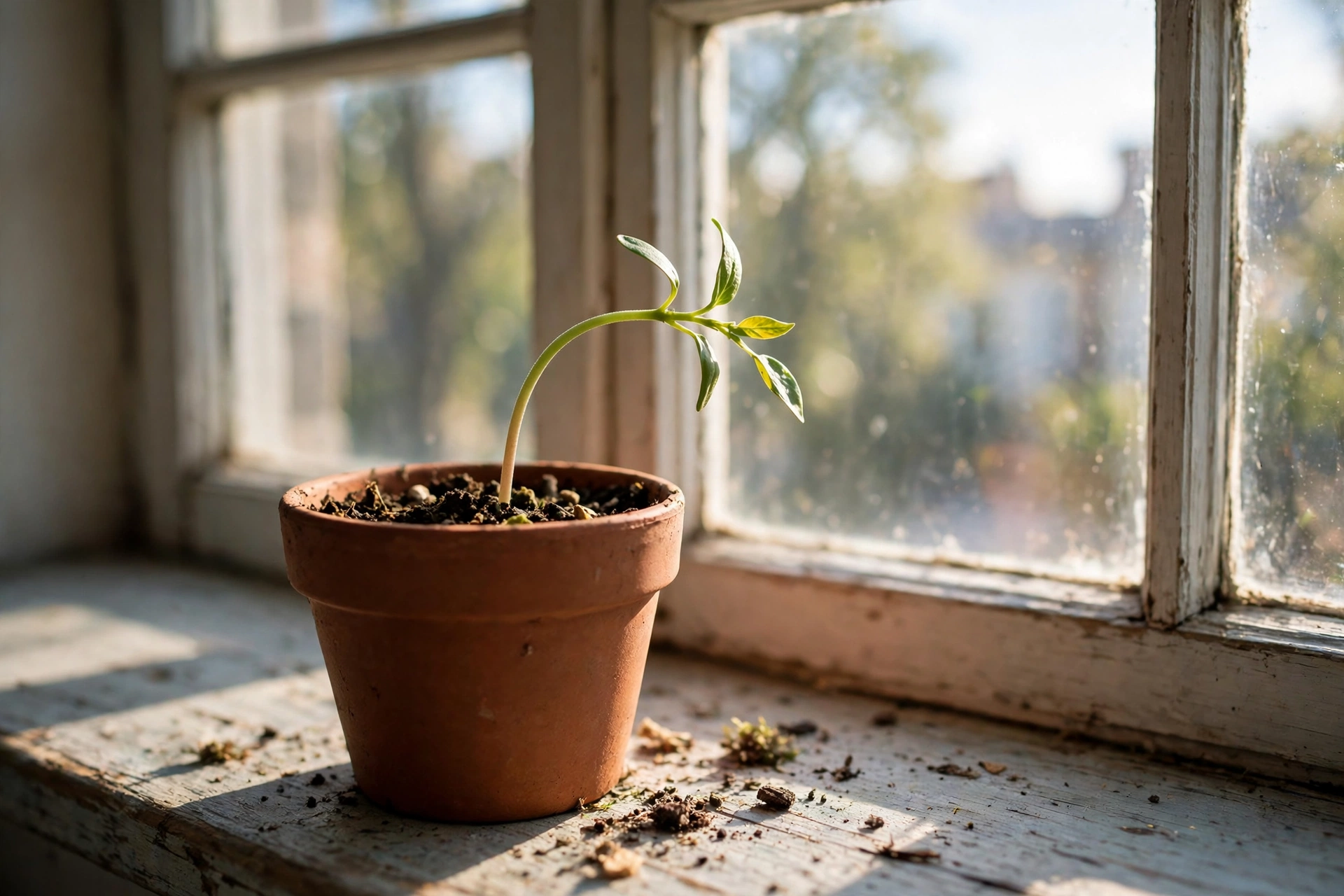
Light is a plant's most important signal: light means energy. When light hits one side of a stem, the plant bends toward it (phototropism). You have seen it in a houseplant leaning to a window.
The bending happens because of a growth hormone, auxin. Light moves auxin to the shaded side, where it makes cells grow longer, so the stem curves toward the light. Plants also sense light colour and duration through photoreceptors: blue light drives bending, while red light senses shade and controls flowering. That is why light matters in the garden: a plant in deep shade may stretch tall and weak, flower late, or fail to fruit, and moving it into better light can transform it.
Photoreceptors: The Pigments Behind Plant Vision
Plants cannot see, but they carry several light-sensing pigments that act like a basic visual system. Phytochrome detects red and far-red light, and it tells the plant whether it is in open sun or in the shade of other plants, since leaves absorb red light and let far-red pass through. When a plant senses too much far-red light, it switches on the shade avoidance response, growing taller and thinner to reach the light. This is why seedlings crowded together become leggy.
Two other photoreceptors handle blue light. Cryptochromes help set the plant's internal clock and influence flowering and leaf opening, while phototropins control the bending of stems towards light and the opening of stomata. Together, these pigments let a plant measure day length, detect the direction of light, and tell the time of year, all without eyes or a brain. Gardeners use this knowledge when they choose grow lights: blue-rich light keeps plants compact and leafy, while red-rich light encourages flowering and fruiting.
Sensing Gravity: How Roots Know Down and Shoots Know Up
Gravity is a constant signal for orientation. Roots grow downward (positive gravitropism) while shoots grow upward (negative gravitropism). Turn a potted seedling sideways and within hours the shoot bends up and the root bends down.
Plants sense gravity with tiny, dense starch grains called statoliths inside special cells. Like sand in a jar, they sink to the lowest side of the cell, telling the plant which way is down. When a plant tips over, they settle on a new side, triggering auxin to make one side grow faster and bend it back — which is why seeds buried in the dark still send roots down and shoots up.
Sensing Touch: Thigmotropism and the Climbing Response
Touch is the third sense gardeners see. When a climber brushes a support, it wraps around it (thigmotropism). Tendrils of peas, grapes, and cucumbers are especially sensitive, detecting a touch lighter than a fingertip and coiling in minutes.
When a tendril is touched, ion channels open, calcium signals ripple through the cells, and the touched side grows more slowly, curling around the support. Repeated touching makes stems shorter and stockier, so wind-exposed plants grow sturdier and brushed seedlings grow stronger. Some plants go further: Mimosa pudica folds its leaves seconds after a touch, and the Venus flytrap counts touches on its trigger hairs before snapping shut.
Putting It Together in Your Garden
A garden plant uses all three senses at once: leaves track the sun, roots grow down, stems feel for support. Work with them, not against them.
Step 1: Give plants the light they need
Learn if each plant prefers full sun, partial shade, or shade. Use the Plant Identifier on aitreeidentier.site to identify an unknown plant, then check its light needs.
Step 2: Rotate indoor plants and support climbers early
A houseplant left in one position leans to the window, so turn the pot a quarter turn each week. Put trellises or canes in place while climbers are young: a tendril that finds support early climbs strongly, while one on the ground may tangle and break.
Step 3: Harden off seedlings with gentle handling
Before moving seedlings outdoors, expose them to breezes and gentle touch for a week or two: touch thickens their stems and prepares them for wind and rain.
Step 4: Watch what your plants are telling you
A leaning stem means too little light, a short sturdy seedling may be responding to wind, and a reaching vine seeks support. These are not faults: they are the plant's senses at work.
Common Mistakes Beginners Make
- Ignoring the lean. A leaning plant asks for more sun. Rotating the pot helps, but a brighter spot solves the cause.
- Planting shade lovers in full sun. Match the plant to the available light: sensing cannot fix a plant in the wrong place.
- Supporting climbers too late. Once a vine has tangled on the ground, it is hard to train, so support it young.
- Overprotecting seedlings. Seedlings in still air grow tall and weak, so give them gentle breeze and light handling to build strong stems.
- Assuming plants are passive. Watching plants grow is one of the best ways to learn what they need.
Thigmomorphogenesis: How Touch Shapes Growth
Repeated touch and movement change how a plant grows, a response called thigmomorphogenesis. Trees exposed to wind grow shorter and thicker, with stronger wood and deeper roots, than sheltered trees of the same species. This is why trees on a windy coast are often stunted and bent, while the same species in a sheltered valley grows tall and straight. The mechanism is hormonal: mechanical stress raises ethylene and lowers growth hormones, shifting resources from height into strength.
Gardeners see the same effect indoors. Seedlings brushed gently with a hand each day often grow sturdier and less leggy than untouched ones, which is why some growers run a fan over their seedlings to simulate a breeze. The opposite mistake is staking a young tree too tightly: a tree that never moves does not build strong wood, and it can become dependent on its stake. The best practice is to stake loosely, allowing some movement, and to remove the stake after a year or two so the tree can strengthen itself.
FAQ
Do plants really feel touch?
Yes, in their own way. Plants have no nerves, but their cells detect pressure through ion channels and chemical signals, changing growth in response, sometimes within minutes.
Why does my houseplant lean toward the window?
That is phototropism: the plant grows toward light so its leaves capture more energy. Turning the pot regularly keeps growth even.
Can a plant grow upside down?
It can try, but gravity sensing fights it: hung upside down, shoots bend up and roots grow down, so most plants grow best the right way up.
Do plants sense anything else?
Yes: temperature, moisture, soil chemicals, insect damage, and vibrations. Plants may even detect a chewing caterpillar and raise their defences; their senses are far richer than most people realise.
Do plants respond to sound or music?
The evidence is thin. Some studies have found that plants exposed to certain sounds grow slightly faster or flower earlier, but the results are inconsistent and hard to reproduce, and it is unclear whether the plants are responding to sound itself or to the tiny vibrations and air movement that come with it. What is well established is that plants respond to touch and vibration, so a loud speaker's vibrations might have a real, if small, effect, but there is no good evidence that plants enjoy music or prefer one genre to another.
Conclusion
Plants sense light, gravity, and touch precisely: photoreceptors and auxin steer them toward the sun, statoliths tell roots and shoots which way is up, and touch-sensitive cells let vines climb and stems grow strong. None of this needs a brain — just clever chemistry. Garden with these senses in mind, and you work with the plant's nature instead of against it.
Try it: Try the free Plant Identifier on aitreeidentier.site — photograph a plant and learn what species it is and how it grows toward light.
Safety disclaimer: Never eat or use any plant based on AI identification alone. AI results are guidance only — consult a local plant expert before eating, touching, or using any wild plant, as many species have toxic lookalikes.