
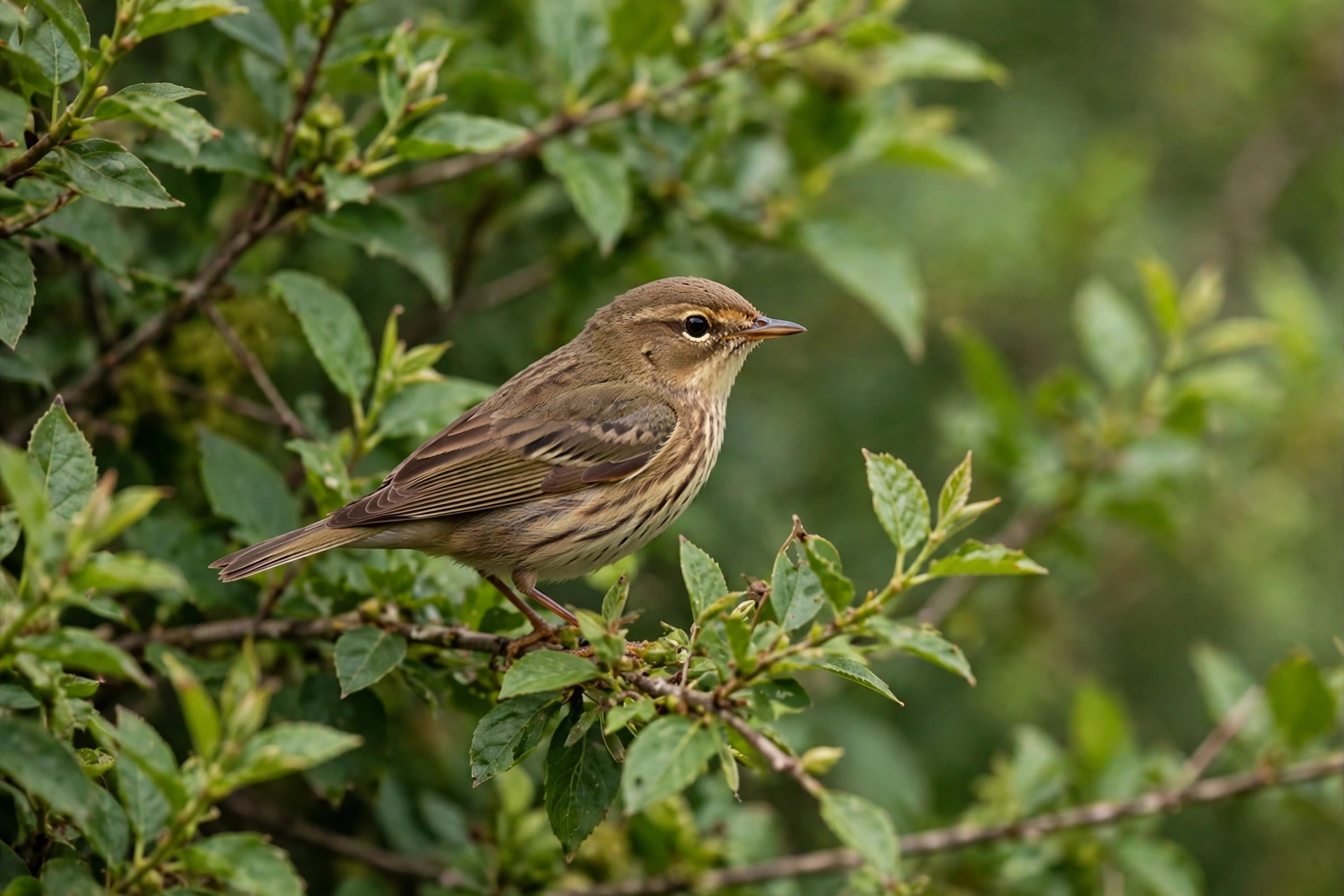
Warblers have a reputation for being impossible. They are small, mostly brown or greenish, quick-moving, and often hidden in leaves. Many beginners see a little brown bird flicker through a bush and give up before they have really looked.
Introduction
Learning how to identify warblers is less about memorising every species and more about learning a simple routine. Start with size and shape, look at a few reliable field marks, listen to the song, and note where and when you saw the bird. With that routine, most garden warblers become much easier to separate.
The first thing to accept is that warblers are hard for everyone, not just for beginners. Even experienced birdwatchers sometimes see a warbler for only a second, in poor light, and cannot identify it with certainty. That is normal, and it is not a failure. What makes warblers easier is not a magic field mark but a habit: watch for a full minute, note the habitat and the season, listen for the song, and pick two or three field marks you actually saw. If you do that, you will identify most warblers correctly, and the ones you cannot identify will at least be recorded honestly as uncertain. The goal is not to name every warbler you see; it is to name most of them, and to enjoy the process of trying.
Why Warblers Seem So Hard
Warblers are small insect-eating birds, usually 11 to 14 centimetres long, with slim bills for picking insects from leaves. Many share the same colours: olive-brown above, paler below, with little obvious pattern. In poor light, even a bright warbler can look dull brown.
Start with Size, Shape, and Behaviour
Compare size and movement
Before you look at colour, judge size. Is the bird smaller than a robin, about the size of a blue tit, or closer to a sparrow? Warblers are generally smaller and slimmer than sparrows, with a more delicate build.
Behaviour is one of the best clues. Chiffchaffs flick their tails up and down regularly, while willow warblers move more smoothly through branches. Blackcaps feed slowly in bushes, while whitethroats may perch on top of a hedge and sing loudly. Note whether the bird stays low in brambles, high in the canopy, or near water.
Look at the bill and legs
A warbler's bill is fine and pointed, unlike the short, stout bill of a finch. Leg colour can also help: chiffchaffs often have dark legs, while willow warblers usually have paler, pinkish-brown legs. This small detail is one of the most useful ways to separate those two lookalikes when you get a clear view.
The Field Marks That Matter Most
Face pattern and colour
Look for a pale stripe above the eye and for pale wing bars. Some warblers have a clear, bright eyebrow, others have almost none. A yellowish wash on the face, a dark line through the eye, or a pale ring around the eye can all help.
Tail length and song
Tail length helps too. A whitethroat has a fairly long tail, while a chiffchaff looks short-tailed and compact. In flight, note whether the wings look long and pointed or short and rounded.
Warbler song is often easier than warbler plumage. A chiffchaff repeats its own name in a steady, two-note rhythm. A willow warbler sings a sweet, descending phrase. A blackcap sings a rich, fluty song that builds to a loud finish. Learn three or four common songs first and describe each one in your own words.
A Simple Step-by-Step Routine
Step 1: Note the place, date, and habitat
Record where you are, the date, and the habitat: garden, woodland edge, reedbed, scrub, or hedgerow. Some warblers only appear in summer, others pass through on migration. Season alone can rule out several species.
Step 2: Watch for a full minute
Watch its movement, tail flicks, and favourite perch for a full minute.
Standing still for a full minute is harder than it sounds, because warblers are restless and your instinct is to follow them. But if you stand still, the warbler will often come back to the same bush, and you will get a second and a third view. Watch how it moves: does it flick its tail? Does it hover to pick an insect from a leaf? Does it stay low, or does it climb high into the canopy? Those movements are clues, and they are easier to see when you are still than when you are chasing the bird through the undergrowth. If the bird disappears, wait: warblers often return to the same bush within a minute or two, and patience is rewarded more often than pursuit.
Step 3: Pick two or three field marks
Choose the clearest marks you actually saw — for example, dark legs, a pale eyebrow, and a yellow wash on the breast. Do not guess at marks you did not see.
Step 4: Listen, then check
If the bird sings, note the song. Then compare your notes with a guide or use a photo with the Bird Identifier. Check that the suggested species fits the season, habitat, and marks you recorded. A photo taken from a distance can be checked later with the free Bird Identifier on aitreeidentier.site.
Common Mistakes Beginners Make
- Trying to identify from colour alone. Light changes colour dramatically. Shape, behaviour, and song are more reliable.
- Chasing the bird instead of waiting. Warblers often return to the same bush. Stand still and let the bird come back into view.
- Forgetting the season and place. A species common in summer may be absent in winter. Always check dates and range.
- Accepting the first suggestion without checking. Use a tool or guide as a starting point, then verify the field marks, habitat, and song yourself.
- Ignoring the song. Many warblers are identified by song more reliably than by sight. If a bird sings, note the song before you worry about its plumage — the song may be the only clue you need.
- Expecting to identify every warbler. Some warblers are seen too briefly, or in too poor light, to identify with certainty. Recording a bird as "warbler, species uncertain" is honest and useful, and it is better than a confident guess that turns out to be wrong.
FAQ
What is the easiest warbler for a beginner to learn?
The chiffchaff is a good first species because its song repeats its name, it often flicks its tail, and it appears early in spring. Learn it well, and other warblers become easier to compare.
How can I tell a chiffchaff from a willow warbler?
Listen first: the chiffchaff repeats a two-note song, while the willow warbler sings a sweet descending phrase. Chiffchaffs often have darker legs, while willow warblers have paler legs and a brighter face, but song is the most reliable clue.
Do I need expensive binoculars to identify warblers?
No. A basic pair helps, but many warblers can be identified by song, habitat, and behaviour with the naked eye. Good fieldcraft — standing still, watching patiently, and listening — matters more than expensive equipment.
When is the best time to see warblers?
Spring is the best time, because warblers are singing, they are in fresh plumage, and they are easier to find. Early morning is best, when they are most active and vocal. In autumn, warblers are quieter and harder to identify, so spring is the season to learn them.
What should I do if I hear a warbler but cannot see it?
Note the song, the habitat, and the date, and record it as heard rather than seen. A song is often enough to identify a warbler, and a heard record is just as valid as a seen one. If you can, make a short recording on your phone and check it later.
Conclusion
Warblers become easier when you stop looking for one magic field mark and start collecting small clues. Size, shape, behaviour, leg colour, face pattern, song, season, and habitat all add up to an identification you can trust. Learn a few common species well, practise the routine in this guide, and keep short notes after each sighting. Before long, the small brown bird in the bush will be a familiar neighbour you can name with confidence.
Try the free Bird Identifier on aitreeidentier.site — upload a clear photo of the bird for instant guidance.
Safety disclaimer: Never disturb nests or wildlife to get a closer view or a better photo. Observe warblers from a distance, stay on paths, keep dogs on a lead near breeding birds, and consult a local expert if you are unsure about a sensitive species or site.