
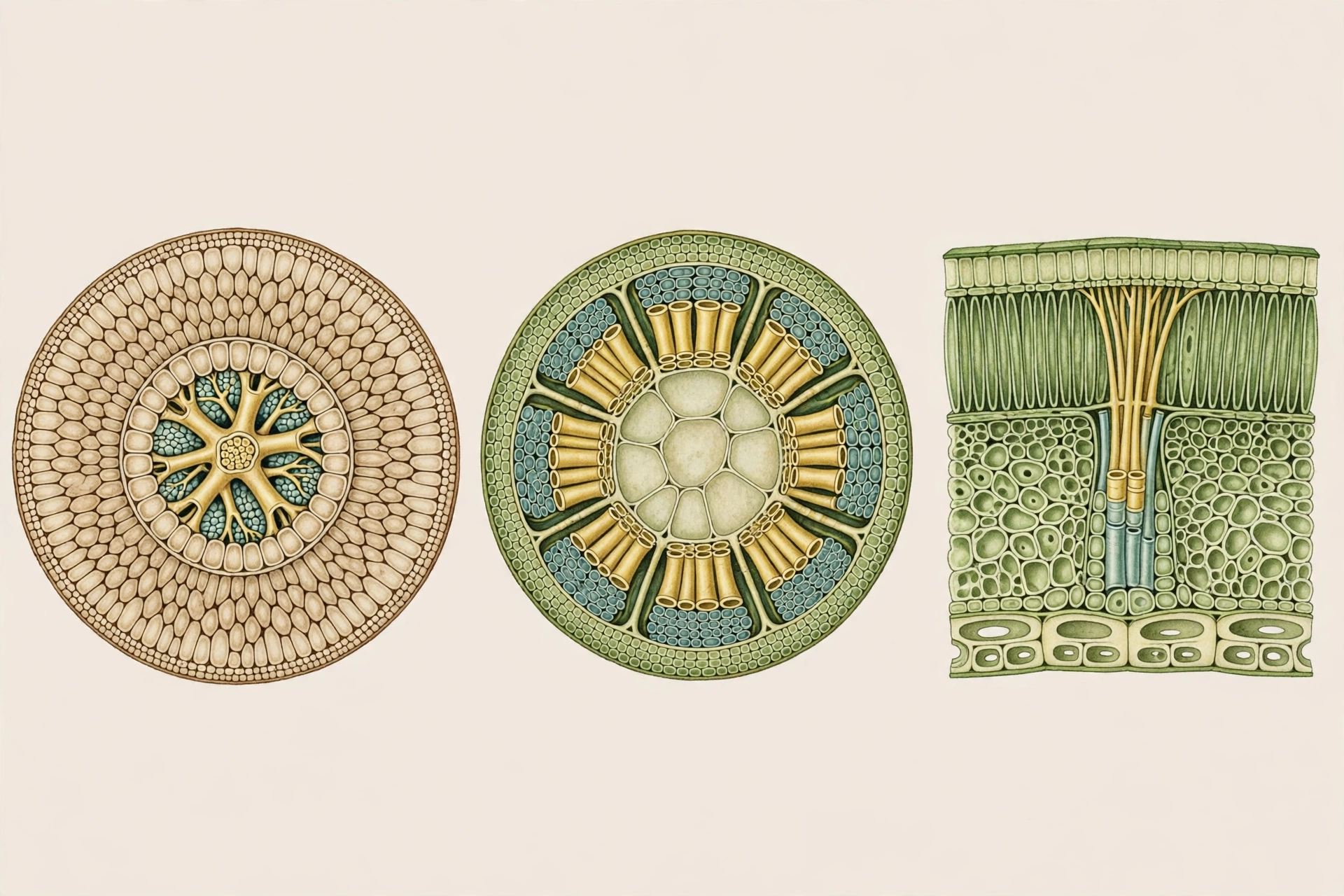
Introduction: Three Parts, One System
If you understand roots, stems, and leaves, you understand most of a plant. These three organs work as a system: roots take up water and minerals and anchor the plant, stems support and transport, and leaves make food through photosynthesis. Flowers and fruits are important for reproduction, but the daily work of staying alive depends on these three parts.
This beginner guide explains what each part does, how to recognise healthy and unhealthy signs, and how simple anatomy knowledge helps you water, prune, and repot with confidence.
Roots: The Hidden Half
Roots are often out of sight, but they do far more than hold a plant in place. Fine root hairs, just behind the growing tip, absorb most water and minerals. Larger roots anchor the plant, store food, and transport water upward. A healthy root system is usually much wider than most people expect, spreading well beyond the canopy of a tree or the pot of a houseplant.
Roots need air as well as water. In waterlogged or compacted soil, roots suffocate, rot, and cannot absorb nutrients. That is why drainage matters more than almost any other factor for potted plants.
Modified Parts: When Roots, Stems, and Leaves Change Jobs
Once you know the basic plan, you start noticing plants that break it. A tendril that lets a pea climb is a modified leaf or stem, and a thorn can be either: rose thorns are outgrowths of the stem surface, while the sharp spines of a hawthorn are modified branches, and cactus spines are modified leaves. Bulbs, such as onions and tulips, are mostly modified leaves wrapped around a short stem, storing food for the next season. Rhizomes, such as those of iris and ginger, are horizontal underground stems, not roots, which is why they have buds and nodes.
Some of the strangest modifications belong to carnivorous plants. A Venus flytrap's snapping jaws are modified leaves, a pitcher plant's trap is a rolled-up leaf, and the sticky tentacles of a sundew are leaf hairs that both lure and digest insects. These plants grow in poor, wet soils where nitrogen is scarce, and catching insects is their way of supplementing their diet. Even familiar vegetables hide modifications: a potato is a swollen underground stem, a carrot is a swollen taproot, and kohlrabi is a swollen stem above ground.
Stems: Support and Transport
Stems hold leaves up to the light, carry flowers and fruit, and transport water, minerals, and sugars between roots and leaves. Inside a stem are two transport systems: xylem, which carries water and minerals upward, and phloem, which carries sugars made in leaves to the rest of the plant, including roots and growing tips.
Leaves: Food Factories
Leaves are the main site of photosynthesis. A typical leaf has a blade for catching light, a stalk called a petiole, and veins that bring water in and carry sugars out. The upper surface is usually darker green and packed with chloroplasts, while the underside has stomata, tiny pores that let gases in and out.
How the Three Parts Work Together
This is why balanced care matters. Watering the leaves does not replace watering the roots. Feeding the soil does not help if roots are rotting. Pruning leaves heavily reduces the food supply for roots. Good plant care is about supporting the whole system, not just the visible part.
How to Check Plant Anatomy at Home: Step by Step
1. Identify the plant. Use the Plant Identifier on aitreeidentier.site so you know what healthy roots, stems, and leaves should look like for that species. 2. Look at the leaves. Are they the right colour, size, and shape? Note yellowing, spots, curling, or holes, and whether the problem is on old or new leaves. 3. Check the stem. Is it firm, upright, and the right colour? Soft, dark, or shrivelled stems can signal rot or drought. Look for new buds at nodes, where leaves join the stem. 4. Check the roots when repotting. Healthy roots are usually firm and pale or light brown. Dark, mushy, foul-smelling roots are rotten and need trimming. 5. Check the soil and drainage. Water should drain within a reasonable time, not sit on the surface or leave the pot soggy for days. 6. Water and feed the roots, not the leaves. Water at soil level, in the morning, and feed according to the species and season. 7. Prune with purpose. Remove dead or diseased parts, improve airflow, and pinch tips to encourage branching, but avoid removing too much leaf area at once.
Common Mistakes
Watering the leaves instead of the roots. Wet leaves can encourage disease, while dry roots remain thirsty. Water the soil, and keep foliage dry where possible.
Repotting into a pot that is far too large. Excess soil stays wet and roots rot. Increase pot size gradually, usually by only a few centimetres.
Ignoring rootbound plants. If roots circle tightly around the pot and water runs straight through, the plant needs repotting, root pruning, or division.
Judging health by leaves alone. A plant can have green leaves but rotting roots. Check stems, soil, and roots together for a fuller picture.
Diagnosing Problems by Plant Part
When a plant looks unwell, the affected part points to the cause. Root problems usually show as wilting even when the soil is wet, because rotting or waterlogged roots cannot take up water, and the plant may lean or lift easily from the soil. Stem problems often appear as weak, stretched growth, called etiolation, which means the plant is reaching for light, or as soft, dark patches that signal stem rot from overwatering or cold.
Leaf symptoms are the most informative. Yellowing of older leaves first often points to nitrogen shortage, since the plant moves nitrogen to new growth. Yellowing between the veins of young leaves often points to iron shortage, which is common in alkaline soils. Brown leaf edges usually mean drought, salt, or wind damage, while pale, bleached patches suggest sun scorch. Reading symptoms by plant part and by position, old leaves versus new, top versus bottom, turns guesswork into a short list of likely causes.
Frequently Asked Questions
Why do roots grow towards water?
Roots grow towards moisture and away from light, guided by gravity and hormones. This helps them find water and anchor the plant, but it also means roots can grow into drains or pipes if water is leaking there.
Can a plant survive without leaves?
Briefly, using stored food, but not for long. Without leaves, it cannot photosynthesize and will weaken. Some plants can regrow leaves from buds if the stem and roots are healthy.
Are bulbs, corms, and tubers roots or stems?
It depends on the plant. Bulbs are usually modified leaves and stems, corms are swollen stems, and tubers can be stems or roots. Potatoes are stem tubers; sweet potatoes are root tubers.
What is the difference between a rhizome and a root?
A rhizome is a horizontal underground stem, so it has nodes, buds, and sometimes small scale leaves, while a root has none of these. Ginger and iris grow from rhizomes, and cutting a rhizome into pieces with a bud each is a common way to propagate them. Roots, by contrast, absorb water and anchor the plant.
Why do some plants have no visible stem?
Some plants, such as dandelions and primroses, have very short stems hidden at ground level, with leaves arranged in a rosette. Their flower stalks rise separately from the base. This low growth form protects the growing point from grazing animals and cold wind, and it is common in alpine and meadow plants.
Conclusion
Roots, stems, and leaves are a simple system with a clear division of labour: roots absorb and anchor, stems support and transport, and leaves make food. When you learn to read each part — firm roots, strong stems, healthy leaves — you can spot problems early and care for plants with less guesswork. Identify the plant, check the whole system, water and feed the roots, and prune with purpose. With practice, plant anatomy becomes not a textbook topic but a practical skill you use every time you garden.
Try it: Try the free Tree Researcher on aitreeidentier.site — identify a tree from a photo and learn more about the science behind it.
Safety note: This guide is for general learning only. Never eat or use a plant based on AI identification alone, and consult a local expert before using any plant for food or medicine.