
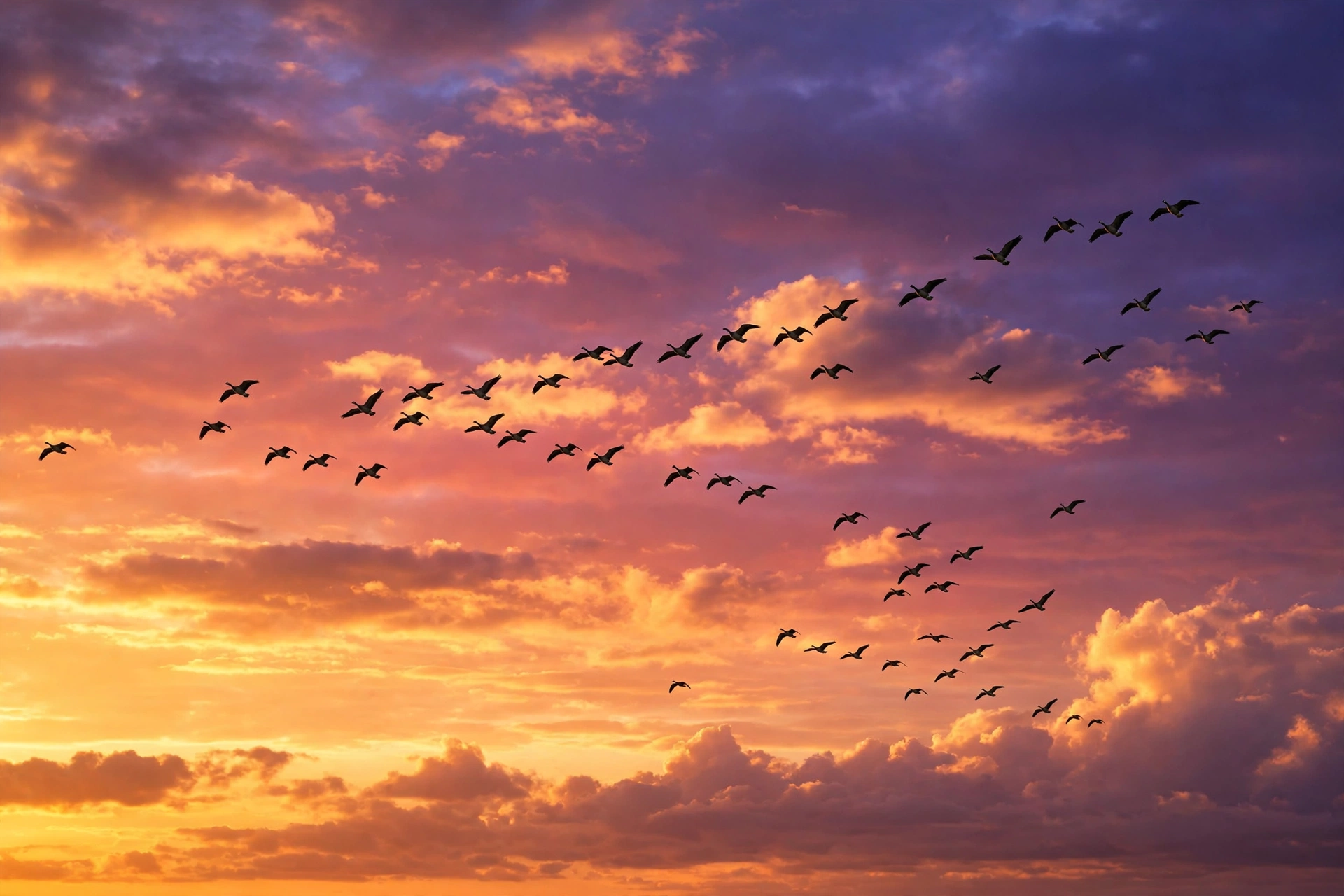
Every year, billions of birds travel thousands of kilometres between breeding grounds and wintering areas. Some cross continents and oceans, navigating by the sun, stars, magnetic field, and landmarks. For birdwatchers, migration brings excitement and change: familiar summer birds leave, winter visitors arrive, and passage migrants pass through briefly on their way elsewhere.
Introduction: Migration Is One of Nature's Great Journeys
Understanding when and where to look helps you make the most of migration. This guide explains the main seasons, what to expect in each, and how to plan your watching so you do not miss the highlights.
Spring Migration: March to May
The Return of Summer Visitors
In spring, birds that spent winter in Africa or southern Europe return north to breed. Early arrivals include chiffchaff, wheatear, and sand martin, often from March. April brings swallows, house martins, blackcaps, and willow warblers. May brings swifts, cuckoos, and spotted flycatchers, among the last to arrive.
Spring migration is a good time to visit coastal headlands, wetlands, and woodland edges, where migrants pause to rest and feed after a long flight. Early morning is often best, when birds that arrived overnight are still low and active. Listen for new songs — a chiffchaff in March or a blackcap in April is a clear sign that spring migration is under way.
The order in which birds arrive is not random. The earliest arrivals are usually the hardiest species, the ones that can cope with cold weather and find food early — chiffchaffs, wheatears, and sand martins. Later arrivals are the birds that depend on flying insects, which do not appear until the weather warms: swallows, house martins, and swifts. The very last to arrive are often the birds that travel the furthest, such as spotted flycatchers and cuckoos. Watching for these arrivals, and noting the date of each first sighting, is one of the great pleasures of spring birdwatching. Keep a list of first dates each year, and you will soon see that the pattern repeats, with small variations caused by the weather. A warm spring brings early arrivals; a cold, wet spring delays them by a week or more.
Autumn Migration: August to October
The Journey South
Autumn migration is longer and more spread out than spring. From late July, waders begin moving south, followed by warblers, flycatchers, and swallows in August and September. October brings thrushes, finches, and wildfowl arriving from the north and east for winter.
Autumn is often the best season for rarities, because young birds on their first migration can be blown off course, and weather systems can bring unexpected visitors. Coastal sites, reservoirs, and estuaries are excellent in autumn, especially after easterly winds or rain, when migrants are grounded and easier to see. Check mudflats at low tide for waders, and hedgerows for warblers and chats.
Winter Visitors: November to February
Winter brings birds from colder northern regions to milder areas. Fieldfares and redwings arrive from Scandinavia and Russia to feed on berries and fallen fruit. Whooper swans, Bewick's swans, and many ducks and geese arrive from Iceland and northern Europe to spend winter on wetlands and estuaries.
Winter is a good time to visit large wetlands, reservoirs, and coastal estuaries, where wildfowl gather in large numbers. Berry-bearing trees and hedgerows are also worth checking for thrushes. Cold weather can push birds into gardens in search of food, so keep feeders full and water unfrozen.
Winter visitors are often the easiest migrants to see, because they gather in large, visible flocks in open places. A flock of fieldfares in a berry bush, a skein of geese flying overhead, or a group of whooper swans on a lake are all spectacles that even a beginner can enjoy. But winter is also a hard season for birds, and the ones that survive it are the ones that find food. A garden with berry-bearing trees, a full feeder, and unfrozen water can be a lifeline in a cold snap, and you may see birds in your garden in January that you never see in summer. Keep a note of when winter visitors arrive and when they leave: their departure in March is one of the first signs that spring is on its way.
How to Plan Your Migration Watching
1. Learn the arrival and departure dates for your area — a local bird report or nature reserve website can help. 2. Visit the right habitat at the right time: coast in spring and autumn, wetlands in winter, woodland in spring. 3. Go early in the morning, when migrants are most active. 4. Check the weather: winds, rain, and cold fronts can bring falls of migrants. 5. Keep a notebook of first and last dates for each species — over years, you will see patterns. 6. Take a photo if you can do so without disturbance, and check it later to confirm the identification.
Planning also means knowing your local sites. Every area has its migration hotspots: a coastal headland where birds make landfall after crossing the sea, a reservoir where waders stop to feed, a woodland edge where warblers pause on their way north. Ask at your local nature reserve, join a local bird group, or read a local bird report to find them. Visit the same sites regularly, so you learn what is normal there and when it changes. And be flexible: migration does not follow a timetable, and the best days are often the ones you did not plan. A morning that starts with rain and wind may end with a fall of migrants that you will remember for years. The key is to be out, to be looking, and to be ready.
Common Mistakes
A common mistake is expecting migration on a fixed date every year. Arrival dates vary with weather, so use them as a guide, not a guarantee. Another mistake is looking in the wrong habitat — a warbler is unlikely to be on an open beach, and a wader is unlikely to be in dense woodland. A third mistake is assuming every unfamiliar bird is a rarity. Many migrants are common species in unfamiliar plumage, especially juveniles in autumn. Check the common species first, then consider rarer options.
FAQ
When is the best time to see migratory birds? Spring (March to May) and autumn (August to October) are the peak migration seasons. Winter is best for northern visitors such as fieldfares and wildfowl.
Where is the best place to watch migration? Coastal headlands, estuaries, wetlands, and reservoirs are often best, because migrants concentrate there. Local nature reserves are a good starting point.
Do all birds migrate? No. Many birds are resident all year, some move only short distances, and others migrate thousands of kilometres. Migration varies by species and by population.
How can I tell a migrant from a resident bird? Check the date, habitat, and behaviour. A species that is only present in summer or winter in your area is likely a migrant, while a bird present all year is likely resident.
How do birds know where to go? Birds navigate using a combination of the sun, the stars, the Earth's magnetic field, landmarks, and even smell. Young birds on their first migration follow an inherited route, while older birds also use experience and memory of places they have visited before. It is one of the most remarkable abilities in nature, and scientists are still learning how it works.
Can I help migrating birds? Yes. Provide food, water, and shelter in your garden, especially in spring and autumn when migrants are passing through. Avoid pesticides, keep cats indoors at night during peak migration, and support the protection of the wetlands, coasts, and woodlands where migrants rest and feed.
Conclusion
Migratory birds bring change and excitement through the seasons. Spring brings summer visitors, autumn brings passage migrants and rarities, and winter brings northern visitors to wetlands and gardens. Learn the timing for your area, visit the right habitats at the right time, and keep notes on what you see. With patience and planning, you will witness one of nature's most remarkable journeys, year after year, close to home.
Try the free Bird Identifier on aitreeidentier.site — upload a clear photo of the bird for instant guidance.
Safety disclaimer: Never disturb nests or wildlife. Observe from a distance, stay on paths, and consult a local expert if you are unsure about a species or a sensitive site.