
Introduction: A Tree Is More Than Wood
A tree looks still and silent, but inside it is busy. Leaves are making food, roots are drinking water, bark is protecting living tissue, and underground networks are exchanging nutrients and warning signals. A mature tree can move hundreds of litres of water a day, produce oxygen, store carbon, and support hundreds of other species.
This guide explains three essential tree processes in simple terms: making food, breathing, and communicating. You will learn how they work, why they matter for tree health, and what you can do to help the trees around you thrive.
How Trees Make Food
Trees make food through photosynthesis, mainly in their leaves. Chlorophyll captures sunlight, water from the roots provides hydrogen and oxygen, and carbon dioxide from the air provides carbon. The result is sugar, which the tree uses for energy, growth, and storage, and oxygen, which is released into the air.
A Tree's Daily Rhythm: Stomata, Transpiration, and Water
A mature tree can move hundreds of litres of water a day from its roots to its leaves, and it does so without a pump. As water evaporates from tiny pores called stomata on the underside of leaves, it pulls the column of water in the trunk upwards, a process called transpiration. This pull is strong enough to lift water to the top of the tallest trees, and it also cools the leaves, much like sweating cools us. On a hot day, a single large oak can release several hundred litres of water into the air, humidifying and cooling the area around it.
Stomata open and close in response to light, humidity, and water supply, and this daily rhythm is a balancing act. Open pores let in the carbon dioxide needed for photosynthesis but lose water at the same time, so on hot, dry afternoons trees partly close their stomata to conserve moisture, even though it slows food production. This is why trees wilt in drought and why watering in the morning, before the heat of the day, helps them most. The transpiration stream also carries dissolved minerals from the soil up to the leaves, so water movement and nutrition are part of the same system.
How Trees Breathe
Trees also respire, breaking down sugars to release energy, day and night, in every living cell. Respiration uses oxygen and releases carbon dioxide, the opposite of photosynthesis in gas terms. During the day, photosynthesis usually outweighs respiration, so a healthy tree is a net producer of oxygen and a net absorber of carbon dioxide.
How Trees Communicate
Trees communicate in several ways, and scientists are still learning how much of this is coordination, competition, or simply shared biology.
Through Roots and Fungi
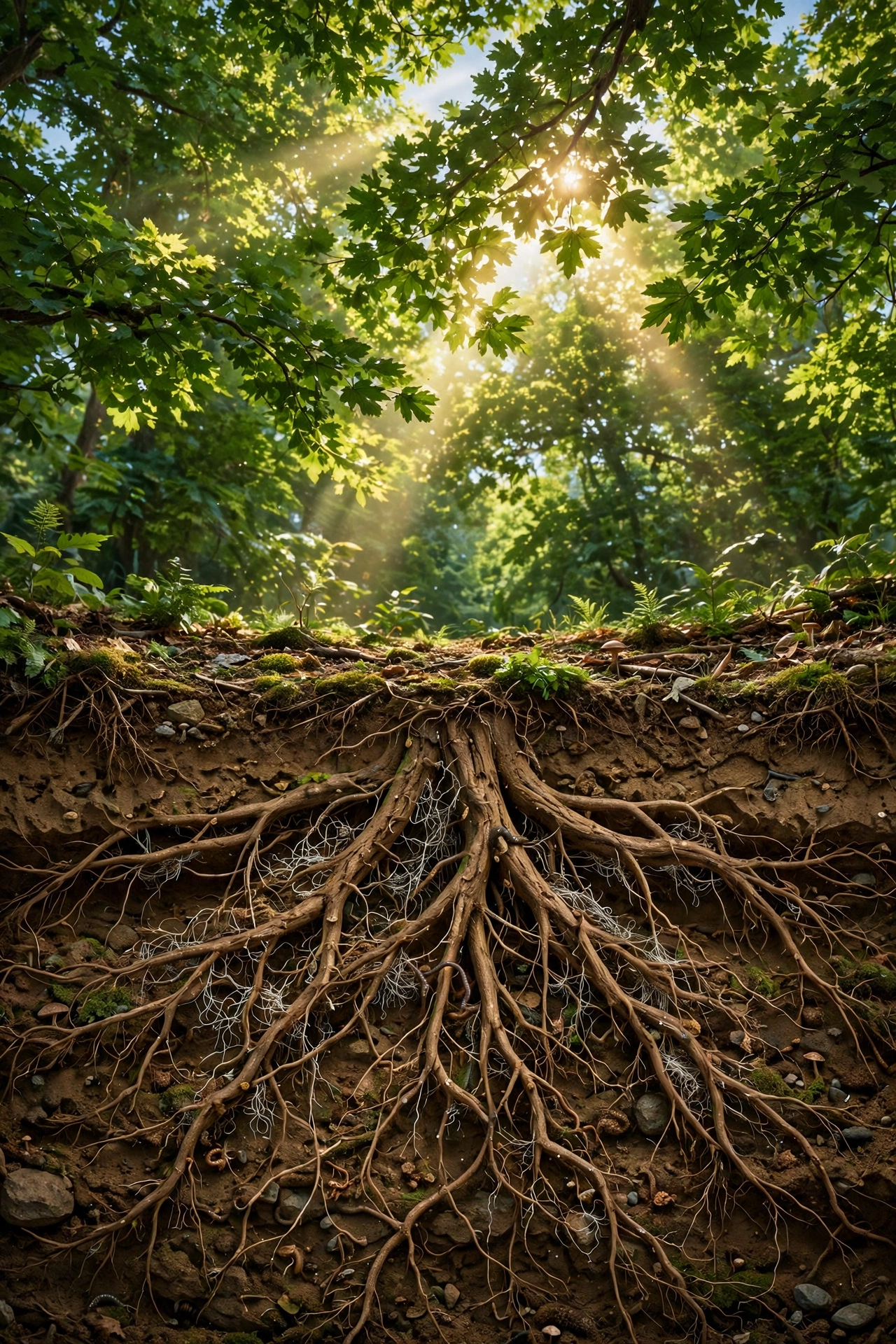
Many trees are connected underground by mycorrhizal fungi, fine fungal threads that link tree roots into a network sometimes called the wood wide web. Through this network, trees can exchange water, nutrients, and chemical signals. Young seedlings growing in the shade of a parent tree may receive carbon and nutrients through these connections, helping them survive until they reach more light.
Through Chemical Signals
When a tree is attacked by insects, it can release volatile chemicals into the air. Neighbouring trees may detect these signals and increase their own defences, such as producing bitter or toxic compounds in their leaves. Trees also send chemical signals through roots when stressed by drought or damage.
What Helps Trees Stay Healthy: Step by Step
1. Identify the tree. Use the Tree Researcher on aitreeidentier.site to learn the species, its mature size, and its soil and water needs before planting or pruning. 2. Protect the root zone. Most feeding roots are in the top 30 centimetres of soil, spreading well beyond the canopy. Avoid digging, parking, or storing heavy materials under a tree. 3. Water deeply, not shallowly. Young trees need deep watering to encourage deep roots. Water slowly at the drip line, not just at the trunk. 4. Mulch, but keep it off the trunk. A layer of mulch 5 to 10 centimetres thick, kept a few centimetres away from the trunk, keeps soil moist, cool, and alive with microbes. 5. Prune lightly and at the right time. Remove dead, damaged, or crossing branches, but avoid removing more than a quarter of the canopy in one year. Prune according to the species and season. 7. Watch for stress signs. Sparse leaves, early autumn colour, dieback at branch tips, or fungal growth at the base can signal root, water, or disease problems. Seek local advice early.
Common Mistakes
Planting too deep. Burying the root flare, where trunk meets roots, suffocates the tree and invites rot. Plant so the flare is visible at soil level.
Volcano mulching. Piling mulch against the trunk traps moisture and encourages bark decay and pests. Keep mulch in a wide, flat ring instead.
Over-pruning for shape. Heavy topping removes the food-making canopy and creates weak regrowth. Prune for structure and health, not for a short-term shape.
Assuming a tree is self-sufficient. Young trees, and trees in dry or urban soil, often need watering, mulch, and protection for several years after planting.
Treating trees as isolated objects. Trees interact with neighbours, fungi, and soil life. Removing one tree, or changing drainage, can affect others nearby.
What the 'Wood Wide Web' Can and Cannot Do
The idea of a "wood wide web", a fungal network through which trees share resources and warnings, has captured the public imagination, but the science is more careful than the headlines. Experiments have shown that carbon, water, and nutrients can move between trees through shared fungal networks, and that seedlings growing near a mature tree of the same species often survive better, partly because they plug into the network. Damaged trees have also been shown to pass chemical warning signals through fungal links to their neighbours.
What is not proven is that trees deliberately help each other, or that they communicate in anything like a language. Much of the transfer may be passive, driven by fungi moving resources towards their own needs rather than by tree generosity. Seedlings near a large tree also benefit from shade, shelter, and better soil, which muddies the picture. The network is real and important, but the most honest description is a shared underground economy run largely by fungi, in which trees both give and take, rather than a forest-wide conversation.
Frequently Asked Questions
Do trees really talk to each other?
They exchange chemical signals and resources through roots and fungi, and respond to airborne chemicals from neighbours. This is communication in a biological sense, not conversation as we understand it.
Can a tree survive without leaves?
For a short time, yes, using stored food, for example in winter or after defoliation. If it cannot regrow leaves, it will weaken and may die, because it cannot photosynthesize.
Do trees feel pain?
Trees respond to damage with chemical and growth responses, but there is no evidence they feel pain as animals do. They are sensitive and responsive, not sentient in the human sense.
How much water does a mature tree use in a day?
It varies widely by species, size, and weather, but a large deciduous tree commonly uses 100 to 400 litres on a warm summer day, and some large trees exceed 500 litres. Young trees use far less. This is why newly planted trees need regular watering until their roots establish, while mature trees usually manage on rainfall alone.
Do trees sleep at night?
Not in the way animals do, but they do have a daily rhythm. At night, photosynthesis stops, stomata mostly close, and branches have been measured drooping slightly, as if relaxing, before rising again at dawn. These rhythms are driven by an internal clock that also controls growth, leaf opening, and seasonal changes.
Conclusion
Trees make food with sunlight, breathe through leaves, bark, and roots, and share signals and resources through fungal networks and the air. They are not passive objects in a landscape; they are active, connected living systems. If you protect their roots, give them space, water young trees deeply, and prune with care, you support all three processes at once. Learn the species first, observe it through the seasons, and let its natural way of growing guide your care.
Try it: Try the free Tree Researcher on aitreeidentier.site — identify a tree from a photo and learn more about the science behind it.
Safety note: This guide is for general learning only. Never eat or use a plant based on AI identification alone, and consult a local expert before using any plant for food or medicine. For tree work at height or near buildings, hire a qualified arborist.