
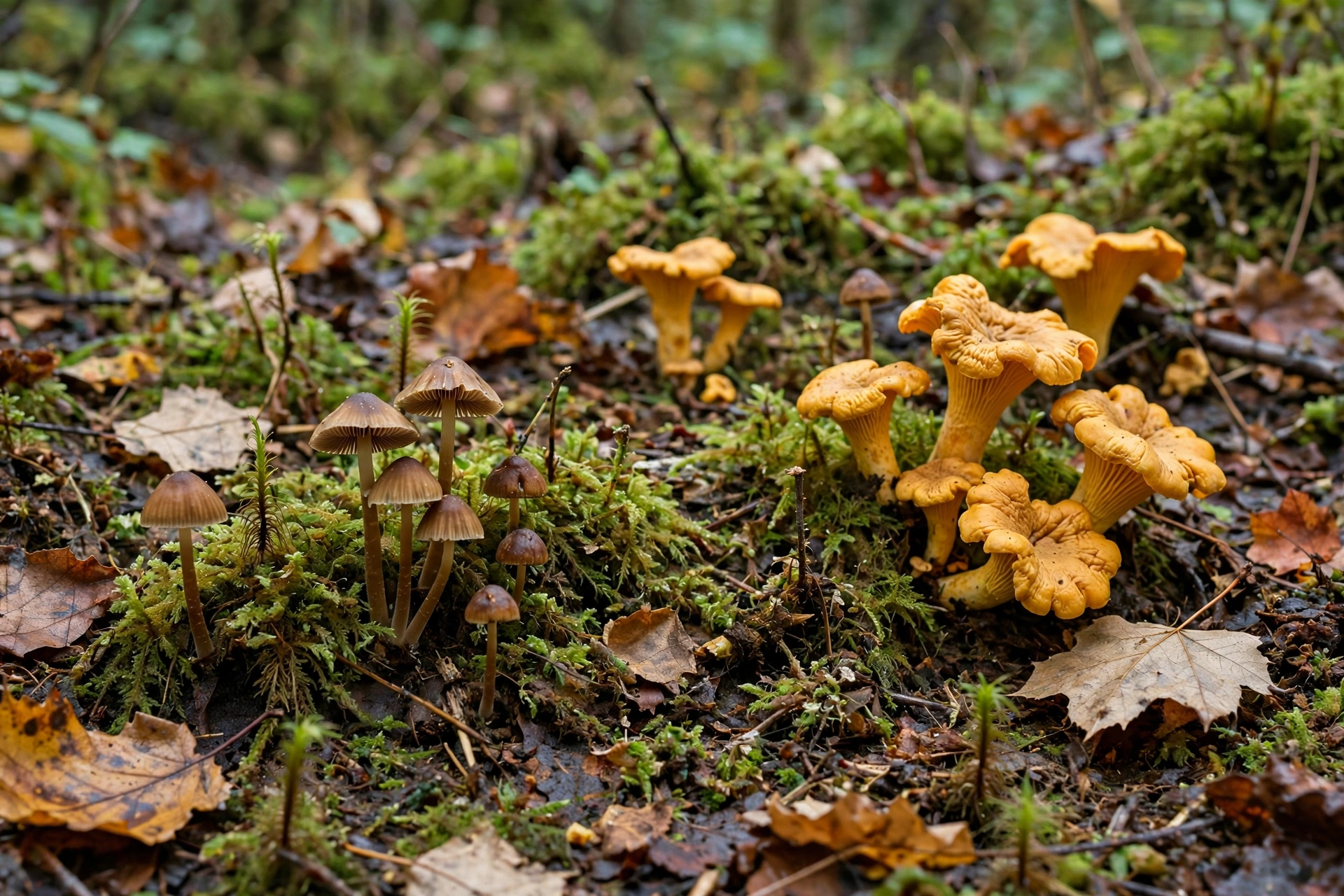
Mushrooms are fascinating, beautiful, and sometimes dangerous. They appear overnight after rain, grow in woodlands, meadows, and gardens, and come in an astonishing range of shapes, colours, and sizes. Learning to identify them is rewarding — it teaches you about trees, soil, seasons, and forest ecology. But mushroom identification is also one of the areas where a mistake can have serious consequences.
This guide explains how to observe mushrooms carefully, what features experts look at, and how to use photos and AI as learning tools. It also makes one point very clearly: never eat a wild mushroom based on AI identification alone, or on a single photo, a single feature, or a guess. When in doubt, leave it alone and consult a local expert in person. That rule is not overcautious — it exists because edible species and poisonous species can look almost identical, and because a single wrong meal can cause serious harm.
What a Mushroom Actually Is
What we call a mushroom is only the fruiting body of a much larger organism. Most of the fungus lives underground or inside wood as a network of fine threads called mycelium, which can spread for metres and live for years or even decades. The mushroom appears when conditions are right — usually after rain, when the air is damp and mild — to release spores and reproduce. That is why mushrooms seem to appear overnight: the fruiting body grows quickly, but the organism underneath has been there all along.
Most fungi are either decomposers, breaking down dead wood and leaves, or mycorrhizal partners, exchanging nutrients with tree roots. A few are parasites that attack living trees. Knowing which role a fungus plays helps with identification: a mushroom growing on a dead log is probably a decomposer, while one growing in a ring around the base of an oak or birch is likely connected to that tree's roots. Note the tree species nearby — many mushrooms are closely tied to particular trees, and that association is one of the strongest clues an expert uses.
The Features Experts Look At
Experts never rely on one feature. They look at the cap first: its shape, size, colour, texture, and whether it is smooth, scaly, sticky, or cracked. Then they look underneath. Gills are thin, blade-like structures; pores are tiny tubes, like a sponge; some fungi have teeth or smooth undersides instead. The colour and spacing of the gills, and whether they are attached to the stem or free from it, all matter. Next comes the stem: its length, thickness, colour, texture, and whether it has a ring or a cup-like volva at the base. The volva is especially important, because some of the most poisonous mushrooms, including the death cap, have one.
Other features include the smell, the flesh colour when cut, the habitat, and the season. Some species smell of aniseed, others of garlic or radish, and a few have an unpleasant chemical smell that is itself a warning. A spore print — the colour of the spores left on paper overnight — adds another piece of evidence: white, pink, brown, and black spores each point to different groups. No single feature proves an identification. It is the combination, all matching, that gives an expert confidence — and even then, experts check with a second person or a trusted reference before calling a mushroom edible.
Step-by-Step: Observe a Mushroom Safely
Step 1: Photograph without picking unnecessarily
Take photos from above, from the side, and from below, showing the cap, gills or pores, stem, and base. Include the habitat and something for scale, such as a leaf or coin placed nearby, not held in your hand if you are unsure what it is.
Step 2: Note the habitat and trees nearby
Record the location, the type of ground, nearby trees, and whether the mushroom was growing alone, in a cluster, or in a ring. These details narrow the possibilities far more than colour alone.
Step 3: Make a spore print — for learning, with guidance
Experts sometimes make a spore print by placing a cap on paper overnight to see the colour of the spores. This is a learning technique, not a shortcut to edibility. Only do this if you are learning with a local group or expert, and wash your hands afterwards.
Step 4: Compare several features, not one
A safe identification is based on many matching features: cap, gills, stem, base, habitat, season, and spore colour. If any feature does not fit, do not force the identification. Many edible species have poisonous look-alikes that differ in only one or two details.
Step 5: Use AI for education, not for eating
Upload your photos to the Mushroom Identifier on aitreeidentier.site to learn what features to notice and what species to research further. Treat the result as a starting point for study, not as permission to eat. No AI tool, photo, or app can guarantee that a wild mushroom is safe.
Common Mistakes to Avoid
Identifying by colour or cap alone. Colour varies with age, rain, and light. Many species share the same cap colour but differ underneath.
Trusting a single photo. A top-down photo hides the gills, stem, and base — the very features experts need most. Always photograph from several angles.
Assuming "it looks like the edible one" is enough. Poisonous look-alikes are common and can be very similar. A close match is not a safe match.
Eating based on AI, an app, or a social media post. AI can be wrong, photos can be misleading, and a mistake can be serious. Never eat a wild mushroom unless a qualified local expert has identified it in person and confirmed it is safe in your area.
Picking every mushroom you find. Picking is not always necessary for identification, and it removes the fruiting body before it can release spores. Photograph first, pick only when you need to check the base or gills, and leave plenty behind.
FAQ
Can AI identify mushrooms accurately? AI can suggest likely species and highlight features to check, especially from clear photos of cap, gills, stem, and habitat. It cannot guarantee safety, and it should never be used as the sole basis for eating a wild mushroom.
What is a spore print and why does it matter? A spore print is the pattern and colour left by spores falling from a cap onto paper. Spore colour is an important identification feature, but it is only one of many, and it does not prove edibility.
Are all brightly coloured mushrooms poisonous? No, and some dull mushrooms are dangerous. Colour alone is not a reliable guide to safety. Always use the full set of features and expert advice.
What should I do if I think someone has eaten a poisonous mushroom? Seek urgent medical help immediately and, if possible, keep a sample or clear photos of the mushroom for identification. Do not wait for symptoms to appear.
When is the best time of year to look for mushrooms? Autumn is the peak season in most temperate regions, especially after warm rain, but mushrooms appear in spring and summer too. Different species fruit at different times, so note the date — it is a useful identification clue in itself.
Conclusion
Mushroom identification is a wonderful way to learn about nature, but it demands care, patience, and humility. Observe the cap, gills, stem, base, habitat, and season. Photograph from several angles, compare many features, and use the Mushroom Identifier on aitreeidentier.site as an educational tool. Enjoy mushrooms with your eyes and your camera — and never eat a wild mushroom based on AI alone. When in doubt, leave it where it grows and ask a local expert.
Safety disclaimer: Never eat or use a wild plant or mushroom based on AI identification alone. Some wild mushrooms are seriously poisonous, and edible species have dangerous look-alikes. Consult a qualified local expert in person before considering any wild mushroom as food. This article is for general education only and is not medical advice.