
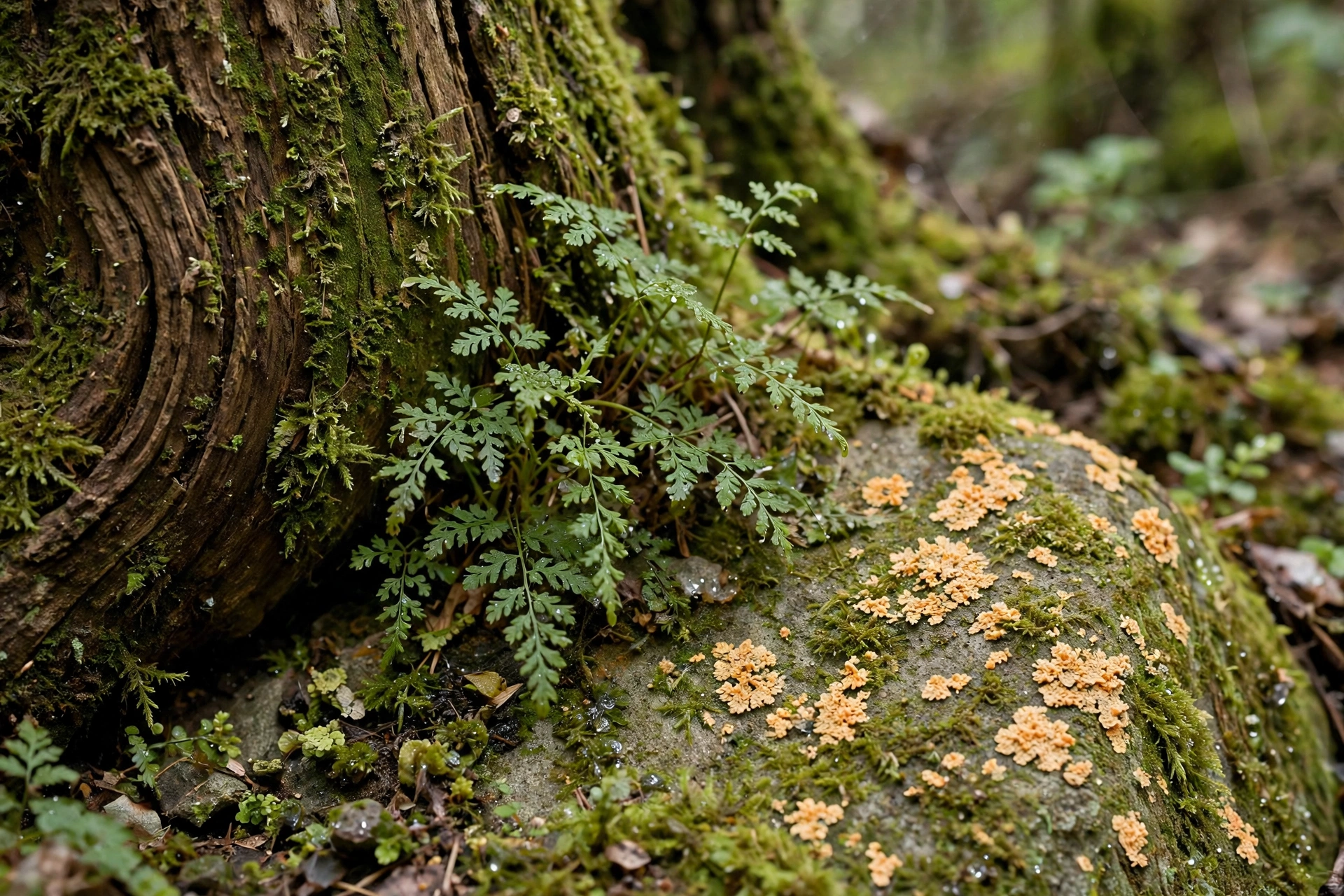
On a damp morning in a wood, the trees and rocks are covered in green. Look closer, and that green resolves into three different kinds of life: mosses, ferns, and lichens. They are often lumped together as "the green stuff on trees", but they are not the same at all. A moss is a small, simple plant. A fern is a larger plant with true leaves and roots. A lichen is not a single plant at all, but a partnership between a fungus and an alga. Learning to tell them apart is one of the most satisfying skills in nature identification, because once you see the differences, you cannot unsee them. This guide shows you how to identify mosses, ferns, and lichens on trees and rocks, what to look for, and where to find them.
How to Identify Mosses
Mosses are small, soft, and low-growing, usually only a few centimetres tall, growing in dense cushions or carpets. They have no flowers, seeds, or true roots. Instead, they have rhizoids, tiny hair-like structures that anchor them and absorb water. They reproduce by spores, released from a thin stalk topped by a small capsule.
Mosses need moisture, so they grow where water collects: on the north side of a tree, in a damp hollow, on a shaded rock, or on soil that stays wet. They have no waterproof cuticle like a flowering plant, so they dry out quickly in sun and rehydrate just as quickly when it rains. That is why a moss can look brown and dead on a dry day and bright green an hour after rain.
To identify a moss, look at its growth form first. Is it a cushion, a carpet, or a trailing mat? Is it upright or creeping? Then look at the leaves with a hand lens if you have one. Moss leaves are tiny, usually less than a few millimetres long, and they are arranged in a spiral around a thin stem. Some mosses have leaves that are pointed, others have leaves that are rounded or toothed. The shape of the leaf, and the shape of the capsule on its stalk, are the keys to naming a moss to species level, though many people are happy to identify mosses to group level.
Mosses are harmless to trees. They do not feed on the tree, they do not damage the bark, and they do not block light in a way that harms the tree. They simply use the tree as a place to live, catching rain and dust for nutrients. A tree covered in moss is usually a tree in a damp, clean-air environment, which is a good sign for the woodland as a whole.
How to Identify Ferns
Ferns are larger and more familiar than mosses. They have true roots, true stems, and true leaves, which are called fronds. A frond is usually divided into leaflets, called pinnae, and each pinna may be divided again. The overall shape is feathery and often arching. Ferns reproduce by spores, which grow in clusters called sori on the underside of the frond. If you turn a fern frond over and see rows of brown dots, you are looking at sori, and you are looking at a fern.
Ferns like shade and moisture, though some tolerate sun and dry soil. On trees, you will rarely find a true fern growing on the trunk, though some ferns grow as epiphytes on trees in damp, tropical woodlands. In a temperate garden or wood, ferns grow on the ground, on walls, and on rocks, often at the base of a tree where the soil is moist and shaded. On rocks, look for ferns in cracks and crevices, where water collects and the roots can find a hold.
To identify a fern, look at the frond shape first. Is it once-divided, twice-divided, or three times divided? Is the frond triangular, lance-shaped, or oval? Is the stem scaly or smooth? Then look at the sori on the underside: are they round, kidney-shaped, or long and straight? Are they covered by a flap, called an indusium, or are they uncovered? The shape and position of the sori are the most reliable features for naming a fern.
Ferns are also harmless to trees. They do not feed on the tree, and they do not damage it. A fern growing at the base of a tree is simply using the shade and moisture the tree provides.
How to Identify Lichens
Lichens are the most misunderstood of the three. A lichen is not a plant, and it is not a single organism. It is a partnership, called a symbiosis, between a fungus and an alga or a cyanobacterium. The fungus provides the structure, the protection, and the attachment to the bark or rock. The alga provides food, by photosynthesising. Together, they can live where neither could live alone: on bare rock, on dry bark, in cold mountains, and in deserts.
Lichens come in three main growth forms, and learning those forms is the fastest way to start identifying them. Crustose lichens are flat crusts that look painted onto the surface. You cannot peel them off without taking the surface with them. They are common on rocks and on smooth bark, and they come in bright colours: orange, yellow, green, grey, and black. Foliose lichens are leafy, with lobes that lift slightly from the surface. You can peel them off with a fingernail. They are common on tree trunks and on rocks, and they are often grey-green with a pale underside. Fruticose lichens are branching, shrubby, or hair-like. They stand up from the surface or hang down from it. Old man's beard, which hangs in long, pale strands from tree branches, is a fruticose lichen.
To identify a lichen, note the growth form first, then the colour, then the surface. Is it smooth, powdery, or covered in small bumps? Are there fruiting bodies, which look like small discs or cups, on the surface? Are there powdery patches, called soredia, which the lichen uses to reproduce? The colour of a lichen can change when it is wet: a grey lichen may turn green when it rains, because the alga inside becomes visible through the wet fungal layer.
Lichens are excellent indicators of air quality. Many lichens are sensitive to air pollution, especially sulphur dioxide, so a tree or rock covered in many different lichens is a sign of clean air. A place with few lichens, or only a few pollution-tolerant species, may have poorer air. That is why lichen surveys are used to monitor air quality in towns and cities.
Try it with the AI identifier on aitreeidentier.site: photograph a moss, a fern, or a lichen, close up and in good light, and see what the tool suggests.
Frequently Asked Questions
Are mosses, ferns, and lichens bad for trees?
No. None of them feed on the tree or damage it. Mosses and lichens use the tree only as a place to live, and ferns usually grow at the base of a tree, not on it. A tree covered in moss or lichen is usually a tree in a damp, clean-air environment, which is a good sign.
How do I tell a moss from a lichen?
A moss is soft, green, and has tiny leaves on a thin stem, and often a stalk with a capsule. A lichen is dry, crusty, or leathery, has no true leaves or stem, and is often brightly coloured — orange, yellow, or grey-green. If you can peel it off like a leaf, it is more likely to be a foliose lichen than a moss.
Do ferns have flowers or seeds?
No. Ferns reproduce by spores, which grow in clusters called sori on the underside of the frond. They do not have flowers, and they do not produce seeds. Mosses also reproduce by spores, while lichens reproduce by spores from the fungus and by small fragments that contain both partners.
Conclusion
Mosses, ferns, and lichens are three different answers to the same problem: how to live on a tree or a rock, with no soil, little water, and a lot of weather. Mosses do it by staying small, soft, and quick to rehydrate. Ferns do it by growing true roots, stems, and fronds, and by reproducing with spores. Lichens do it by joining forces, fungus and alga together, to live where neither could live alone. Learn to tell them apart — soft carpet, feathery frond, painted crust — and every tree and rock you pass will tell you more about the place you are in, the air you are breathing, and the life that is quietly thriving on the surface.
Disclaimer: This article is for general education only. Some lichens and ferns can be irritating or toxic if eaten. Do not eat any moss, fern, or lichen, and confirm identity with an expert before use.