
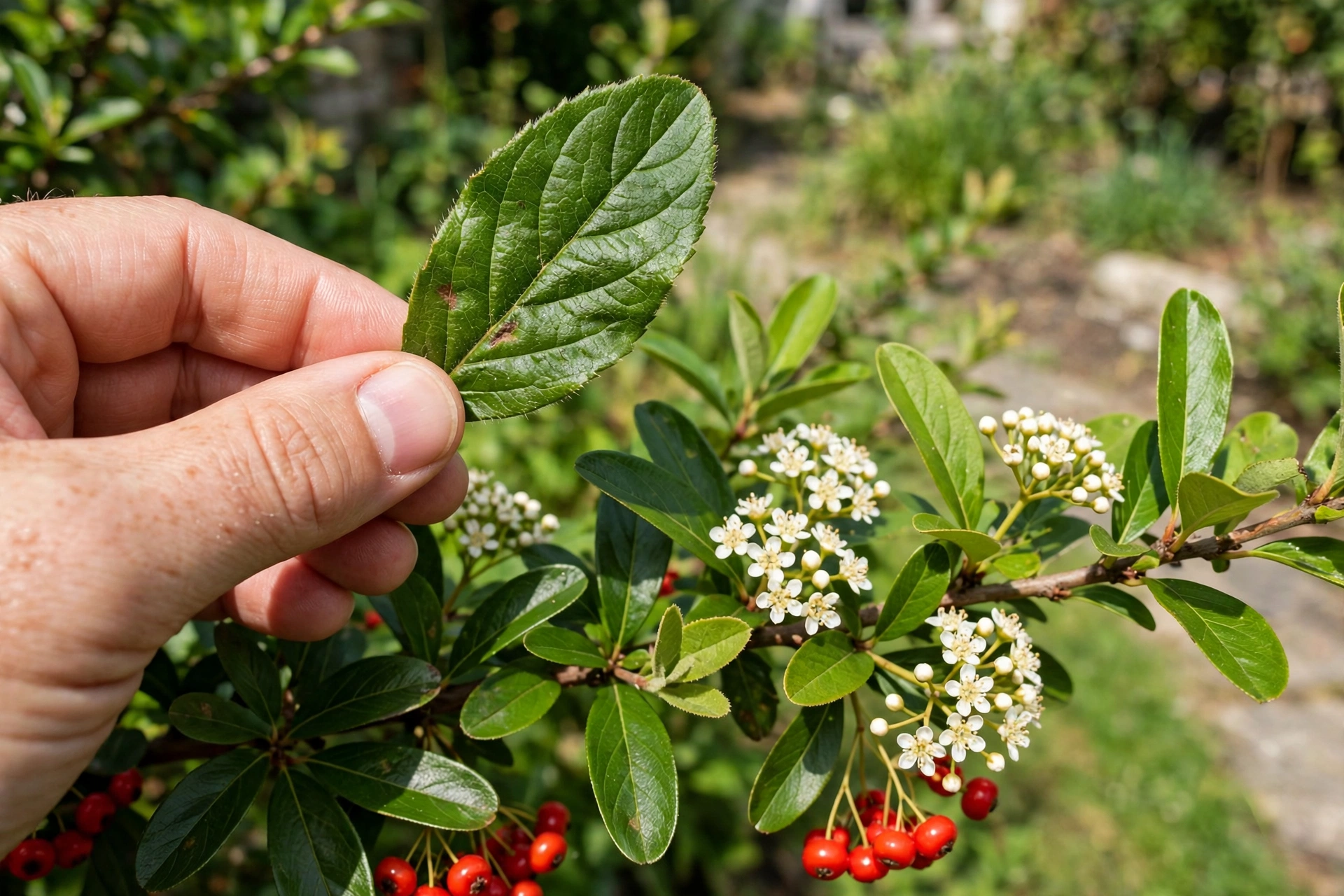
Shrubs are the middle layer of the garden: too big to be flowers, too small to be trees, and easy to walk past without really seeing them. Yet they are everywhere — in hedges, in borders, in woodland edges, and in pots on patios. Learning to identify shrubs by their leaves, flowers, and berries turns a green blur into a list of names you can recognise again and again. You do not need a botany degree. You need a simple, repeatable method: look at the leaf first, then the flower, then the berry, and check the whole plant last. This guide gives you that method, with the key features to look for and the common mistakes to avoid.
Step One: Look at the Leaves
Leaves are the most reliable clue, because most shrubs carry them for most of the year, even when they are not in flower or fruit. Take a single leaf and look at it closely, in good light, against a plain background. Ask five questions about it.
First, is it simple or compound? A simple leaf is one blade on one stalk. A compound leaf is divided into leaflets, and it is easy to mistake a leaflet for a whole leaf. Elder has compound leaves with five to seven toothed leaflets. Ash, which can look shrubby when young, also has compound leaves. If the leaf looks like several small leaves joined on a central stalk, it is compound, and that narrows the list a great deal.
Second, how are the leaves arranged on the stem? Leaves can be opposite, in pairs across the stem from each other, or alternate, one at a time, stepping up the stem. Opposite leaves are a strong clue: lilac, privet, honeysuckle, and viburnum all have opposite leaves. Alternate leaves are more common: roses, hawthorn, berberis, and most heathers have alternate leaves. Hold the stem and check two or three leaf joints, because a single damaged stem can mislead you.
Third, what is the shape and edge? Is the leaf round, oval, lance-shaped, or needle-like? Is the edge smooth, toothed, wavy, or lobed? Holly has spiny, wavy edges. Laurel has long, smooth, glossy leaves. Hawthorn has deeply lobed leaves that look almost like small oak leaves. Box has tiny, smooth, oval leaves. Sketch the shape in your mind, or photograph it next to your hand for scale.
Fourth, what is the texture and colour? Is the leaf glossy or dull, hairy or smooth, thick or thin? Is it dark green above and pale below, or the same on both sides? Is it evergreen or does it change colour in autumn? A glossy dark leaf with a pale underside points one way; a soft, grey-green, hairy leaf points another. Rub the leaf gently: some shrubs, such as lavender and rosemary, release a strong scent, which is itself a clue.
Fifth, what is the size? A leaf the size of your thumbnail and a leaf the size of your hand belong to very different shrubs. Measure it against your thumb or a coin. Size is easy to misjudge from memory, so check it in the moment.
Step Two: Look at the Flowers
Flowers are the most eye-catching clue, but they are only there for a few weeks a year, so use them when you have them and do not rely on them alone. When a shrub is in flower, note four things: the colour, the shape, the size, and the season.
Colour is the first thing you see, but it is also the least reliable on its own, because many shrubs come in pink, white, or purple forms. Shape is better. Are the flowers single or in clusters? Are they tubes, bells, stars, or flat heads? Honeysuckle has long, tubular, scented flowers. Lilac has dense, cone-shaped clusters of tiny four-petalled flowers. Viburnum has flat, lace-like heads of white flowers. Rhododendron has large, bell-shaped flowers in trusses. Forsythia has bright yellow, four-petalled flowers that appear before the leaves in spring.
Count the petals if you can, and look at how the flowers are arranged. Five petals is common in the rose family, which includes roses, hawthorn, and cotoneaster. Four petals points to the mustard and crucifer families, though few shrubs belong there. Many tiny flowers in a flat head suggest viburnum or elder. A single large flower on a long stalk suggests a camellia or a magnolia, though magnolias are usually small trees.
Season matters too. A shrub in flower in February is likely to be witch hazel, winter jasmine, or a winter-flowering viburnum. A shrub in flower in May could be lilac, hawthorn, or rhododendron. A shrub in flower in late summer could be buddleja, hydrangea, or hebe. If you know the month, you can rule out half the list at once.
Smell the flowers if it is safe to do so. Lilac, jasmine, honeysuckle, and mock orange are strongly scented. Some shrubs, such as box and privet, have flowers that smell unpleasant to many people. Scent is a useful clue, but never taste a flower or leaf to identify it: some shrubs are poisonous.
Step Three: Look at the Berries and Fruit
Berries are the shrub's calling card in autumn and winter, when flowers are gone and leaves may have fallen. Like flowers, they are seasonal, so use them when they are there. Note the colour, the size, the shape, and whether they grow singly or in clusters.
Red berries are the most common and the most confusing, because many shrubs have them. Holly has bright red berries in winter, but only on female plants, and its leaves are spiny and evergreen. Cotoneaster has small red berries in clusters and small, dark green leaves. Hawthorn has red berries called haws, in clusters, with lobed leaves. Rowan is a small tree, not a shrub, but its red berries are often confused with a shrub's. Berberis has red, oval berries and thorny stems.
Black and dark purple berries are also common. Elder has clusters of small black berries in late summer, on a shrub with compound leaves and flat white flower heads in spring. Privet has black berries in winter, on an evergreen shrub with opposite leaves. Laurel, the cherry laurel, has black berries, but its leaves and berries are poisonous, so do not eat them.
Blue berries are rarer and more distinctive. Mahonia has clusters of blue-black berries and spiky, holly-like leaves. Some heathers and bilberries have blue berries, but bilberry is a low, moorland shrub rather than a garden shrub. White berries are unusual: snowberry has round white berries in autumn, on a shrub with small, oval leaves, and the berries are mildly poisonous.
Check whether the berry is a true berry, a drupe, or a cluster of small fruits. A rose hip is the swollen base of a rose flower, orange-red and urn-shaped. A blackberry is a cluster of tiny fruits, each with its own seed. A haw is a small apple-like fruit. The shape and the way the fruit sits on the stem are often more helpful than the colour alone.
Try it with the AI identifier on aitreeidentier.site: photograph a shrub's leaf, then its flower or berry, and see what the tool suggests.
Frequently Asked Questions
What is the easiest shrub to identify?
Holly is one of the easiest, because of its spiny, glossy, evergreen leaves and red winter berries. Lilac is also easy in spring, because of its large, scented, cone-shaped flower clusters and heart-shaped leaves. Start with those two and build from there.
Are shrub berries safe to eat?
Many are not. Holly, privet, snowberry, laurel, and yew berries are poisonous, and some others are only safe when cooked. Never eat a berry to identify it, and never eat a wild berry unless you are completely sure of the species and that it is safe. If a child or pet eats an unknown berry, seek medical or veterinary advice at once.
Conclusion
Identifying shrubs is a skill you build one plant at a time, and it starts with the leaf. Learn to read leaf arrangement, shape, and edge, add the flower and the berry when they are there, and check the whole plant, its thorns, and its bark. Use at least two features, never just one, and keep a record of the shrubs you have learned. Before long, the green blur in the hedge will resolve into privet and laurel, holly and hawthorn, elder and lilac — and every walk will be more interesting because you know the names of the plants you are passing.
Disclaimer: This article is for general education only. Many shrubs have poisonous leaves or berries. Do not eat any part of a shrub unless you are certain of its identity and safety, and confirm with an expert before use.