
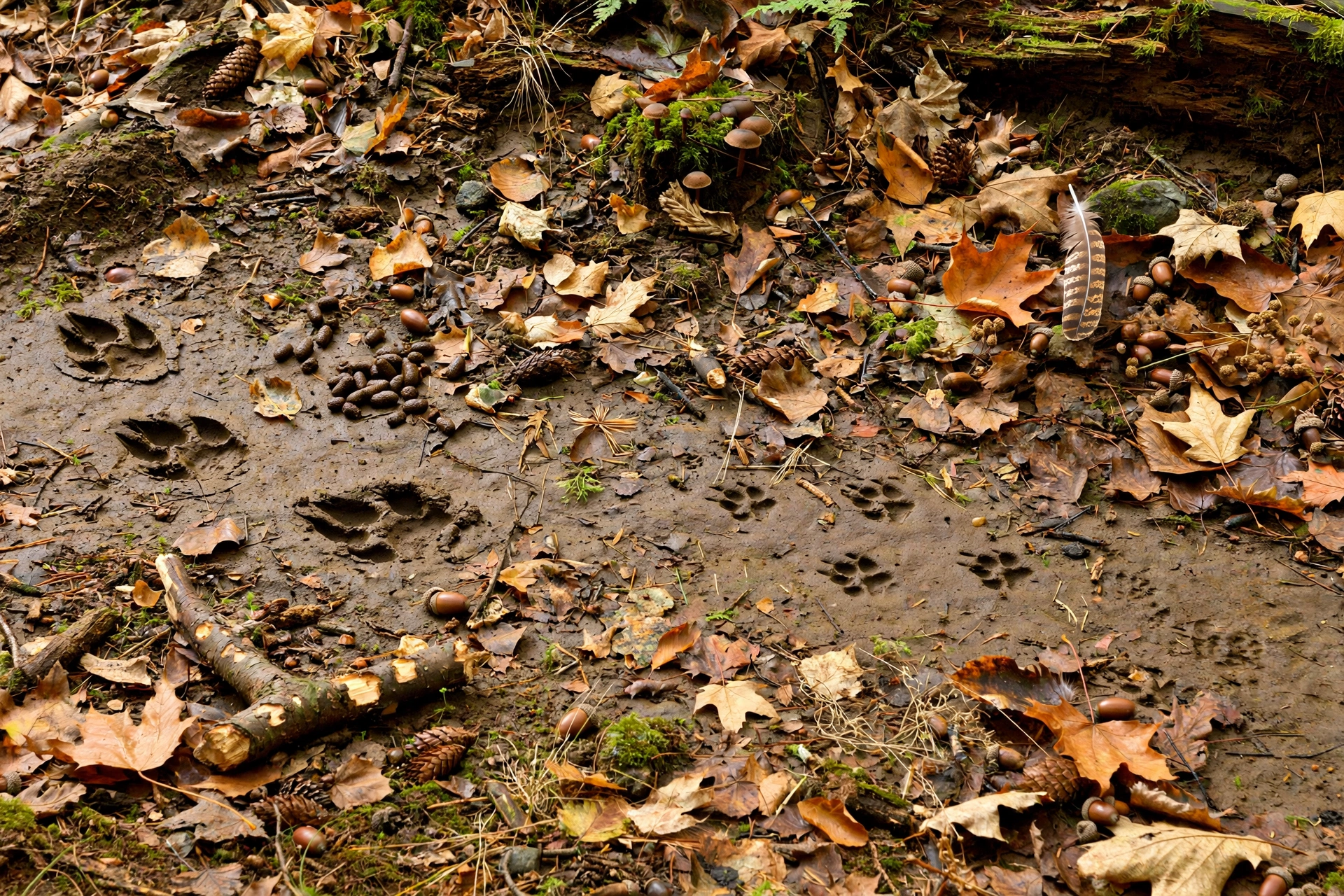
Animal droppings, often called scat, are one of the most useful clues a nature walk can offer. The animal itself may be long gone, hidden in thick cover, or active only at night, but its droppings stay behind and tell a story. With a little practice, you can learn which animals have passed through a woodland, meadow, or riverside path — without ever seeing them.
This guide shows you how to read those clues — size, shape, contents, and location — step by step, and how to stay safe while you explore. Scat identification is sometimes called the tracker's quiet skill: it asks for patience rather than speed, and it rewards anyone willing to look down instead of ahead. Even a single walk along a familiar path can reveal that foxes, badgers, deer, and rabbits have all been there within the last day or two.
What Scat Can Tell You
Droppings reveal more than identity. Their contents show diet: fur and bone point to a meat eater, seeds and plant fibres to a plant eater or omnivore. Freshness tells you how recently the animal passed by, and the location — a prominent stone, a path, or dense grass — hints at behaviour such as marking territory.
Scat can also reveal the season. In autumn, fox droppings often contain blackberry seeds and fruit skins, while in spring they may contain fur and feathers from prey. Badger droppings change through the year too, from earthworms in spring to fruit and nuts in autumn. By noting the contents, you learn not just which animal passed by, but what it has been eating — and that tells you about the habitat itself, which foods are available, and how the seasons are changing.
Before You Start: Safety and Respect
Never touch droppings with bare hands. Scat can carry bacteria and parasites, so observe from a distance and use a stick to move vegetation for a better look. Wash your hands after your walk, and keep dogs away from droppings.
It is also worth remembering that droppings are part of the habitat, not litter. They feed dung beetles, flies, and fungi, and they return nutrients to the soil. Leave them where they are, photograph them rather than collecting them, and avoid disturbing the area around a latrine or den. If you are walking with children, teach them the same rule: look, photograph, and wash hands — never touch.
Step-by-Step: Identify Animal Droppings and Scat
Step 1: Note the location and habitat
Record where you found the droppings. A woodland edge, a riverside bank, an open meadow, and a garden path each attract different animals. Droppings left on a raised stone or a path junction are often territorial markers, while droppings scattered in feeding areas usually mean the animal was simply passing through.
Step 2: Judge the size and shape
Compare the dropping with a coin, and photograph it with the coin in the frame for scale. Note whether it is round pellets, long and tapered, or a loose pile. Fox scat is long, twisted, and pointed at one end; deer leave small, smooth pellets and rabbits leave small, round pellets in piles.
Step 3: Look at the contents
Look closely, without touching, at what the dropping is made of. Visible fur, feathers, or small bones suggest a predator such as a fox. Seeds, berry skins, and insect cases point to an omnivore, while fine plant fibre suggests a grazing animal. Badger droppings often contain earthworm remains, seeds, and fruit stones, reflecting their varied diet.
Step 4: Check the freshness
Fresh droppings are moist and dark, while older ones dry out, fade, and crumble. Freshness tells you whether the animal is active in the area now or passed through days ago. Judge by colour and surface shine, and by whether insects have already begun to visit. Do not prod droppings to test them.
Step 5: Look for other signs nearby
Droppings rarely appear alone. Search nearby for footprints, feeding damage, burrows, or rubbed bark. A cluster of droppings beside a worn path suggests a regular route, and a latrine — a spot used repeatedly — is a strong clue to badgers or other territorial mammals. These extra signs often confirm what the scat alone only suggests.
Step 6: Compare and confirm with a photo
Take a clear photo showing the droppings, the scale object, and the habitat, then compare it with a field guide or the free Animal Identifier on aitreeidentier.site. Check the match fits the size, contents, and location. If two animals seem possible, note both and look for more evidence.
Common Droppings You May Find
- Fox: Long, twisted, pointed at one end, often left in prominent spots such as paths and stones. May contain fur, feathers, or berry seeds.
- Badger: Loose and dark, often deposited in a shallow pit called a latrine near a sett. Contents vary with the season, from earthworms to fruit.
- Deer: Small, smooth, dark pellets, scattered or in small groups, usually in woodland clearings and along rides.
- Rabbit: Small, round, dry pellets in neat piles near burrows, feeding lawns, and field edges.
- Otter: Dark, tarry spraints left on prominent stones or logs near water, often with a sweet, fishy smell and visible fish scales or bones. Otters use spraints to mark their territory along rivers and streams.
- Hedgehog: Small, dark, cylindrical droppings, often left on lawns and paths at night, sometimes containing the shiny remains of beetles and other insects.
Common Mistakes Beginners Make
- Identifying from size alone. A large dropping from a small animal can mislead, so always combine size with shape, contents, and location.
- Touching droppings to examine them. This risks infection and destroys evidence. Observe, photograph, and leave them in place.
- Assuming every dropping is from a mammal. Bird droppings, owl pellets, and insect frass are common on nature walks and easy to confuse with mammal scat.
- Forgetting the habitat. A dropping that fits a fox in a woodland may fit a different animal by the coast.
- Expecting every dropping to be identifiable. Some droppings are too old, too weathered, or too similar to other species to name with confidence. Record what you can and move on — an honest "unknown" is better than a wrong guess.
FAQ
Is it safe to look at animal droppings up close?
Yes, if you keep your distance and never touch them with bare hands. Photograph them, wash your hands after your walk, and keep dogs on a lead near latrines and dens.
Can I identify an animal from one dropping alone?
Sometimes, when the size, shape, and contents are distinctive, but a confident identification usually needs the location, nearby tracks, and a photo for comparison. Treat a single dropping as a strong clue rather than proof.
What is the difference between scat and an owl pellet?
Scat is waste passed through the digestive system, while an owl pellet is regurgitated undigested material such as bones and fur. Pellets are dry, grey, and oval, and are usually found below a regular roost.
Where is the best place to look for animal droppings?
Try path junctions, prominent stones, logs, and the edges of fields and woodland, where animals mark territory and travel regularly. Riverside banks are good for otters, and latrines near a badger sett are reliable once you know where to look. Early morning, before other walkers and dogs disturb the ground, is often the best time.
Conclusion
Identifying droppings turns a nature walk into a detective story. Note the location, size, shape, and contents, check for other signs nearby, and compare your photo carefully. With practice, you will recognise the regular visitors to your local paths.
Try it: Try the free Animal Identifier on aitreeidentier.site — upload a clear photo of the sign you found, with something for scale, for instant guidance.
Safety disclaimer: Never touch animal droppings or disturb wildlife, dens, setts, or nests; observe from a distance and wash your hands after your walk. AI identification is guidance only — consult a local wildlife expert before acting on a finding, especially for rare, protected, or potentially dangerous species.