
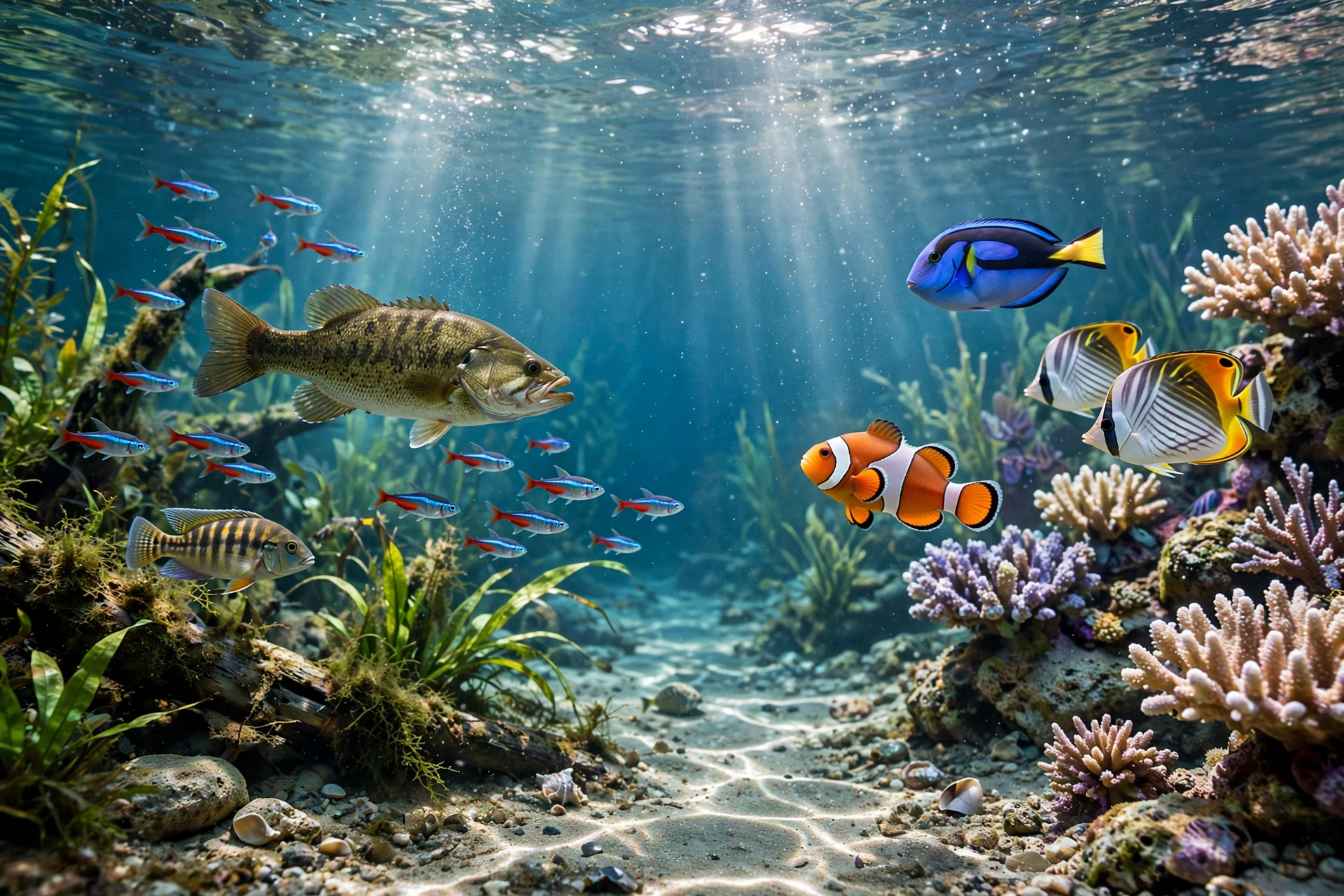
At first glance, many fish look alike: a streamlined body, fins, and a tail. Yet freshwater and saltwater fish live in very different worlds, and those worlds shape their bodies, colours, and behaviour. Learning the key features that separate them helps anglers, snorkellers, aquarium keepers, and nature lovers identify what they have seen — and understand the habitat it came from.
This guide explains the differences in body shape, fins, colour, size, and habitat, and gives you a practical step-by-step method for identifying a fish from a photo. You do not need to be an expert to start; you need a clear photo, a few structured observations, and a willingness to check the habitat first. The single most useful habit is to write down where you saw the fish before you try to name it, because location alone can rule out most wrong answers.
Body Shape and Size
Freshwater fish are often found in rivers, lakes, and ponds, where the water is calmer and the space is more enclosed. Many are deep-bodied or moderately streamlined, built for short bursts of speed, manoeuvring around plants and rocks, or living near the bottom. Examples include perch, carp, trout, and catfish, each with a different body plan.
Saltwater fish live in oceans, seas, and estuaries, where currents, depth, and open water shape their bodies. Many are strongly streamlined for sustained swimming, while reef fish are often deep, compressed, and brightly coloured for life among coral. Some saltwater fish are much larger than most freshwater species, although size alone is not a reliable guide — there are large freshwater fish and small saltwater fish too.
Bottom-dwelling fish add another shape to learn. Flatfish such as flounder and plaice lie on the seabed, while catfish and loaches in freshwater have flattened undersides and barbels — whisker-like feelers — for finding food in murky water. Eel-like fish, from freshwater eels to marine morays, have long, snake-like bodies for slipping through rocks, reeds, and crevices. If the fish you saw looked nothing like a typical torpedo shape, check these bottom and eel-like forms first.
Fins, Tails, and Colour
Fins are one of the most reliable identification features, and they repay close attention. Count the dorsal fins on the back: perch have two, trout have one plus a small fleshy adipose fin, and many reef fish have a single long dorsal fin. Note the tail shape too — forked tails usually belong to fast, open-water swimmers, rounded tails to fish that manoeuvre in tight spaces, and long, flowing fins often signal an ornamental or slow-moving species. Spines in the dorsal or pectoral fins are a warning: some fish, such as weever fish and certain catfish, can give a painful sting, so handle with care or not at all.
Colour and pattern are useful, but treat them as supporting evidence, not proof. A fish can look silver in open water and dark among weeds, and breeding males often develop bright colours that vanish within weeks. Stripes, spots, and bars are more stable than overall colour, so record their number, position, and shape. Also note any distinctive marks — a dark spot on the gill cover, a stripe through the eye, or a coloured edge to the fins — because these small details often separate two similar species.
Step-by-Step: Identify a Fish from a Photo
Step 1: Note the water and location
Was it freshwater or saltwater? A river, lake, pond, estuary, coast, or reef? Write this down first — it is the most powerful filter.
Step 2: Describe the body
Is the body long and eel-like, deep and flat, or torpedo-shaped? How large is it compared with something nearby? Note the overall silhouette before you look at colour.
Step 3: Look at fins and tail
Count the dorsal fins, note the tail shape, and look for an adipose fin, spines, or long, flowing fins. Photograph the fish from the side if possible, with all fins visible.
Step 4: Note colour and pattern
Record the main colours, spots, stripes, bars, and any distinctive marks on the head, fins, or tail. Remember that colours fade quickly after a fish is out of the water, so a photo taken in the water is more reliable.
Step 5: Use an AI tool to narrow it down
Upload your clearest side-view photo to the Fish Identifier on aitreeidentier.site, along with your notes on habitat and location. Compare its suggestion with your shortlist and check that the species matches the water type and range.
Estuaries and Migratory Fish
Estuaries, where rivers meet the sea, are the exception that proves the habitat rule. The water there is brackish — a mix of fresh and salt — and it changes with the tide, so only adaptable fish thrive there. Mullet, flounder, and bass are common estuary visitors, and the same fish may be found in fresh water at one time of year and in the sea at another. Migratory species add more complexity: salmon are born in rivers, grow up at sea, and return to their birth river to spawn, while eels do the reverse, spawning at sea and living most of their lives in freshwater. If you saw a fish in an estuary or during a migration season, say so in your notes, because it changes which species are possible.
Common Mistakes to Avoid
Identifying by colour alone. Colour changes with light, depth, age, breeding season, and whether the fish is in or out of the water. Combine colour with body shape, fins, and habitat.
Ignoring the habitat. A fish that looks right but lives only in saltwater cannot be the fish you saw in a freshwater lake. Habitat is a hard filter, not a soft hint.
Using a photo taken out of water. Colours fade, fins collapse, and the body can look distorted. In-water photos, or photos taken quickly with the fish supported, are far more useful.
Forgetting juveniles look different. Young fish often have different colours and patterns from adults. Note the size and, if you can, whether it looked young or adult.
Trusting size estimates from memory. Fish look bigger in photos and in stories than they were. Compare the fish with something of known size in the photo, or estimate against your hand or a landing net, and write the estimate down at the time.
FAQ
Can the same species live in both freshwater and saltwater? Some can. Salmon, eels, and some other species move between fresh and salt water during their lives. Most species, however, live in one or the other, so habitat remains a strong clue.
What is the most useful photo for fish identification? A sharp side view showing the whole body, all fins, and the head, taken in good light. A top view and a note of the location help too.
Do saltwater fish always look brighter than freshwater fish? Not always. Reef fish are often bright, but many open-water saltwater fish are silver and plain, and some freshwater fish are very colourful, especially in breeding season.
Can AI identify a fish from a photo? Yes, often well, if the photo is clear, shows the side view, and includes habitat notes. Blurry, cropped, or out-of-water photos are much harder to identify reliably.
What should I do if a fish looks like two different species? Narrow it down with habitat and range first, then compare the fins, tail, and markings in a field guide. If the two candidates live in different waters or different regions, the location usually decides it. When still unsure, record it as a probable identification rather than a certain one.
Conclusion
Freshwater and saltwater fish identification starts with habitat, then body shape, fins, and pattern. Note where you saw the fish, describe its silhouette, check its fins and tail, and record its colours while they are fresh. Use the Fish Identifier on aitreeidentier.site as a second opinion, and cross-check the result against range and water type. With clear photos and structured notes, you will identify fish more confidently — and learn more about the waters they live in.
Safety note: Handle fish gently and briefly if you must, follow local fishing rules, and never eat or use a wild plant or mushroom based on AI alone. Consult a local expert if you are unsure.