
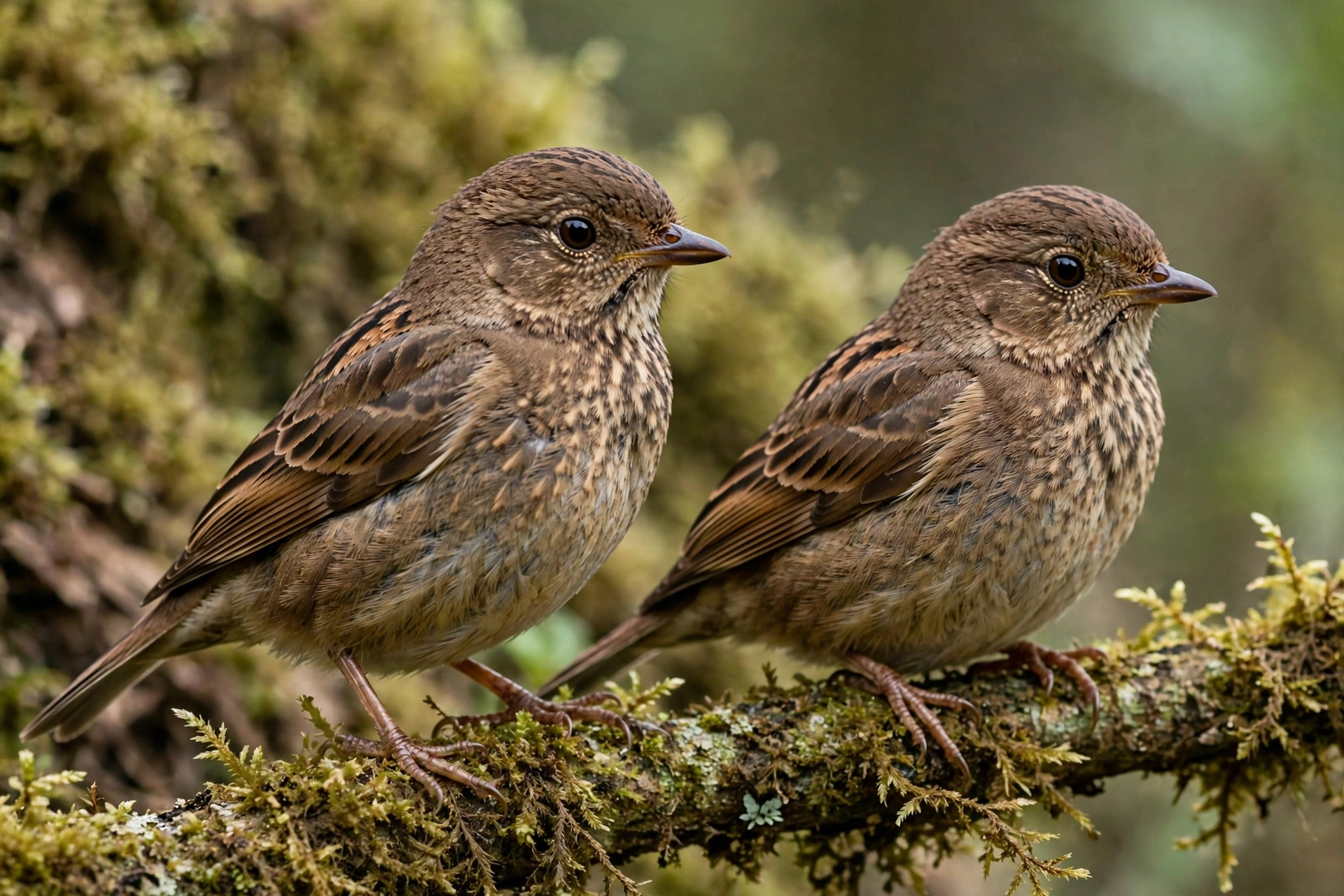
Every birdwatcher, from beginner to expert, makes identification mistakes. Birds are fast, plumage varies, light changes, and many species look similar. The difference between a beginner and an experienced watcher is not that the expert never makes mistakes — it is that the expert knows which mistakes are common, how to avoid them, and how to check an identification before being certain.
Introduction: Everyone Makes Identification Mistakes
This guide covers the most common mistakes, why they happen, and practical ways to avoid them. Learning these will make your identifications more accurate and your birdwatching more enjoyable.
Mistake 1: Relying on Colour Alone
Colour is the most obvious feature of a bird, and the least reliable. The same bird can look bright in sunlight, dull in shade, and almost black in silhouette. A robin's breast can look orange, red, or brown depending on the light, and a blackbird in poor light can look like a different bird entirely. Wet feathers look darker, and a bird seen against a bright sky loses its colours altogether. When colour and shape disagree, trust shape, size, and behaviour first.
How to avoid it: Use size, shape, bill, behaviour, and habitat together with colour. Note two or three field marks, not just one colour. If colour and shape disagree, trust shape and behaviour first.
Mistake 2: Ignoring Size and Shape
How to avoid it: Always start with size — compare with a familiar bird — and shape — body, tail, bill, and wings. Describe the bird in plain words before you look at a guide.
Mistake 3: Forgetting Females, Juveniles, and Seasonal Plumage
Field guides often show the bright male in breeding plumage, but many birds you see will be females, juveniles, or birds in winter or eclipse plumage. A female mallard looks nothing like a male mallard. A juvenile starling is brown, not glossy black. A male duck in eclipse looks like a female for a few weeks in summer. If you only learn the male, you will misidentify many birds.
How to avoid it: Learn females and juveniles for common species, and check the guide for seasonal changes. Note the date — a bird in July may look different from the same species in April.
Mistake 4: Assuming a Rare Species When a Common One Fits
It is exciting to think you have seen a rarity, but most unfamiliar birds are common species in unfamiliar plumage, at an odd angle, or in poor light. A rare bird is rare for a reason — it is unlikely to be in your garden on a normal day. Starting with the most likely species for your area and season is not boring; it is accurate.
How to avoid it: Check the common species first. Ask: does the range, habitat, season, size, and field marks fit a common bird? Only consider a rarity if the common options clearly do not fit, and seek a second opinion or a photo to confirm.
Mistake 5: Identifying from Memory Instead of Notes
How to avoid it: Write notes in the field, even rough ones, and take a photo if you can do so without disturbance. Record size, shape, field marks, behaviour, and habitat at the time, not later.
Mistake 6: Using Only One Source or One Photo
How to avoid it: Cross-check. Compare your photo and notes with a field guide, check range and season, and look at the closest lookalikes. If you cannot see the feature that separates two species, record the bird as uncertain or as a species pair.
Mistake 7: Checking the Guide Before Watching the Bird
Many beginners reach for the guide the moment a bird appears, and by the time they have found the right page, the bird has gone. Worse, once you have a picture in front of you, your brain starts to fit what you saw to that picture, even if the match is poor. You may convince yourself you saw a wing bar because the picture shows one, even though you never actually saw it. Watch first, note second, and check the guide third. The bird in front of you is the evidence; the guide is only a tool for interpreting it.
How to avoid it: Watch the bird for at least 20 seconds before you open a guide or an app. Write down two or three field marks you definitely saw, then check those marks against the guide. If the guide shows a mark you did not see, do not assume it was there.
Mistake 8: Ignoring Habitat, Season, and Range
Where and when you saw a bird is as important as what it looked like. A bird that lives only in reedbeds is unlikely to be in a dense wood. A summer visitor is unlikely to be present in midwinter. A bird whose range is hundreds of kilometres away is unlikely to be in your garden. Beginners often ignore these clues because they feel less exciting than plumage, but they are among the most powerful checks available. A quick look at a range map or a local bird report can rule out a species in seconds, and it can also point you toward the right answer when two species look identical.
How to avoid it: Always record the habitat, date, and location. Before you settle on an identification, check that the species occurs in your area at that time of year and in that habitat. If it does not, look again at the common species that do.
A Checklist Before You Confirm an Identification
1. Does the size and shape fit? 2. Do two or three field marks fit? 3. Does the habitat fit? 4. Does the season and range fit? 5. Does the behaviour fit? 6. Have you checked the closest lookalike and ruled it out? 7. If you are still unsure, is it honest to record it as probable or uncertain?
If you can answer yes to the first six, you can be reasonably confident. If not, keep it as uncertain and learn from it.
FAQ
Is it okay to be unsure about a bird identification? Yes. Being honest about uncertainty is better than being confidently wrong. Record it as probable or as a species pair, and check it later.
How can I get better at avoiding mistakes? Practise regularly, keep notes, learn common birds well, and check your identifications. Join a local bird group or walk with a more experienced watcher if you can.
What should I do if I think I saw a rare bird? Note size, shape, field marks, behaviour, habitat, date, and location, take a photo if possible without disturbance, and seek confirmation from a local expert or bird group.
Do experts make identification mistakes? Yes, all birdwatchers do. Experts make fewer mistakes because they know the common pitfalls and check their identifications carefully.
How do I learn from a mistake I have already made? Write down what you got wrong and why — for example, "thought it was a willow warbler, but the leg colour and song showed it was a chiffchaff." That note turns a single error into a lesson you will remember, and the next time you see a similar bird, you will check the right field mark first.
Should I correct a wrong identification in my list? Yes, always. A list that you correct is more useful than a list that looks perfect but contains errors. Birdwatching is about learning, not about keeping score, and an honest list is worth more than a long one.
Conclusion
Common bird identification mistakes — relying on colour alone, ignoring size and shape, forgetting females and juveniles, assuming a rarity, identifying from memory, and using only one source — are all avoidable with a structured approach. Start with size and shape, use several field marks, check habitat, season, and behaviour, take notes in the field, and cross-check your identification. Be honest about uncertainty, learn from every mistake, and enjoy the process. Accurate identification is a skill that grows with practice, and every bird you identify correctly makes the next one easier.
Try the free Bird Identifier on aitreeidentier.site — upload a clear photo of the bird for instant guidance.
Safety disclaimer: Never disturb nests or wildlife. Observe from a distance, stay on paths, and consult a local expert if you are unsure about a species or a sensitive site.