
Plumage helps you identify a bird, but behaviour tells you what it is doing and why. A bird that hovers, one that climbs down a tree headfirst, one that feeds in a large flock, and one that performs a courtship display are all giving you clues — about their species, their food, their social life, and the season.
Introduction: Behaviour Is a Field Mark You Can Watch
Learning to read behaviour makes birdwatching richer and identification more reliable. This guide explains three key areas — feeding, flocking, and courtship — and how to watch them without disturbing the birds.
Behaviour is useful precisely because it does not change with the light. A bird's colours can look different in shade, in fog, or against a bright sky, but the way it moves is consistent. A nuthatch will always climb down a trunk headfirst, a wagtail will always bob its tail, and a kestrel will always hover when it hunts. Experienced birdwatchers often identify a bird by its behaviour before they have seen its colours clearly at all. If you train yourself to watch what a bird does first, and worry about what it looks like second, your identifications will become faster and more accurate, and you will notice things — a courtship dance, a food delivery, a warning call — that a watcher who only looks at plumage will miss entirely.
Feeding Behaviour
Different Birds Feed in Different Ways
Feeding style is often diagnostic. A nuthatch climbs down a tree trunk headfirst, probing bark for insects. A treecreeper spirals up a trunk, using its curved bill to pick insects from bark crevices. A woodpecker hitches up a trunk in short bursts, then flies to another tree. A wagtail walks and runs on the ground, wagging its tail as it picks insects. A goldfinch hangs upside down on thistle heads to reach seeds.
Watch where a bird feeds — on the ground, in a tree canopy, in a bush, on water, or in the air — and how it moves while feeding. A robin hops and pauses, a blackbird runs then stops to listen, a starling probes the ground with its bill, and a swallow catches insects in flight. Those patterns are consistent and can identify a bird even when plumage is hard to see.
Flocking Behaviour
Why Birds Flock
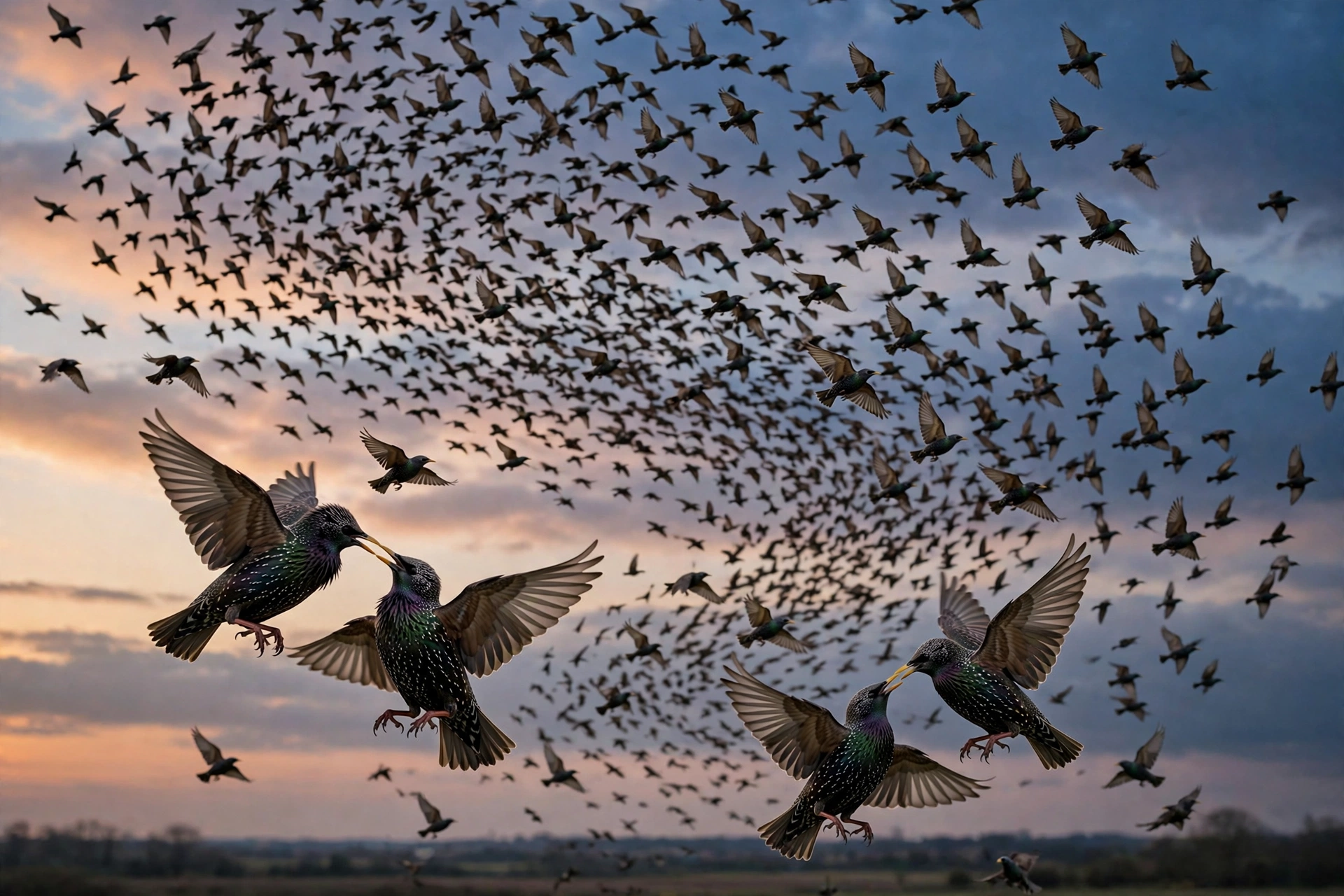
Many birds gather in flocks, especially outside the breeding season, for safety and for finding food. A flock has many eyes to spot predators, and birds can learn from each other where food is. Starlings form spectacular murmurations — huge, swirling flocks that move like a single organism at dusk. Long-tailed tits move in small, noisy, family flocks through trees. Finches and buntings gather in winter flocks in fields and hedgerows. Waders feed in large flocks on mudflats, moving together as the tide changes.
Watch how a flock moves and feeds. Does it stay together or spread out? Does it feed on the ground or in trees? Does it fly in a tight group or in a loose, straggling line? A flock of starlings is noisy and fast-moving. A flock of fieldfares is more scattered, feeding on berries and fallen fruit. A flock of goldfinches is small, twittering, and often around thistles and feeders. Flocking behaviour, combined with size and call, can help you identify birds at a distance.
Flocks also have a social order worth watching. In a flock of tits at a feeder, there is often a pecking order: larger birds such as great tits dominate the best perches, while smaller birds wait, dart in, grab a seed, and fly away to eat it elsewhere. In starling flocks, birds constantly change position, and the flock can split and rejoin in seconds. Wader flocks on an estuary move as the tide comes in, and if a sparrowhawk appears, the whole flock lifts at once and wheels in the air in a single, coordinated wave. Watching a flock is not just about counting birds; it is about seeing how they cooperate, compete, and warn each other, and those interactions are often the most memorable part of a day's birdwatching.
Courtship Displays
Songs, Dances, and Gifts
Courtship is most visible in spring, when birds display to attract a mate and defend a territory. Displays can be visual, vocal, or both. A male great crested grebe performs a synchronised dance with its partner, shaking heads and offering weed. A male lapwing performs a tumbling display flight, calling loudly as it dives and climbs. A male robin sings from a prominent perch and shows off its red breast. A male chaffinch sings a loud, descending song to claim a territory.
Some displays are easy to miss unless you know what to look for. A male mallard may bow and whistle to a female. A male goldfinch may sing while swaying from side to side on a perch. A pair of ravens may tumble and roll together in the air. Food gifts are common too: a male tern offers a fish to its mate, and a male robin may feed its partner. These behaviours are brief and easily missed, so the best approach is to sit quietly and watch one pair for several minutes rather than scanning constantly for something new. Courtship is also when birds are most sensitive to disturbance, so keep your distance, especially near nests, and never use playback to provoke a display.
How to Watch Behaviour Well
1. Sit quietly in one place for 10–20 minutes, rather than walking constantly. 2. Watch one bird at a time, and note what it does — feeding, preening, singing, or interacting with others. 3. Note the habitat, time of day, and season, as behaviour changes through the year. 4. Keep a notebook of behaviours you see, and link them to the species. 5. Use binoculars from a distance, and do not approach nests or displaying birds. 6. Be patient — behaviour unfolds over time, and a longer watch reveals more than a brief glimpse.
Common Mistakes
A common mistake is assuming behaviour is the same all year. A bird that is territorial and solitary in spring may be social and flocking in winter. Another mistake is interpreting human emotions in birds — a bird is not "happy" or "angry" in a human sense, and its behaviour is better understood as feeding, avoiding predators, or breeding. A third mistake is disturbing birds to see behaviour more closely, especially during courtship or nesting. Always watch from a distance, and let the bird behave naturally.
FAQ
Why do birds flock in winter? Flocking helps birds find food and spot predators. Many eyes are safer than one, and birds can learn from flock mates where food is available.
What is a murmuration? A murmuration is a large flock of starlings that swirls and changes shape in the sky at dusk before roosting. It is thought to help confuse predators and share information about roost sites.
How can behaviour help with identification? Feeding style, flight pattern, flocking, and courtship displays are often distinctive. A nuthatch climbing down a tree or a kestrel hovering are good examples.
Should I use playback to attract birds? Avoid it. Playback can stress birds, waste energy, and attract predators. Listen and watch naturally instead.
What does it mean when a bird flicks its tail or wings? Tail flicking and wing flicking are often signals. Chiffchaffs flick their tails constantly, wagtails bob theirs, and many birds flick their wings when alarmed. The movement itself can be a field mark, so note how often and how strongly the bird flicks.
Why do birds preen so much? Preening keeps feathers clean, waterproof, and in good condition for flight. Birds preen after bathing, after feeding, and when they are relaxed. A bird that is preening is usually comfortable and not alarmed, which is a good sign that you are watching from a safe distance.
Conclusion
Bird behaviour — feeding, flocking, and courtship — is a window into how birds live. Learn to watch feeding style, flocking patterns, and displays, and you will identify birds more confidently and understand them more deeply. Sit quietly, watch one bird at a time, keep notes, and always observe from a distance. The more you understand behaviour, the more rewarding every walk will become.
Try the free Bird Identifier on aitreeidentier.site — upload a clear photo of the bird for instant guidance.
Safety disclaimer: Never disturb nests or wildlife. Observe from a distance, do not use playback, and consult a local expert if you are unsure about a species or a sensitive site.