
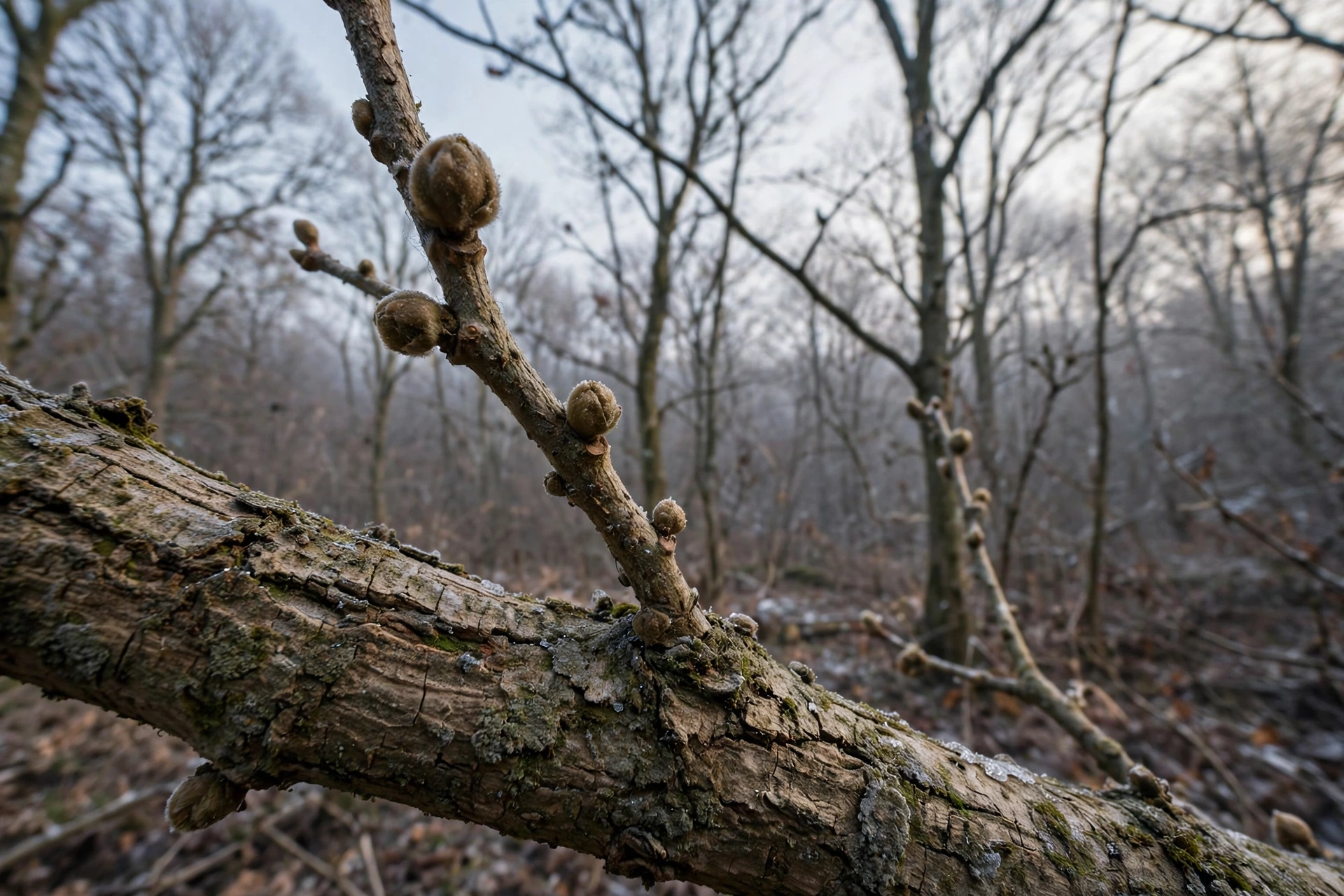
Winter is often seen as the hardest season for tree identification — no leaves, no flowers, no fruit. In reality, it is one of the most revealing. Without foliage, you can see the tree's true structure: its branching pattern, bark, buds, and silhouette. Those features are present all year, but in summer they are hidden behind leaves.
This guide shows you how to identify bare trees in winter, step by step, using the clues that remain when leaves are gone.
Winter identification also teaches a skill that improves your identification in every season. When you learn to read bark and buds, you stop depending on leaves alone, and you start noticing details — twig colour, bud arrangement, branch angles — that are useful all year round. Many experienced tree identifiers say winter is their favourite season for exactly this reason: the tree is stripped back to its essentials, and there is nothing to hide behind.
Try it: Use the Bark Identifier on aitreeidentier.site — photograph a clear patch of bark in daylight for an instant suggestion.
Why Winter Identification Works
Leaves are only one part of a tree. Bark texture, bud shape, twig arrangement, and overall form are just as distinctive — and in winter they are easier to see. An oak's rugged, fissured bark, a birch's white peeling bark, and a beech's smooth grey bark are all recognisable from a distance once you know what to look for.
Winter also forces you to slow down and observe structure, which makes you a better identifier in every season.
Step-by-Step: Identifying a Bare Tree
Step 1: Look at the overall shape
Stand back and study the silhouette. Is the tree tall and straight, broad and spreading, or narrow and conical? Oaks tend to be broad and spreading. Poplars are tall and narrow. Willows often have drooping branches. The shape alone can narrow the options considerably.
Step 2: Examine the bark
Bark is the single most useful winter clue. Note its colour, texture, and pattern. Is it smooth, rough, peeling, fissured, or plated? Is it grey, brown, white, or reddish? Young bark can be smooth while older bark on the same tree is rough, so check both the trunk and a branch.
Photograph a patch of bark at chest height, filling the frame, in even daylight without flash.
When you photograph bark, include a hand or a coin for scale — a close-up without scale can make a small twig look like a massive trunk, and an identification tool needs to know the real size. Take two photos if you can: one close-up of the texture and one wider shot showing the trunk and lower branches, so the pattern and the tree's shape are both visible.
Step 3: Study the buds and twigs
Look at a twig tip with a hand lens or a close-up photo. Note whether buds are opposite or alternate, their size, colour, and shape, and whether they are hairy, sticky, or smooth. Horse chestnut buds are large and sticky. Beech buds are long, pointed, and brown. Ash buds are dark, almost black, and sit in opposite pairs.
Also note the twig itself: its colour, thickness, and whether it has thorns, lenticels (small pale spots), or a distinctive smell when scratched.
Step 4: Check the ground and surroundings
Look for fallen fruits, nuts, seed cases, or leaf litter still on the ground. Acorns, beech mast, conkers, or winged maple seeds can confirm a species even in midwinter. Old leaves still clinging to branches — a habit called marcescence, common in beech and oak — are another useful clue.
Step 5: Combine at least three clues
A reliable winter identification combines shape, bark, and buds. If two clues point to the same species and the third does not contradict it, you are on solid ground. If clues disagree, take more photos and compare them at home.
A Quick Winter Bark Guide
- Silver birch: White, peeling bark with dark horizontal marks.
- Beech: Smooth, pale grey bark, even on older trees.
- Oak: Deeply fissured, rugged grey-brown bark.
- Sweet chestnut: Bark with a distinctive spiral twist on older trunks.
- London plane: Mottled bark that peels in patches, revealing pale green and cream underneath.
- Cherry: Dark bark with horizontal bands, often with a shiny, reddish tinge.
Learn these six first, and winter walks become far more rewarding.
Once you know these six, add ash, horse chestnut, and willow to your list. Ash has smooth grey bark when young and dark, almost black buds in opposite pairs. Horse chestnut has dark, rugged bark and large, sticky buds that are easy to spot even from the ground. Willow bark is grey-brown and fissured, and its twigs are often yellow or reddish and very flexible. With nine species in your pocket, most winter walks will feel familiar.
Common Winter Identification Mistakes
Relying on bark alone. Bark changes with age and varies between trees of the same species. Always check buds and shape as well.
Photographing bark in poor light. Dark, shadowy photos hide texture. Photograph in soft daylight and fill the frame with bark.
Forgetting evergreens. Pines, spruces, firs, and yews keep their needles in winter. Needle length, arrangement, and cones are key identifiers for them.
Ignoring size and location. A tree in a garden may be a planted ornamental, while the same species in a wood may be native. Context helps narrow the list.
Frequently Asked Questions
Is winter the hardest season to identify trees? It can feel harder at first, but bark, buds, and shape are reliable once you learn them. Many experienced identifiers enjoy winter because structure is so clear.
Can I identify a tree from bark alone? Sometimes, especially for distinctive species such as birch or London plane. For most trees, bark plus buds gives a much more reliable result.
What should I bring on a winter identification walk? A phone camera, a small hand lens for buds, gloves, and a notebook or app to record location, date, and notes. Warm clothing helps you take your time.
Do buds change during winter? Buds swell as spring approaches, but their arrangement, shape, and colour stay broadly consistent through winter, making them a dependable clue.
How can I tell a pine from a spruce or a fir in winter? Look at the needles and cones. Pines have long needles in bundles, usually of two, three, or five. Spruces have short, sharp, single needles and cones that hang down. Firs have soft, flat needles and cones that stand upright and fall apart on the tree.
What is marcescence, and why do some trees keep dead leaves? Marcescence is when a tree holds its dead leaves through winter instead of dropping them in autumn. It is common in beech, oak, and hornbeam, especially in young trees. The leaves usually fall in spring when new buds push them off.
A good way to build confidence is to photograph the same five trees in winter, then again in spring when their buds open. The winter photo shows bark, buds, and silhouette; the spring photo shows the same tree in blossom or new leaf. Put the two side by side and the connection becomes obvious — the dark, almost black buds you photographed in January belong to the ash that leafs out late in May, and the long, pointed brown buds belong to the beech. After one winter of doing this, bare trees will never look anonymous again.
Conclusion
Winter tree identification rewards patience and observation. Learn to read bark, buds, branching, and silhouette, and bare trees stop looking alike. Start with a few common species near your home, photograph them in winter, and revisit the same trees in spring to see how buds open into leaves. That year-round habit is the fastest way to become confident at identifying trees in any season.
Safety note: Never eat or use any part of a tree or plant based on AI identification alone. Always consult a local expert for confirmation.