
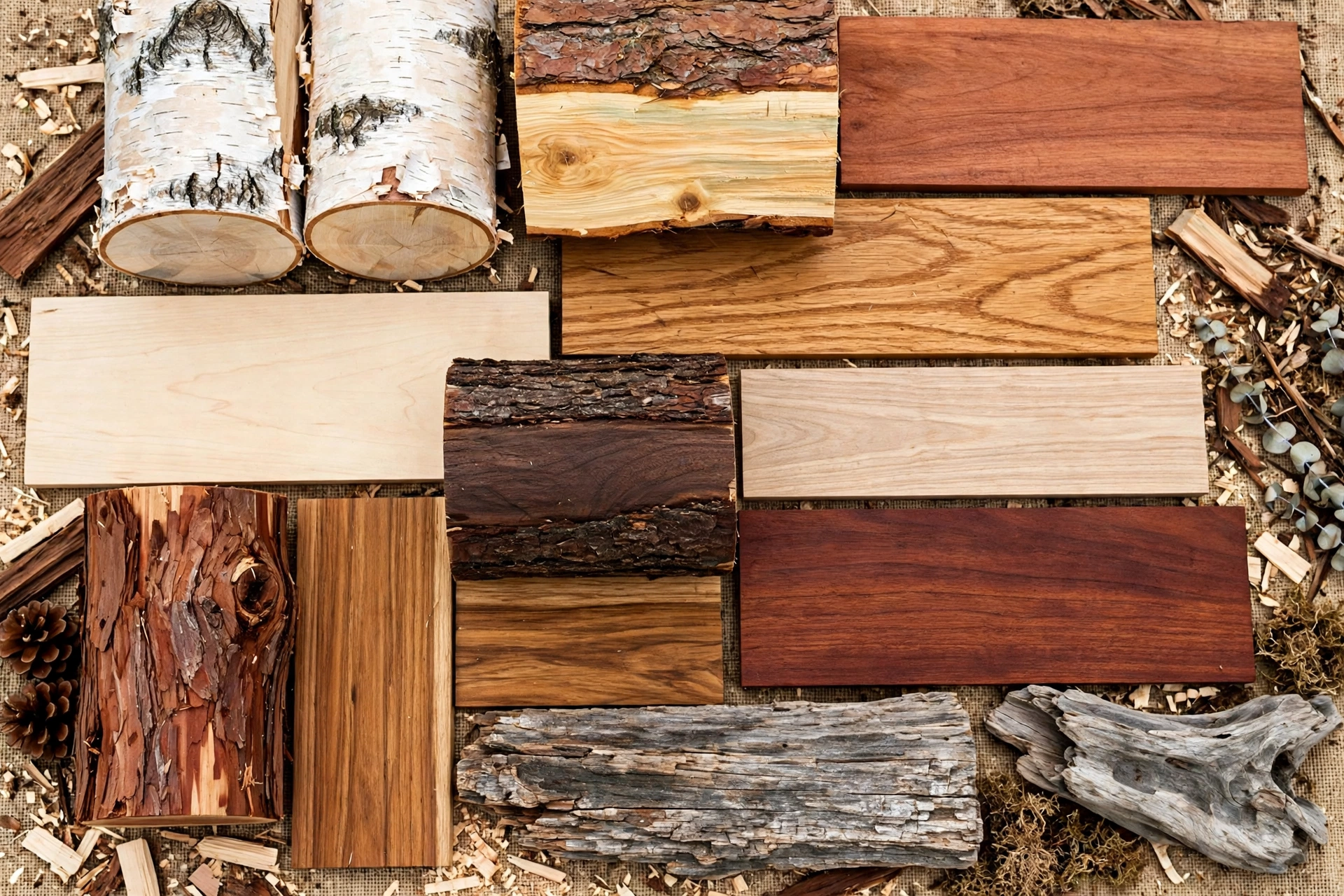
Try it: Photograph the end grain and try the free Wood Identifier on aitreeidentier.site — it can help narrow down the timber type.
Introduction
A pile of logs, a reclaimed plank, or a piece of furniture can all prompt the same question: what wood is this? Knowing the answer matters. Different woods have different strengths, weights, durability, and workability. Oak is strong and durable outdoors. Pine is light and easy to work but soft. Teak resists water. Walnut is prized for its colour and figure.
Hardwood vs Softwood — What the Terms Really Mean
The terms hardwood and softwood are botanical, not a simple measure of hardness. Hardwoods come from broadleaved trees, such as oak, ash, beech, and walnut. Softwoods come from conifers, such as pine, spruce, fir, and cedar.
Key Features to Check
When you examine a piece of timber, check these features in order. Colour: Note the colour of the heartwood — the inner, older wood — and the sapwood — the outer, paler ring. Oak heartwood is warm brown. Walnut is dark brown with a purplish tinge. Ash is pale, almost white. Pine is pale yellow.
Identifying Common Timbers
Oak is heavy, hard, warm brown, with a bold grain and large pores. On a quarter-sawn face, it shows distinctive ray flecks. It is durable outdoors and is a classic for furniture, flooring, and beams. Ash is pale, heavy, and hard, with a straight, open grain and a ring-porous end grain. It is strong and flexible, traditionally used for tool handles and sports equipment. Beech is pale pinkish-brown, heavy, and hard, with a fine, even texture and small ray flecks. It is not durable outdoors but is excellent for indoor furniture and turning. Pine is light, soft, pale yellow, with a simple grain, knots, and a resinous smell. It is easy to work and widely used for construction and furniture, but it dents easily. Walnut is dark brown, moderately heavy, with a rich, wavy grain and a smooth texture. It is prized for fine furniture and veneers. Teak is golden-brown, oily, heavy, and very durable outdoors, with a straight grain and a leathery smell. Cedar is light, soft, reddish-brown, with a strong, pleasant smell and good natural durability. It is often used for cladding, decking, and chests.
Reading the End Grain: Pores, Rays, and Growth Rings
The end grain — the surface you see when you cut across a log — is the most informative face of any piece of timber, and learning to read it is the key to identifying wood. Start by looking for pores, the tiny holes that carried water up the tree. Ring-porous woods, such as oak, ash, and sweet chestnut, have a clear band of large pores in the earlywood of each growth ring, with smaller pores in the latewood, which makes the rings easy to see. Diffuse-porous woods, such as beech, birch, and maple, have small pores spread evenly across the ring, so the rings are fainter and the texture looks smoother. Softwoods have no pores at all: their end grain shows only growth rings and resin canals, which is itself a useful clue.
Next, look for rays — the pale lines that run from the centre of the log outwards, like the spokes of a wheel. Oak has very wide, obvious rays that appear as flecks on a quarter-sawn face, while beech has smaller but still visible rays, and pine has rays so fine that you need a hand lens to see them. Finally, look at the growth rings themselves: wide rings usually mean fast growth in good conditions, narrow rings mean slow growth, and a sudden change in ring width can tell you about the tree's history. With a hand lens and a clean, sanded end grain, you can see all of this in a few minutes, and it will narrow your identification far more reliably than colour alone.
Wood for Different Uses: Strength, Durability, and Workability
Knowing a wood's identity is only half the story; the other half is knowing what it is good for. Oak is strong, heavy, and durable, which is why it has been used for beams, ships, and outdoor furniture for centuries, but it is hard to work and it can stain if it gets wet. Ash is strong and flexible, which made it the traditional choice for tool handles, sports equipment, and cartwheels, though it is not durable outdoors. Beech is hard and heavy with a fine texture, excellent for indoor furniture and turning, but it rots quickly outside. Pine is light, soft, and easy to work, which makes it popular for construction and simple furniture, but it dents easily and needs protection outdoors.
Walnut is prized for fine furniture because of its rich colour and figure, but it is expensive and should be used where it will be seen. Teak is naturally oily and very durable outdoors, which is why it is used for garden furniture and boats, but its price reflects that quality. Cedar is light, aromatic, and naturally resistant to rot and insects, making it a good choice for cladding and chests. When you choose wood for a project, match the species to the job: strength for a beam, durability for outdoor use, stability for a table top, and beauty for a visible surface. A wood that is perfect for one job can be a poor choice for another.
Practical Steps for Identification
1. Clean a small area of end grain with sandpaper so you can see the structure clearly. 2. Note colour, weight, hardness, grain, and smell. 3. Use a hand lens to check for pores, rays, and growth rings on the end grain. 4. Compare with a reference sample or a trusted guide, using several features together. 5. If the wood is painted, stained, or very old, look for an unexposed area — under a table, inside a drawer, or on a fresh cut — where the natural wood is visible.
Common Mistakes to Avoid
- Relying on colour alone: Colour changes with age, light, and finish. Use grain, weight, and end grain as well.
- Confusing stain with species: A dark stain can make pine look like walnut. Check the end grain and weight.
- Ignoring moisture content: Wet wood is heavier and darker than dry wood of the same species.
- Forgetting that timber varies: Wood from the same species can vary in colour and grain depending on where it grew.
- Assuming all reclaimed wood is old or valuable: Reclaimed timber can be any species, and its value depends on species, condition, and size.
- Cutting into a valuable piece unnecessarily: Take a small sample from a hidden area, or sand a small patch, rather than cutting a large piece.
FAQ
Can I identify wood from a photo alone? A clear photo of the end grain, plus the face grain and a note of weight and smell, can narrow it down considerably, but a certain identification often needs a clean end-grain sample and several features together.
What is the easiest wood to identify? Oak is one of the easiest, thanks to its bold grain, large pores, and ray flecks. Pine is also easy, with its light colour, knots, and resinous smell.
Is all dark wood walnut? No. Many woods are stained dark, and several species, such as mahogany, teak, and stained oak, can look similar. Check the grain, weight, and end grain before concluding it is walnut.
How can I tell if wood is suitable for outdoor use? Check the species' natural durability. Oak, teak, cedar, and sweet chestnut are naturally durable. Pine, beech, and ash are not durable outdoors unless treated. When in doubt, check a durability table for the species.
How do I tell the difference between oak and ash? Both are ring-porous hardwoods, but oak has very wide, obvious rays that show as flecks on the face grain, while ash has finer rays and a more open, straight grain. Oak heartwood is warm brown; ash is pale, almost white.
Does old wood look different from new wood? Yes. Sunlight darkens most woods over time, and some, such as cherry, deepen dramatically in colour with age. Always check an unexposed surface, such as the underside of a board, to see the wood's natural colour.
Conclusion
Identifying timber is a matter of looking closely and using several clues together. Start with the end grain — pores or no pores, rays, and growth rings — then add colour, grain, weight, hardness, and smell.
Safety note: Never eat or use any plant material based on an AI identification alone. Wear a dust mask and eye protection when cutting or sanding wood, as some timbers can irritate skin, eyes, or lungs. If you are unsure about a timber's safety, especially for food contact or children's toys, consult a local expert.