
Try it: Identify your tree first, then water it right — try the free Tree Identifier on aitreeidentier.site to confirm the species and its needs.
Introduction
Water is the single most important factor for a young tree, and the most common reason new trees die is not disease or pests, but drought. At the same time, overwatering can be just as damaging, drowning roots and inviting rot. The trick is to water the right amount, at the right frequency, in the right place — and to change that as the tree grows.
How Much Water Does a Young Tree Need?
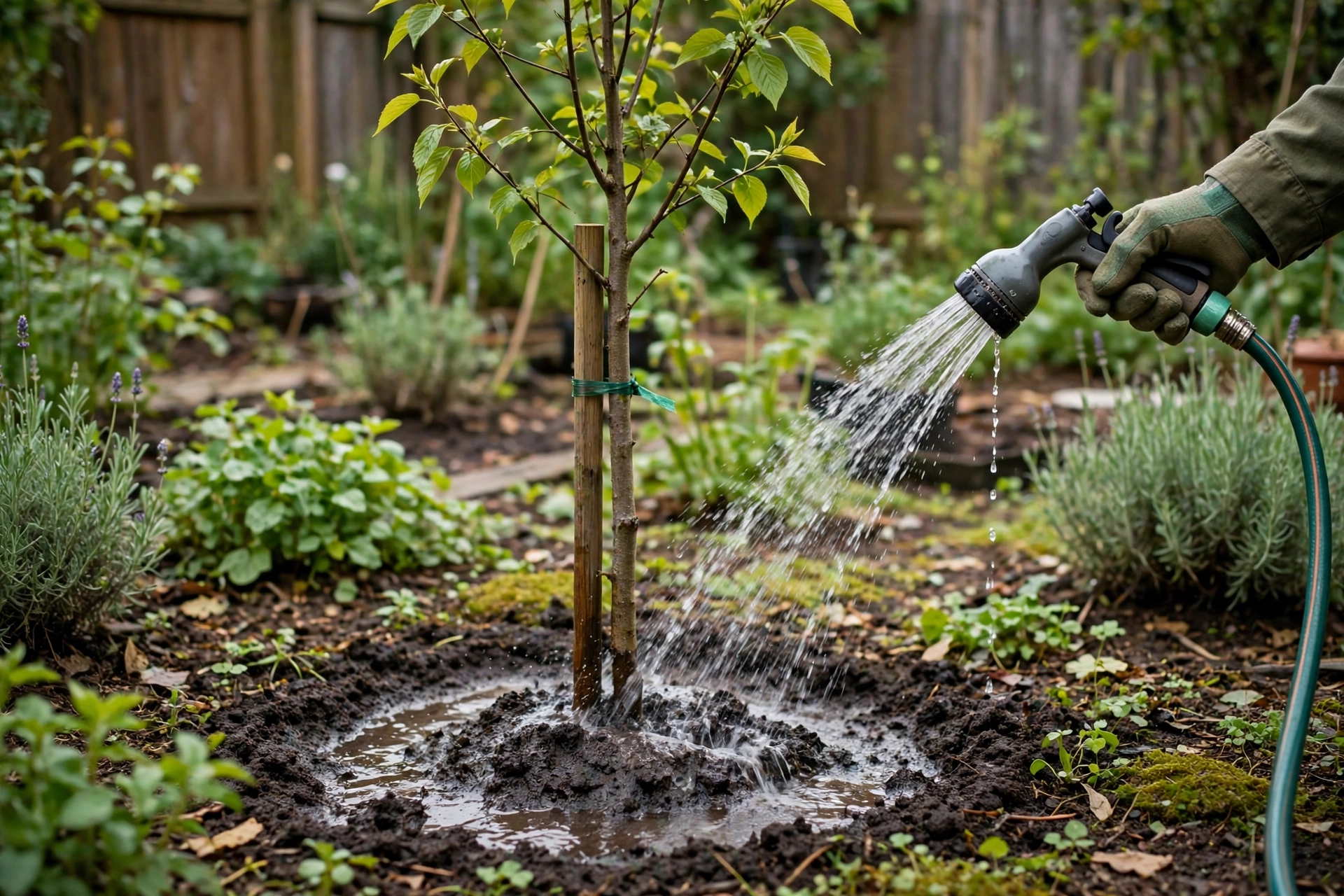
A newly planted tree has a small root system that has not yet spread into the surrounding soil. It depends entirely on the water you give it, and on rain that falls in its planting hole. A useful starting point is 10–20 litres per watering for a small tree, and 20–40 litres for a larger standard, applied slowly so it soaks in rather than running off. Water deeply and infrequently, rather than a little every day. Deep watering encourages roots to grow downwards, where soil stays moist longer.
How Often Should You Water?
Frequency depends on weather, soil, and season. Sandy soil drains quickly and may need watering twice a week in summer. Clay soil holds water longer and may need watering only once a week or less. Hot, windy weather dries soil far faster than cool, still weather. A tree in full sun needs more water than the same tree in shade. In spring and autumn, when the tree is growing but the weather is cooler, water less often.
Watering Mature Trees
Mature trees have extensive root systems and usually find enough water on their own, even in dry summers. They may look stressed — leaves may wilt, yellow, or drop early — but they will usually recover when rain returns. Watering a mature tree is most important during prolonged drought, especially for trees on shallow, sandy, or compacted soil, and for trees already stressed by disease, construction, or root damage. When you do water a mature tree, water the whole root zone, not just the trunk.
How Soil Type Changes Everything
Soil type is the single biggest factor in how often you need to water, and it is worth understanding your own soil before you set any routine. Sandy soil drains quickly and holds little water, so a tree in sand may need watering twice a week in summer, even after rain. Loamy soil is the gardener's friend: it holds moisture well but still drains, so once a week is often enough. Clay soil holds water for a long time, and a tree in clay may need watering only every ten days or so in summer — but when clay dries out, it cracks and becomes very hard, and water runs off the surface instead of soaking in. If your clay soil has dried to a hard crust, water very slowly, or in two short sessions an hour apart, so the water has time to soak in.
You can test your soil's drainage in a minute. Dig a hole about 30 centimetres deep, fill it with water, and time how long it takes to drain. If it drains within an hour, your soil is free-draining and you will need to water often. If it is still full after four hours, drainage is poor and you should water less often and more carefully, because overwatering is a real risk. Improving the soil with compost helps in both cases: compost helps sandy soil hold water and helps clay soil drain, which is why mulching with compost is one of the best watering strategies of all.
Watering in Drought: Saving a Tree When Rain Fails
In a prolonged drought, even mature trees can suffer, and young trees can die within weeks. The first sign is often leaves that wilt in the afternoon and recover overnight; if they stay wilted in the morning, the tree is in real trouble. Water deeply and slowly, giving a young tree 20 to 40 litres in one session, and a mature tree as much as you can manage over the whole root zone. A soaker hose left running on a low trickle for several hours is far more effective than a quick blast from a hose, because slow water soaks deep into the soil instead of running off the surface.
Prioritise your watering when water is scarce. Young trees planted in the last two years come first, because they have small root systems and no reserves. Next come fruit trees while their fruit is developing, and trees that are already stressed by disease or construction. Mature, healthy trees in good soil can usually wait for rain, even if they drop some leaves early — that is a survival strategy, not a death sentence. Mulch widely to keep every drop in the soil, and avoid fertilising during a drought, because fertiliser encourages new growth that the tree cannot support.
Best Time of Day and Best Methods
Water early in the morning or in the evening, when the sun is low and evaporation is low. Watering in the heat of the day wastes water and can scorch leaves if water sits on them. Avoid wetting the trunk and foliage where possible — water the soil, not the tree. Useful methods include a watering can or hose on a slow trickle, a soaker hose laid in a spiral around the tree, or a drip system for a group of trees.
Signs Your Tree Needs Water — or Has Too Much
A thirsty tree may show wilting, drooping, or curling leaves, leaf edges that turn brown and crisp, early autumn colour, or premature leaf drop. Growth may be slow, and new shoots may be short. These signs are a prompt to water deeply and check the soil. An overwatered tree can look surprisingly similar. Leaves may turn yellow, wilt, and drop, but the soil will be soggy and may smell sour. Roots that sit in waterlogged soil cannot breathe, and they begin to rot.
Common Mistakes to Avoid
- Watering a little every day: This creates shallow roots and wastes water.
- Watering only at the trunk: Roots are spread out — water the whole root zone.
- Watering on a fixed schedule: Always check the soil and the weather first.
- Assuming rain has done the job: Light rain may wet only the top centimetre. Check the soil after rain.
- Stopping too soon: A tree needs regular watering for at least two years after planting.
- Overwatering in clay soil: Clay holds water; let it dry a little between waterings.
FAQ
How do I know if I have watered enough? After watering, the soil should be moist 20–30 cm down for a young tree. Push a trowel in and check. If only the top few centimetres are wet, you need to water more slowly, for longer.
Should I water trees in winter? Usually not, but in a dry winter with no rain for weeks, a newly planted evergreen may need a drink on a mild day when the ground is not frozen. Deciduous trees need very little water while dormant.
Is tap water safe for trees? Yes, in most cases. Rainwater is ideal, but tap water is fine. If your water is very hard or salty, it is still better than no water in a drought.
Can I use a sprinkler for trees? Yes, but use it on a low setting for a long time so water soaks in, and avoid wetting the trunk and leaves for hours at a time, which can encourage fungal disease.
How can I tell if my soil is dry enough to need watering? Push a trowel or a screwdriver 15 to 20 centimetres into the soil near the tree. If it comes out dry and the soil crumbles to dust, water deeply. If the soil sticks to the tool and feels cool and moist, wait a day or two and check again.
Is rainwater better than tap water for trees? Rainwater is slightly better, because it is soft and free of chlorine, and trees respond well to it. But tap water is perfectly safe for almost all trees, and in a dry spell any water is far better than none.
Conclusion
Tree watering is not about a fixed recipe, but about paying attention. Young trees need deep, regular watering for their first two years. Mature trees need help mainly in drought. Always check the soil before you water, water the whole root zone slowly, and adjust for weather and soil type. Get watering right, and you will prevent more tree problems than any fertiliser or spray ever could.
Safety note: Never eat or use any part of a tree based on an AI identification alone. If you are unsure about a species or its safety, consult a local expert.