
Try it: Confirm the species before you move it — try the free Tree Identifier on aitreeidentier.site, as care needs vary by tree type.
Introduction
Sometimes a tree ends up in the wrong place. It may have been planted too close to a house, it may be in the way of a building project, or it may simply have outgrown a small garden. Moving it — transplanting — is possible, but it is one of the most stressful things you can do to a tree.
When to Transplant
Timing is the most important decision. The best time to transplant most deciduous trees is when they are dormant — late autumn to early spring — when they have lost their leaves and are not losing water through transpiration. Autumn is often ideal, as the soil is still warm and roots can grow before winter. Early spring, just before buds open, is also good.
How Large a Root Ball Do You Need?
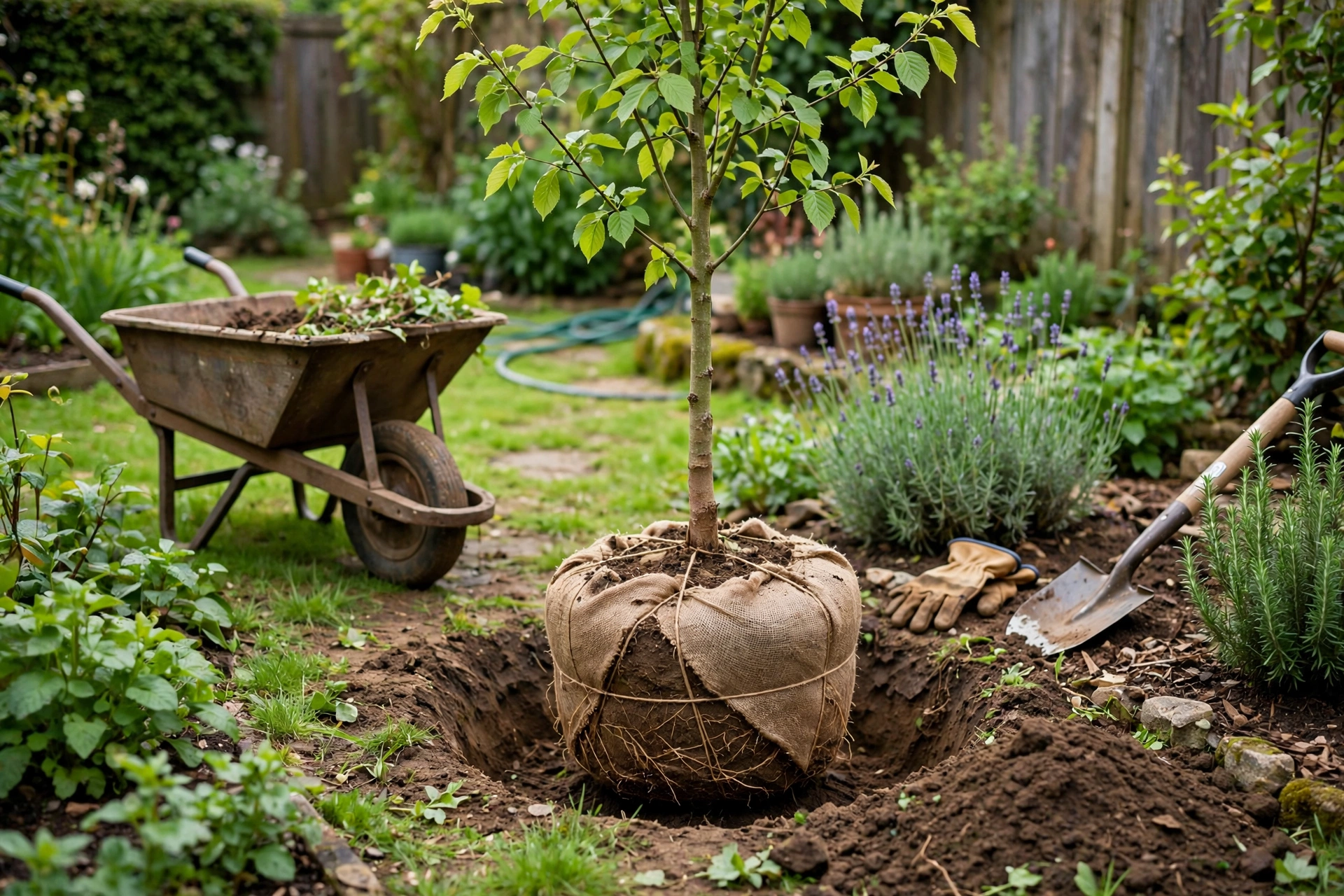
A tree's roots extend well beyond its canopy, but you cannot take them all. The aim is to take as large a root ball as you can manage, while keeping it intact. As a starting point, the root ball should be at least 30 cm across for every 2.5 cm of trunk diameter, measured at chest height. A tree with a 5 cm trunk needs a root ball at least 60 cm across, and larger is better.
Which Trees Transplant Well — and Which Do Not
Not all trees move equally well, and knowing this before you start can save you a great deal of disappointment. Trees with fibrous, spreading root systems, such as birch, maple, alder, and many fruit trees, usually transplant well, because they regrow new roots quickly from the cut ends. Trees with a deep taproot, such as oak, walnut, and sweet chestnut, are much harder to move, because the taproot is easily damaged and the tree depends on it for water. Conifers vary: yew and cedar can move surprisingly well if they are young, while pine and spruce are more sensitive and resent root disturbance. Large, old trees of any species are risky to move, because they have lost the vigour to regrow roots quickly.
Age matters as much as species. A tree under five years old, with a trunk less than 5 centimetres across, will usually recover within a year or two. A tree of ten years or more may take three to five years to re-establish, and it may never regain its former vigour. If the tree you want to move is large, old, or a poor transplanter, think honestly about whether it is kinder to leave it where it is, or to plant a new tree in the right place instead. A new tree, planted correctly, will often overtake a struggling transplant within a few years, and it will cost far less in time, effort, and worry.
Preparing the New Hole Before You Dig Up the Tree
The new hole should be ready before the tree comes out of the ground, because every minute the roots spend exposed to air and sun increases transplant shock. Dig the hole two to three times as wide as the expected root ball, but no deeper than the root ball itself, and loosen the soil around the edges so new roots can spread into it. Keep the topsoil separate from the subsoil, and put the topsoil back around the roots when you backfill. Water the hole the day before if the soil is dry, and have mulch, a watering can or hose, and any staking materials ready beside it.
Check the new site as carefully as you would for a new tree: the right light, the right soil, enough space for the mature tree, and no overhead wires or underground services in the way. A transplanted tree needs a good site more than a healthy tree does, because it has fewer roots to cope with a poor one. If the new site is exposed to wind, plan a windbreak or a temporary screen for the first year. A little preparation before the move makes the move itself calmer, quicker, and far more likely to succeed.
Step 1: Prepare the Tree in Advance
If you know months ahead that you will move a tree, you can prepare it by root pruning. In the season before the move, dig a trench in a circle around the tree, at the distance where you will eventually cut the root ball, and cut through the roots cleanly. Backfill the trench with loose soil.
Step 2: Dig Up the Tree
Water the tree the day before, and dig on a cool, calm day. Mark a circle around the tree at the edge of the planned root ball, and dig a trench outside that circle, working inwards and downwards. Use a sharp spade to cut roots cleanly, rather than tearing them. As you go deeper, work under the root ball to free it, keeping as much soil attached to the roots as possible.
Step 3: Replant Quickly and Correctly
Plant the tree as soon as possible, ideally the same day. Place it in the prepared hole, with the root collar — where trunk meets roots — level with the surrounding soil. Check that the tree is upright and facing the right way. Backfill with the soil you dug out, firming gently to remove air pockets, and water well as you go.
Aftercare: The First Two Years
Aftercare is where most transplants succeed or fail. Water deeply and regularly for at least two years, especially in dry weather. A transplanted tree has lost many of its roots and cannot find water as easily as before. Water the whole root ball and the surrounding soil, not just the trunk.
Common Mistakes to Avoid
- Moving in summer: Heat and leaf water loss make transplant shock far worse.
- Taking too small a root ball: Small root balls mean fewer roots and a slower recovery.
- Letting roots dry out: Keep the root ball moist and covered at all times.
- Planting too deep: The root collar must be at soil level.
- Moving by the trunk: Lift and carry by the root ball, not the stem.
- Over-pruning at the time of moving: The tree needs leaves to recover.
- Stopping watering too soon: A transplanted tree needs two years of attentive watering.
FAQ
What is the best time of year to transplant a tree? Late autumn to early spring, while the tree is dormant, is best for most deciduous trees. Early autumn or early spring is best for evergreens. Avoid summer and frozen or waterlogged ground.
How big a tree can I transplant myself? A tree under 2–3 metres tall with a trunk under 5 cm in diameter is usually manageable with help. Larger trees need professional equipment and expertise.
Will a transplanted tree survive? Young, healthy trees moved at the right time with a good root ball and good aftercare have a high survival rate. Older, larger, or already stressed trees have a lower chance, and some species transplant better than others.
How long does it take for a transplanted tree to recover? Expect at least one to two years for a small tree, and longer for a larger one. Growth may be slow in the first year as roots re-establish. Regular watering and patience are essential.
Should I prune a tree before transplanting it? Do not prune heavily before or at the time of moving. The tree needs its leaves to make the energy for new roots. Remove only dead or damaged branches, and leave shaping until the tree has recovered, usually in its second year after moving.
Can I transplant a tree in a pot? Yes, and potted trees are the easiest to move, because their roots are contained. Water the pot well the day before, slide the tree out carefully, and plant it at the same depth. Check for circling roots and tease them out before planting.
Conclusion
Transplanting a tree is possible, but it is a serious undertaking that should not be done lightly. Choose the right season, prepare the tree and the new hole in advance, take as large a root ball as you can manage, keep roots moist, plant at the right depth, and water attentively for two years.
Safety note: Never eat or use any part of a tree based on an AI identification alone. Transplanting large trees can be dangerous — if the tree is large, near buildings or power lines, or the root ball is too heavy to lift safely, consult a qualified arborist.