
Try it: Before you mulch, confirm what you are growing — try the free Tree Identifier on aitreeidentier.site with a photo of the leaves or bark.
Introduction
Mulch is one of the simplest, cheapest, and most effective things you can do for a tree. A layer of organic material around the base mimics the leaf litter of a woodland floor, keeping soil moist, cool, and full of life. It suppresses weeds, protects roots from heat and frost, and slowly feeds the soil as it breaks down. Yet mulch is also one of the most commonly misused garden materials. Piled against the trunk, spread too thick, or made from the wrong material, it can rot bark, harbour pests, and suffocate roots.
Why Mulch Matters
In a natural woodland, trees are never bare at the base. Fallen leaves, twigs, and dead wood build up into a rich, living layer that holds moisture, feeds fungi and worms, and protects the soil. In a garden, that layer is often removed — grass is mown right up to the trunk, soil is left bare, and roots are exposed to sun, drought, and mower damage. Mulch restores that protective layer. It reduces evaporation, so soil stays moist longer after rain or watering. It keeps soil temperature more stable, protecting roots from summer heat and winter cold.
Best Mulch Materials for Trees
Not all mulches are equal. The best materials for trees are coarse, organic, and slow to break down. Good choices include bark chips, wood chips, shredded bark, leaf mould, composted bark, and well-rotted compost. Wood chips from arborists are excellent and often free — just let fresh chips age for a few weeks before use, and avoid chips from diseased trees. Leaf mould is superb for woodland trees and improves soil gently over time.
Mulch and Soil Life: What Happens Underground
The most important work mulch does is invisible. Beneath a mulch layer, the soil stays moist and cool, and that stable environment is exactly what earthworms, fungi, and bacteria need to thrive. Worms pull fragments of mulch down into the soil, aerating it as they go and leaving behind castings that are rich in nutrients. Fungi form networks that connect to tree roots, helping the tree absorb water and minerals in exchange for sugars from the leaves. A single handful of healthy, mulched soil can contain more living organisms than there are people on Earth, and all of them are working for your tree.
This is why bare soil is so damaging. Without a mulch layer, soil dries out, heats up, and bakes into a hard crust that water runs off instead of soaking into. The organisms that keep soil alive die back, and the tree's fine feeder roots, which live in the top few centimetres of soil, suffer first. Mulch restores the conditions of a woodland floor, where the soil is never bare and never baked. Over time, a mulched tree develops a dense mat of fine roots just under the mulch, exactly where water and nutrients are most available, and that is why mulched trees grow faster and cope better with drought.
Choosing Mulch for Different Situations
The best mulch depends on the tree and the situation. For a newly planted tree, coarse bark chips are ideal: they suppress weeds well, break down slowly, and stay in place. For a woodland garden, leaf mould is perfect, because it mimics the natural leaf litter and improves the soil gently. For a fruit tree, well-rotted compost is hard to beat, because it feeds the tree as well as mulching it, replacing the nutrients removed by each harvest. For a large tree in a lawn, wood chips from a local tree surgeon are excellent and often free — ask for a load and let it age for a few weeks before spreading it.
Avoid a few materials. Fresh grass clippings in thick layers mat down, heat up, and can smell; use them thinly or compost them first. Fresh sawdust can lock up nitrogen as it breaks down, so use it only in thin layers mixed with other material. Rubber mulch and plastic sheeting may suppress weeds, but they do not feed the soil and they can overheat in summer, so they are a poor choice around trees. Peat moss is best avoided for environmental reasons, and it can become water-repellent when it dries out. When in doubt, choose a coarse, local, organic material, and your tree will thank you for it.
How to Apply Mulch Correctly
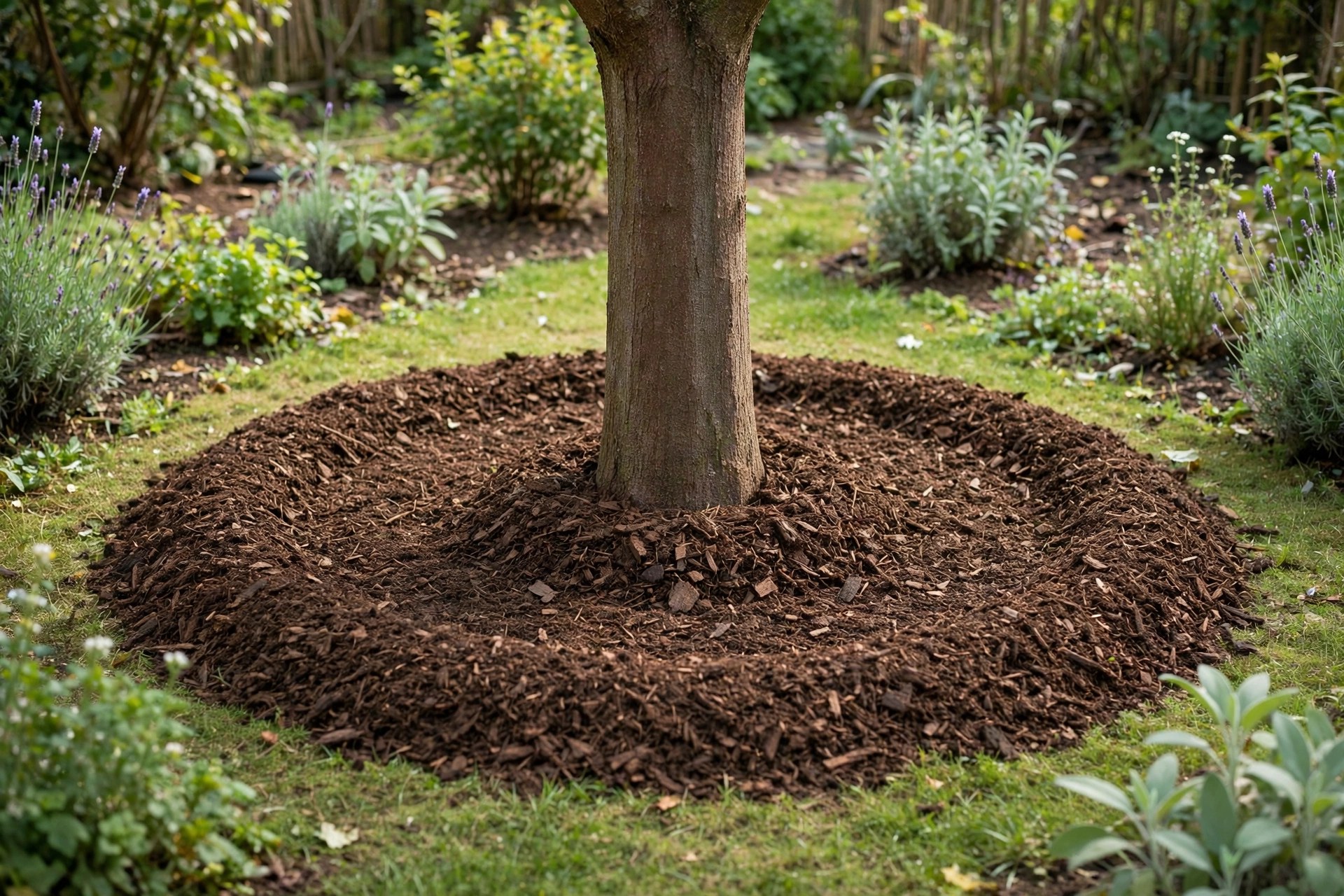
Apply mulch in a wide ring, not a narrow pile. For a young tree, mulch out to at least the edge of the planting hole, and ideally to the drip line — the edge of the canopy — as the tree grows. Spread mulch 5–8 cm thick. That is enough to suppress weeds and retain moisture without suffocating the soil. Thinner mulch dries out and lets weeds through.
When and How Often to Mulch
The best times to mulch are spring, after the soil has warmed and before summer drought, and autumn, to protect roots through winter. Avoid mulching on frozen or very dry soil. If the soil is dry, water first. Top up annually, but do not keep adding layer upon layer without checking depth. If mulch has built up to more than 10 cm, remove some old material before adding new. Over years, mulch will break down and disappear into the soil — that is a sign it is working.
Common Mistakes to Avoid
- The mulch volcano: Piling mulch against the trunk causes bark rot, invites pests, and can kill a young tree.
- Too thick: More than 10 cm of mulch can suffocate roots and stay soggy.
- Too thin: Less than 3 cm does little to suppress weeds or retain moisture.
- Too narrow: A tiny ring around the trunk helps little. Go wide.
- Using fresh, uncomposted material against roots: Fresh wood chips can temporarily lock up nitrogen, and fresh manure can burn roots.
- Mulching over weeds without clearing them: Perennial weeds will grow through. Clear them first.
- Forgetting to water before mulching: Mulch on dry soil locks in dryness.
FAQ
How thick should mulch be around a tree? Aim for 5–8 cm. That is thick enough to work and thin enough to let air and water through. Check the depth each year and top up as it breaks down.
Can I use grass clippings as mulch? You can, in thin layers mixed with other material, but thick layers of fresh clippings mat down, heat up, and can smell. Let them dry first, or compost them before use.
Should I remove old mulch before adding new mulch? If the old layer is still thick, rake it back and check the depth. Remove excess material, or fork it lightly to aerate it, before adding a fresh top-up.
Does mulch attract pests? Mulch can provide shelter for slugs and some insects, but it also shelters beneficial organisms. Keeping mulch away from the trunk and not overdoing the depth minimises problems. Avoid mulch from diseased trees.
Can I mulch in winter? Yes, autumn mulching is one of the best times to mulch, because it protects roots from frost and the mulch will be partly broken down by spring. Just make sure the soil is moist before you mulch, and do not mulch over frozen ground.
Will mulch stop weeds completely? A good mulch layer will suppress most annual weeds, but tough perennial weeds such as bindweed and couch grass can still push through. Clear them before mulching, and pull any that appear while they are still small.
Conclusion
Mulching is simple, but doing it right matters. Use a coarse, organic mulch, spread it wide and 5–8 cm thick, and keep it away from the trunk. Water before you mulch, top up once a year, and clear weeds first. Done this way, mulch will save you watering, weeding, and worry, and it will help your tree grow stronger roots and a healthier canopy. Done badly, as a volcano against the trunk, it can do more harm than good. The doughnut, not the volcano, is the shape to remember.
Safety note: Never eat or use any plant material based on an AI identification alone. If you are unsure about a mulch material, especially wood chips from an unknown tree, consult a local expert before using it around food trees or in a garden where children play.