
Try it: Try the free Tree Identifier on aitreeidentier.site — identify your tree first, since leaf-out times vary widely between species.
Introduction
A bare tree in late winter can look alarming, especially if your neighbours' trees are already in leaf. Before you reach for the chainsaw, stop: many healthy trees are simply dormant, waiting for the right temperature and day length to wake up.
The good news is that telling a dead tree from a dormant one is usually straightforward. A few simple, gentle tests — on the bark, buds, twigs, and roots — will give you a clear answer in most cases.
Dormancy and Identifying Your Tree
In autumn, deciduous trees drop their leaves and enter dormancy, a resting state that protects them from cold. Growth stops, buds close tight, and the tree conserves energy through winter. In spring, rising temperatures and longer days trigger buds to swell and open, but not all species wake at the same time.
Some trees, such as oaks, walnuts, and ashes, leaf out late and can look dead well into spring while other species are already green. A bare tree in March or April is often perfectly normal; the same tree bare in midsummer is a much stronger warning sign.
Before any test, work out what species you have and when it normally leafs out in your area. A photo-based identification or a leaf or bark check from last season will help. Compare it with similar trees nearby: if every oak on your street is still bare, yours probably is too.
The Tests, in Order
Test 1: Look at the buds
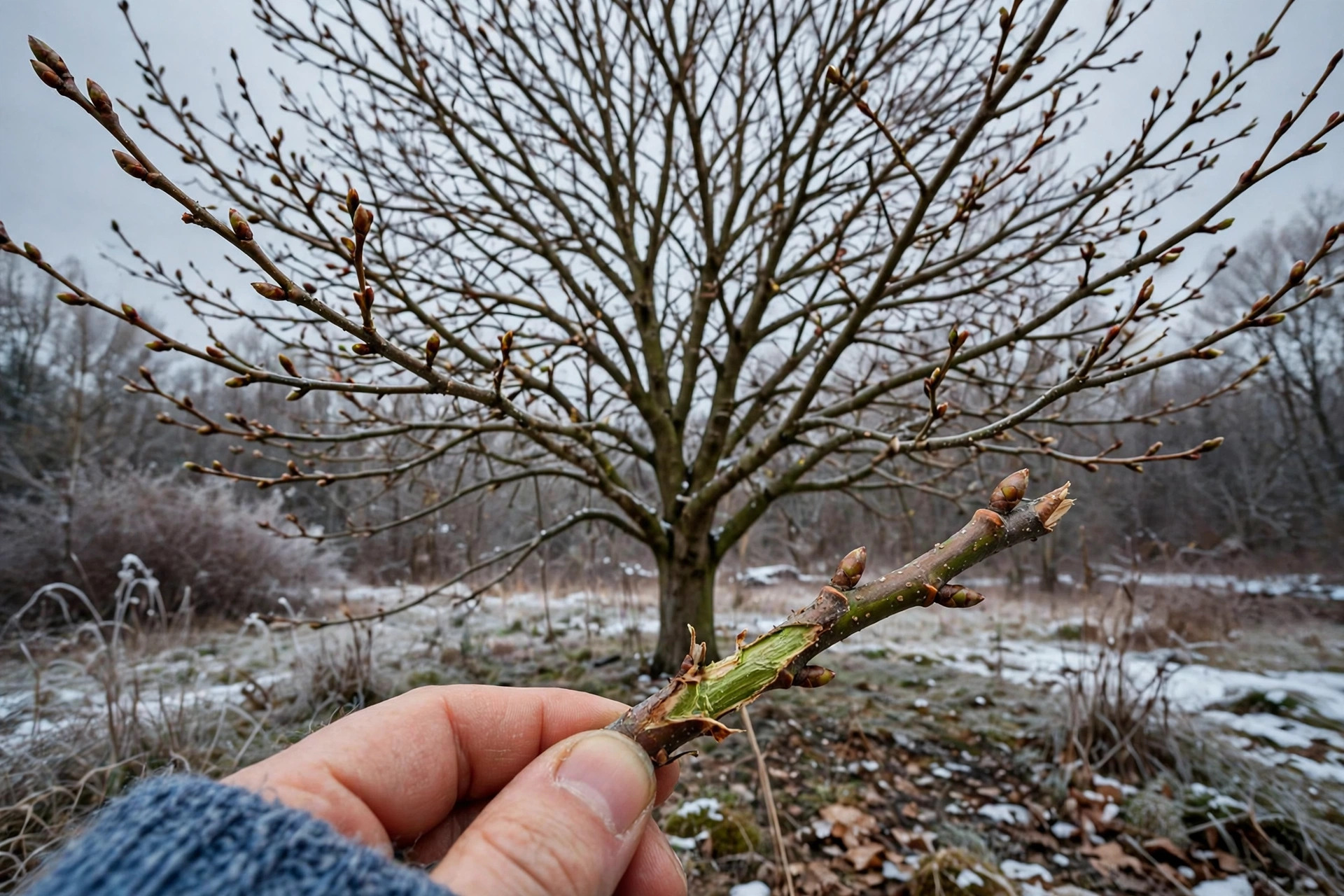
Healthy dormant buds are plump, firm, and closed. Dead buds are dry, shrivelled, brittle, or missing altogether. Gently squeeze a few buds on different branches: if they feel soft and full, the tree is likely alive.
Test 2: The scratch test
This is the most useful test for beginners. Use a fingernail or a small knife to scrape a tiny patch of bark on a small twig. Under the outer bark, living wood shows a thin green layer, the cambium. Brown, dry wood suggests that part is dead. Test several twigs, as dieback often starts at the top.
Test 3: The bend test
Take a small twig and bend it gently. A living twig bends and feels supple, then springs back. A dead twig snaps easily with a dry crack. Do not force large branches — a gentle bend on a pencil-thick twig is enough.
Test 4: Check the bark and trunk
Look closely at the trunk and main branches. Healthy bark is firm and attached; dead bark may be loose, peeling in large sheets, or falling away to reveal dry wood. Mushrooms growing from the trunk, large cracks, or a hollow sound when tapped can point to serious decay.
Test 5: Look at the roots and base
Check the base of the tree for new shoots or suckers, which are a strong sign of life, even if the crown looks bare. Look for heaving soil, exposed roots, or a worsening lean, which can mean root damage. If the soil is very dry, water deeply and wait a few weeks.
What the Results Mean
If the buds are plump, the scratch test shows green, and twigs bend without snapping, your tree is almost certainly dormant or just slow. Give it time, water it if the soil is dry, and check again in two to three weeks.
If every test shows brown, dry, brittle wood, no buds, peeling bark, and no new growth by midsummer, the tree is probably dead. Even then, wait until the growing season has passed before removing it, unless it is dangerous.
Late-Leafing Species: A Calendar to Keep in Mind
One of the most common causes of worry is simply not knowing when a species normally leafs out. Early species such as willow, birch, and cherry may be in full leaf by early April, while late species such as oak, ash, walnut, and sweet chestnut may not leaf out until May, and in a cold spring they can be bare well into late May. That is a difference of six weeks or more, and during those weeks a healthy oak can look completely dead next to a green birch. The exact timing also varies from year to year: a warm March brings everything forward, while a cold, wet spring delays it. Keep a simple note each year of when each tree in your garden first shows green buds, and after two or three years you will have a personal calendar that tells you whether this year's delay is normal or a cause for concern.
When a Tree Is Partly Alive: Dieback and What It Means
Many trees are neither fully alive nor fully dead, but somewhere in between, with dieback in part of the crown. Dieback at the top of the tree often points to a problem underground — drought, root damage, or compacted soil — because the highest branches are the furthest from the roots and the first to suffer when water is short. Dieback on one side may point to damage on that side, such as a trench dug through the roots, or a wound on the trunk. A tree with dieback can often be saved if the cause is found and fixed, and if the dead wood is pruned out carefully to prevent disease entering through it.
Prune dead branches back to healthy wood, making clean cuts just outside the branch collar, and dispose of the prunings rather than leaving them under the tree. Do not prune a large amount at once, because a stressed tree needs all the leaves it has left to make energy. Water deeply in dry weather, mulch widely around the base, and give the tree a full growing season to respond. If new shoots appear from the lower branches or the trunk, the tree is fighting back, and with patience it may recover a new, if smaller, crown. If the dieback spreads despite good care, ask an arborist to assess whether the tree can be saved or should be removed for safety.
When to Wait, and When to Act
Wait if it is still spring, the tree was healthy last year, and the tests are mixed or unclear. Water during dry spells, mulch around the base, kept clear of the trunk, and avoid fertiliser until you see new growth. Act promptly if the tree is leaning or shows serious decay at the base — call a qualified arborist for an assessment and safe removal.
Common Mistakes Beginners Make
- Judging too early in spring. Late-leafing species look dead for weeks after early species are green.
- Testing only one twig. A single dead twig does not mean a dead tree, so test several branches.
- Scraping large patches of bark. The scratch test needs only a tiny scrape.
- Removing a tree after one dry summer. Drought can make a tree drop leaves early, so water it well and wait.
- Ignoring safety signs. A leaning or weak tree can be dangerous, so get professional advice.
FAQ
How long should I wait before deciding a tree is dead?
Wait until the end of the growing season — usually midsummer at the earliest — unless the tree is dangerous.
Can a tree with no leaves still be alive?
Yes. A dormant tree has no leaves for months each year, and a stressed tree may leaf out very late.
What if only the top of the tree is dead?
Dieback at the top often points to root or water problems, but the lower branches may still be alive. Prune out the dead wood and monitor the tree.
Can a tree come back after looking dead for a whole year? Sometimes, yes. A tree that has been badly stressed by drought or frost may stay bare for a full season and then sprout from the trunk or base the following spring. Wait at least one full growing season before removing a tree that is not dangerous.
Should I water a tree I think is dead? Yes, if the soil is dry. Watering costs little, and if the tree is alive, water may be exactly what it needs to leaf out. If it is truly dead, the water does no harm.
Conclusion
A bare tree is not necessarily a dead tree. Identify the species, check when it normally leafs out, then use the bud, scratch, and bend tests on several branches. If the wood is green and the buds are plump, give the tree time, water, and patience.
Try it: Try the free Tree Identifier on aitreeidentier.site — identify your tree first, since leaf-out times vary widely between species.
Safety disclaimer: Never work on large trees or use sharp tools unsafely based on AI guidance alone. Do not climb a tree, cut large limbs, or remove a tree yourself. Consult a local arborist for any tree that is leaning or damaged.