
Try it: Know your species before you cut — try the free Tree Identifier on aitreeidentier.site, because pruning time varies by tree type.
Introduction
Pruning a young tree is not about making it look tidy today. It is about training its structure for the next fifty years. A young tree that is pruned well develops a strong central leader, well-spaced branches, and a balanced crown that can carry weight, resist wind, and stay healthy.
Why Prune Young Trees?
Young trees need pruning for three main reasons: structure, health, and safety. Structural pruning creates a strong framework. You want one central leader, branches spaced around the trunk, and wide angles where branches join the trunk. Narrow, V-shaped forks are weak and can split as the tree grows. Health pruning removes dead, diseased, damaged, or crossing branches before they become a problem.
When to Prune
Timing depends on the species. For most deciduous trees, late winter or early spring, while the tree is dormant and before buds open, is the best time. You can see the branch structure clearly without leaves, and the tree will heal quickly as growth starts. Avoid pruning in late autumn, when wounds heal slowly and frost can damage fresh cuts.
Tools You Need
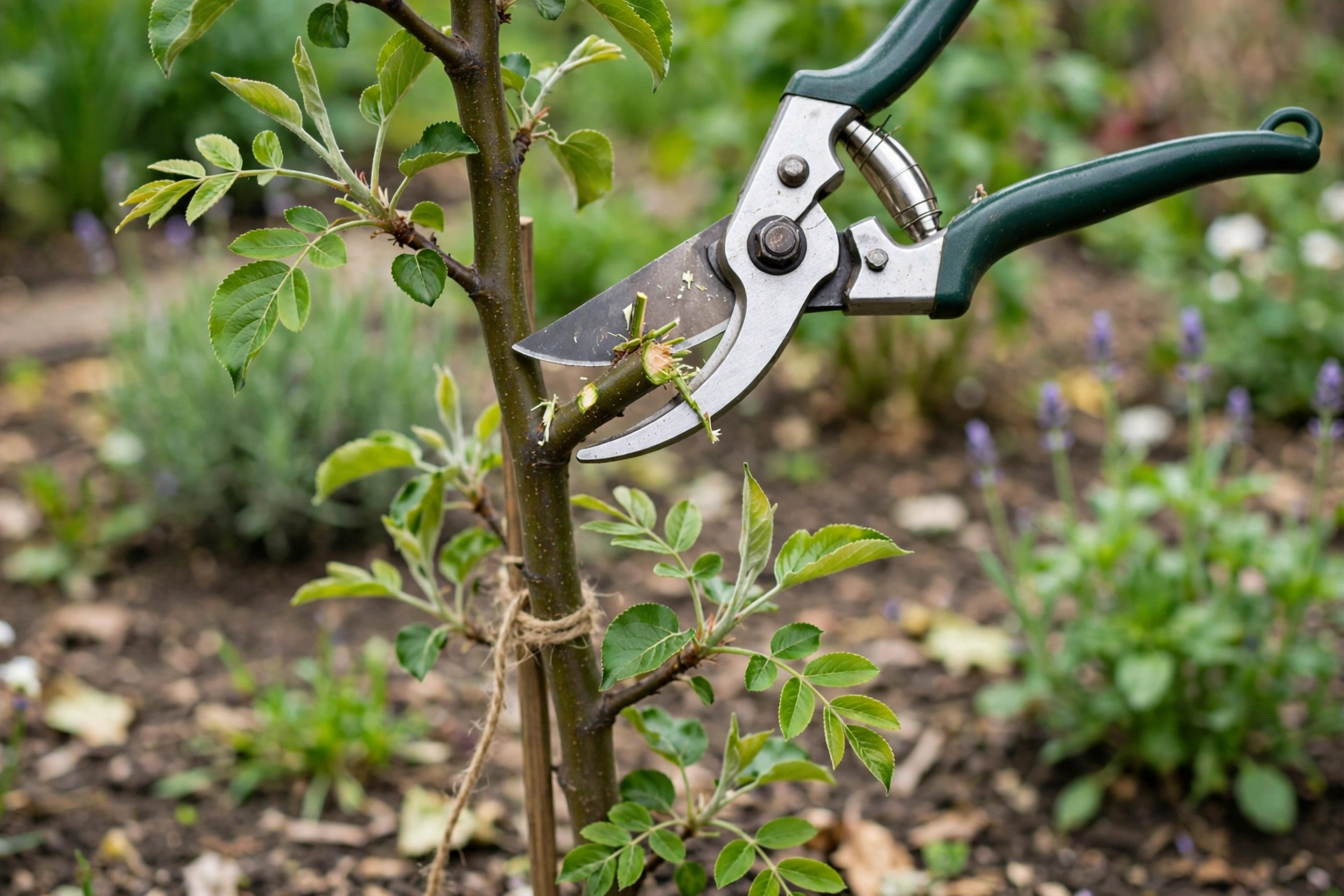
Use the right tool for the branch size. Secateurs are for branches up to about 2 cm thick. Loppers handle branches up to about 5 cm. A sharp pruning saw is needed for anything larger. Never use a tool that crushes or tears — a clean cut heals far better than a ragged one. Keep tools sharp and clean.
Step-by-Step: Pruning a Young Tree
Step 1: Stand back and look. Walk around the tree and decide what its final shape should be. Identify the central leader — the strongest, straightest upright stem — and keep it. Step 2: Remove dead, damaged, and diseased wood first. Cut back to healthy wood, well below any discoloured or dead tissue. Step 3: Remove crossing and rubbing branches. If two branches cross or rub, keep the better-placed one and remove the other. Choose the branch with the wider angle and better spacing. Step 4: Remove competing leaders. If two stems are competing to be the leader, choose the straightest and strongest, and remove or shorten the other. A tree with two leaders will eventually split. Step 5: Remove low branches gradually. Do not remove all low branches at once — the tree needs leaves to grow. Raise the crown a little each year over two or three years. Step 6: Thin, do not top. Remove selected branches entirely, back to the trunk or to a side branch. Never cut the top off a tree — topping creates weak, fast-growing shoots, ruins the shape, and shortens the tree's life. Step 7: Step back and stop. Young trees need only a few cuts a year. If you have removed more than a quarter of the canopy in one year, you have pruned too much.
What a Well-Shaped Young Tree Should Look Like
Before you make a single cut, it helps to have a clear picture of the finished shape. For most garden trees, the ideal is a single straight trunk with a central leader, and branches spaced evenly around it, like the rungs of a spiral staircase. Branches should leave the trunk at a wide angle — roughly 45 to 60 degrees — because wide angles are strong, while narrow, upright forks are weak and likely to split when the tree is older and heavier. There should be a clear gap between each whorl of branches, so light and air can reach every part of the crown, and no two branches should cross or rub against each other.
For a fruit tree, the aim is slightly different: an open, goblet-shaped crown with three or four main branches spreading outwards, and a clear centre that lets sunlight reach the fruit. For a street or avenue tree, the aim is a clear trunk of two metres or more, so people can walk underneath without ducking. Whatever the final shape, the principle is the same: train the tree while it is young and flexible, because a branch that is removed at two years old leaves a tiny wound, while the same branch removed at twenty leaves a large one and a permanent scar. A few minutes each winter for the first five years will save hours of corrective surgery later.
After Pruning: Helping Wounds Heal
A well-made pruning cut needs very little help to heal. The tree seals the wound itself, growing new wood over the cut from the branch collar outwards, and most cuts heal within one or two growing seasons. You do not need to paint cuts with wound sealant — in fact, most modern advice is against it, because sealant can trap moisture and slow healing. What matters is that the cut is clean, just outside the collar, and made at the right time of year, when the tree can respond quickly. Keep the tree watered and mulched after pruning, especially in a dry spring, so it has the energy to heal and to grow new shoots.
Check your pruned tree a few weeks later. If shoots are sprouting just below a cut, you can rub off the ones you do not want while they are still small and soft, which is far easier than cutting them off later. If a cut looks dark, wet, or weeping, watch it through the season; most will dry out and heal, but a wound that stays wet or smells bad may need advice from an arborist. Keep a simple record of what you pruned and when, with a photo each year, and you will soon see the shape of your tree emerging exactly as you planned it.
How to Make a Good Cut
Make cuts just outside the branch collar — the slightly swollen ring where the branch meets the trunk or a larger branch. Do not cut flush with the trunk, and do not leave a long stub. A cut just outside the collar heals fastest.
Common Mistakes to Avoid
- Topping the tree: Cutting the top off ruins structure and creates weak growth.
- Pruning too much at once: Never remove more than 25% of the canopy in a year.
- Leaving stubs: Stubs die back and invite disease.
- Cutting flush to the trunk: This removes the branch collar and slows healing.
- Pruning at the wrong time: Check your species — some bleed, some are disease-prone in winter.
- Using blunt tools: Ragged cuts heal slowly and invite infection.
- Removing low branches too early: The tree needs those leaves to establish roots.
FAQ
How often should I prune a young tree? A light prune once a year, in the right season, is usually enough. Check the tree each year and remove only what needs to go — dead wood, crossing branches, and competing leaders.
Should I prune a tree in its first year after planting? Only remove dead or damaged branches in the first year. Let the tree establish roots and leaves first, then start shaping in the second year.
What is the difference between thinning and heading? Thinning removes a whole branch back to its base, which opens the crown and keeps the natural shape. Heading cuts a branch back partway, which encourages bushy regrowth below the cut. For young trees, thinning is usually better.
Can I prune a young tree in summer? Yes, for some species summer pruning is preferred, and light summer pruning to remove vigorous upright shoots can be useful. Avoid heavy pruning in summer, when the tree needs its leaves to make energy.
What should I do with a branch that is growing straight up? Upright, vigorous shoots, often called water shoots, rarely make good branches because they grow at a narrow angle and crowd the crown. Remove them while they are young, or shorten them to an outward-facing bud if you need to fill a gap in the crown.
Can I prune a young tree that is already too tall? Do not cut the top off to reduce height — topping ruins the shape and creates weak regrowth. Instead, thin the crown to reduce its density, and choose a smaller-growing species or variety next time. Height is largely decided by the species and rootstock, not by pruning.
Conclusion
Pruning young trees is a small annual investment with a large long-term return. Identify the species, prune in the right season, use sharp, clean tools, and make a few thoughtful cuts: remove dead wood, crossing branches, and competing leaders, and raise the crown gradually. Never top a tree, never remove more than a quarter of its canopy, and always leave the branch collar intact.
Safety note: Never eat or use any part of a tree based on an AI identification alone. If you are unsure about a species or its safety, consult a local expert before pruning or using it.