
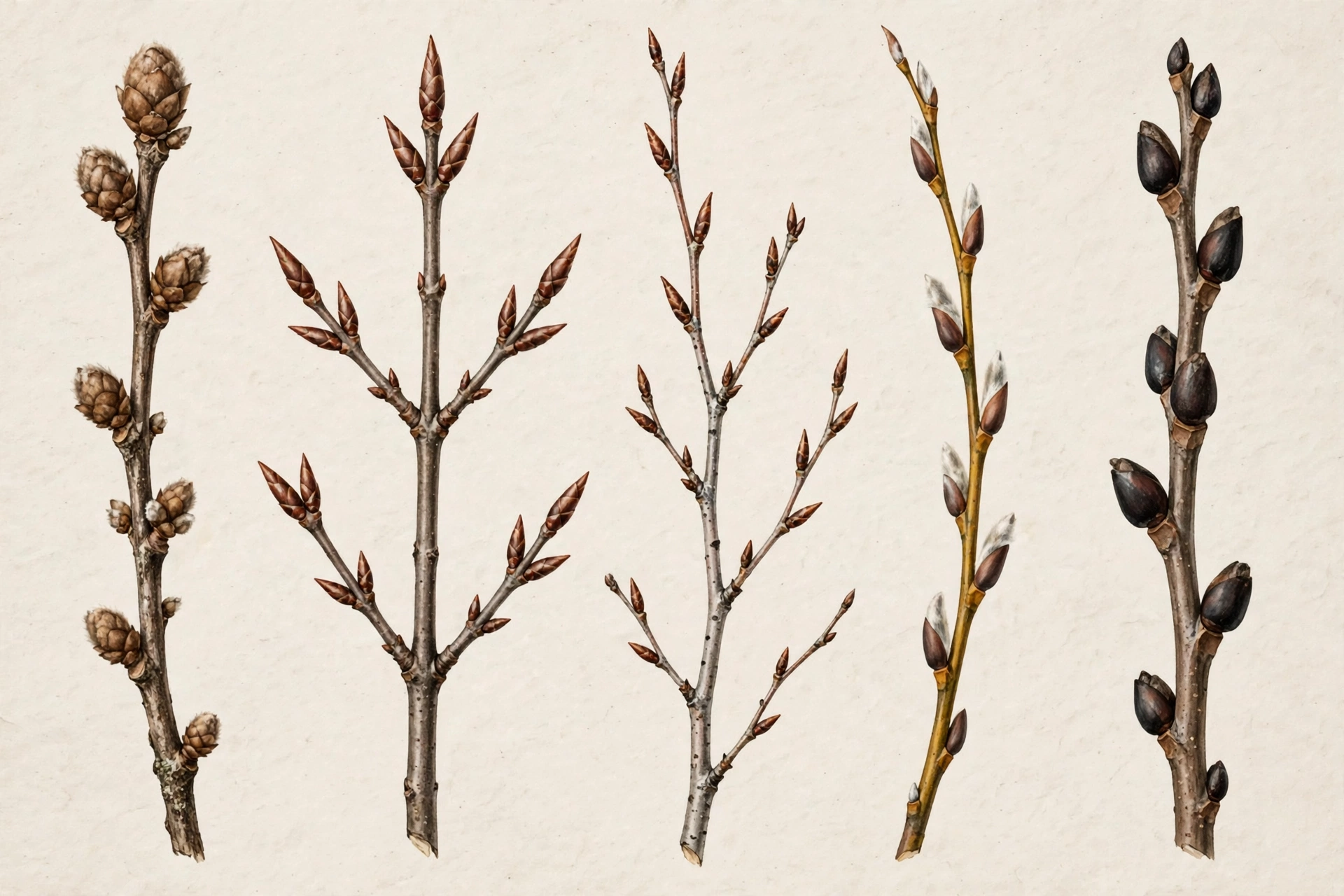
When the leaves fall, most beginners assume tree identification stops until spring. In fact, winter is one of the best times to learn trees, because the clues that remain — buds, twigs, leaf scars, and bark — are distinctive and easy to study without a canopy in the way.
Winter identification rewards slow, close looking. A bud is not just a small bump at the end of a twig: its size, shape, colour, scales, and position all carry information, and the scar left by each fallen leaf adds another layer. This guide shows you how to read those clues step by step.
Winter is also a good time to start because there is less to look at, which makes learning easier. In summer, a tree offers hundreds of leaves, flowers, and fruit to sort through; in winter, you need only a twig, a notebook, and a little patience. Learn five or six common trees this winter, and when spring arrives you will already know them before their leaves appear.
Why Winter Identification Is Different
In summer, leaves do most of the work. In winter, you must rely on smaller features, so combine two or three clues rather than trusting one alone. A single bud rarely proves an identification, but a bud plus its arrangement plus the bark usually does.
Winter also has advantages. Twigs are visible from the ground, bark patterns stand out without leaves hiding them, and the tree's overall shape is fully exposed. Many trees also hold useful extras through winter, such as cones or seed pods, which can confirm a guess.
Another advantage is that winter trees are easier to photograph. With no leaves in the way, you can photograph a twig against the sky, capture the whole shape of the tree from a distance, and study the bark without shade from the canopy. Use a plain background for twig photos, and take one photo from a short distance to show the twig and its buds, and one close-up to show the terminal bud and leaf scars.
The Key Features to Learn
Bud arrangement: opposite or alternate
Look at how buds sit along a twig. In opposite arrangement, buds grow in pairs directly across from each other. In alternate arrangement, they grow singly, taking turns along the twig. Only a small group of common trees — maples, ashes, dogwoods, and horse chestnuts — have opposite buds.
Bud shape, size, and scales
Study the terminal bud at the tip and the smaller lateral buds along the sides. Note whether buds are pointed or rounded, fat or slim, smooth or hairy. A large, sticky, pointed bud suggests horse chestnut, while small, dark, clustered buds suggest oak.
Leaf scars and bundle scars
Where each leaf fell, it left a leaf scar on the twig. Note its shape — round, triangular, or shield-shaped — and look for the tiny dots inside it, called bundle scars, where the leaf's veins once connected. Ashes typically show a U-shaped scar, and walnuts show a three-lobed scar.
Twig colour, texture, and smell
Note whether the twig is smooth or rough, thick or slender, green, brown, or reddish. Some twigs smell strongly when scratched: cherry smells faintly of almonds. Never taste a twig, but a gentle scratch-and-sniff is a safe and useful test.
Common Winter Trees to Learn First
Start with beech, whose long, slender, sharply pointed buds are very distinctive, and horse chestnut, whose large, sticky buds are easy to spot. Add oak, with its clustered buds and rough bark, and ash, with its large dark buds and U-shaped leaf scars. Once you know these four, add birch, with its white peeling bark, and maple, with its opposite buds and winged seeds that often remain on the tree or on the ground. Six trees is a good first set, and each one you learn makes the next one easier, because you will start to recognise the patterns — opposite versus alternate, pointed versus rounded, smooth versus rough — that separate all the others.
Step-by-Step: Identify a Bare Tree in Winter
Step 1: Photograph the whole tree
Stand back and photograph the tree's full shape, trunk, and branching pattern. Note whether branches grow upward, spread outward, or droop, and whether the crown is rounded or pointed.
Step 2: Find a low twig and photograph it
Choose a twig you can reach safely, with a clear terminal bud and several lateral buds. Photograph it against a plain background, such as the sky, so the buds stand out clearly.
Step 3: Check opposite or alternate
Look at the buds along the twig and decide whether they are opposite or alternate. Write this down first, because it is the most powerful single clue and guides everything that follows.
Step 4: Examine the buds and leaf scars
Look closely at the terminal bud's size, shape, colour, and scales, then find the leaf scars below the buds. A hand lens or your phone's zoom can help with small buds.
Step 5: Check the bark and any leftovers
Look at the bark on the trunk and larger branches, and search the ground for acorns, beech mast, maple keys, or seed pods. These remnants often confirm an identification quickly.
Step 6: Compare and confirm
Use an AI identification tool to compare your twig photo with likely matches. Check that the bud arrangement, bud shape, bark, and overall form all fit, and keep looking if one feature disagrees.
Common Mistakes Beginners Make
- Judging by one bud alone. Buds vary along a single twig, so check several and combine them with arrangement, scars, and bark.
- Forgetting opposite versus alternate. Skipping this step leaves you comparing your tree with far too many species.
- Confusing similar buds. Ash and maple buds can look alike, so check the leaf scars and twig thickness before deciding.
- Ignoring the bark. Bark changes with age, but its basic pattern — smooth, furrowed, or peeling — is still a strong clue.
- Identifying from a dead twig. Dead twigs lose their buds and colour, so always work with live, flexible twigs.
- Forgetting to check the ground. Fallen seeds, cones, and seed cases beneath a tree often confirm an identification faster than the twig alone, so always look down before you look up.
FAQ
Can I really identify a tree in winter without leaves?
Yes, in most cases. Buds, twig arrangement, leaf scars, and bark are reliable clues, and many common trees can be named from a single twig.
What is the easiest winter tree to recognise?
Beech is a good first tree: its long, slender, sharply pointed buds are very distinctive. Horse chestnut is another easy one, with large, sticky buds.
Do I need special equipment for winter identification?
No. A phone camera, a notebook, and optionally a small hand lens are enough to learn a great deal.
How do I tell ash from maple in winter?
Both have opposite buds, but ash buds are large, dark, and blunt, and the leaf scars are U-shaped, while maple buds are smaller and more pointed, and the twigs are usually slimmer. Check the leaf scars and the twig thickness together to separate them.
Can I identify a tree from a twig I found on the ground?
Sometimes, but a fallen twig may be dead, damaged, or blown in from another tree. Check that it is fresh and flexible, and compare its buds and leaf scars with a twig still on the tree. A ground twig is a useful extra clue, not a reliable identification on its own.
Conclusion
Identifying trees in winter by buds and twigs is a skill that grows quickly with practice. Start with opposite versus alternate arrangement, then study bud shape, leaf scars, and bark, and confirm with any leftover seeds or fruit. Each bare tree you name in winter makes spring identification easier, because you will already know the tree before its leaves appear.
Try it: Try the free Tree Identifier on aitreeidentier.site — photograph a twig with its buds for instant guidance.
Safety disclaimer: Never eat or use any part of a tree based on AI identification alone. AI results are guidance only — consult a local expert before eating, using, or treating any tree or plant, especially near children, pets, food crops, or waterways.