
Try it: Found a cone, nut, or pod you cannot name? Try the free Tree Seed Identifier on aitreeidentier.site — upload a photo for a likely match.
Introduction
Leaves are the most obvious way to identify a tree, but they are not always available. In autumn and winter, the ground is often covered with a better clue: seeds, cones, nuts, and pods.
Why Seeds Are Such Good Clues
Seeds are designed to be noticed — by wind, by water, or by animals that carry them away. That means they often have distinctive shapes, sizes, and structures. A winged seed, a spiky case, a woody cone, or a fleshy fruit is rarely generic.
How to Describe a Seed, Cone, Nut, or Pod
Start by noting the basics: size, shape, colour, and texture. Is it round, oval, long, flat, or winged? Is it smooth, spiky, hairy, woody, or fleshy? Is it in a case, a husk, a cone, or a pod, or is it bare?
Common Seeds, Cones, Nuts, and Pods
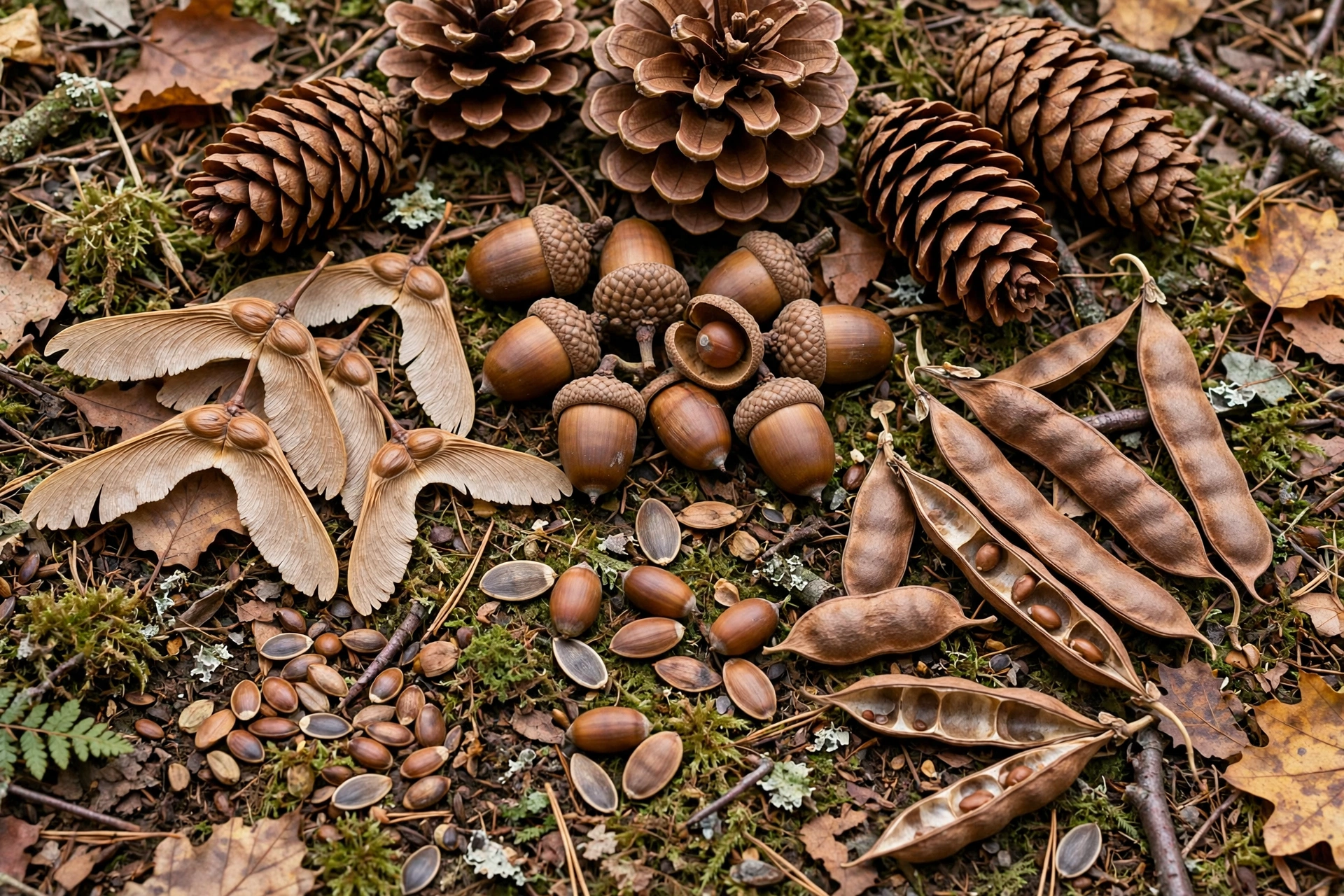
Acorns are the fruit of oaks: smooth, oval nuts with a distinctive cap, like a small cup. Different oak species have acorns of different sizes, with caps that may be shallow or deep. Conkers are the seeds of the horse chestnut: large, shiny, brown nuts in a spiky green case that splits open in autumn. The sweet chestnut looks similar but has a smaller, flatter nut in a very spiky case, with a pointed tip. Beech mast consists of small, triangular nuts in a spiky, four-lobed husk that opens like a small cup. Sycamore and maple keys are winged seeds in pairs, often called helicopters. They spin as they fall, carrying the seed away from the parent tree. Ash keys are single winged seeds that hang in bunches, longer and narrower than maple keys. Pine cones vary greatly by species. Scots pine cones are small, about 5–7 cm, with a slightly prickly tip. Other pines have larger, heavier cones with thick scales. Note the size, shape, and whether the scales are open or closed. Alder cones are small, dark, woody cones that look like miniature pine cones and stay on the tree through winter. Pods include the long, flat pods of honey locust and laburnum, and the bean-like pods of catalpa. Note length, width, colour, and whether the pod twists or splits open.
How Trees Spread Their Seeds — and What That Tells You
The way a seed travels is one of the best clues to its identity, because each dispersal method shapes the seed. Wind-dispersed seeds, such as maple keys, ash keys, and birch seeds, are light and often winged, and they are found scattered over a wide area, far from the parent tree. Animal-dispersed seeds, such as acorns, conkers, hazelnuts, and beech mast, are larger and more nutritious, because the tree is paying an animal to carry them away. Some, like acorns, are buried by squirrels and jays and forgotten, which is exactly how a new oak wood begins. Water-dispersed seeds, such as alder cones, float and are found along streams and ponds, while explosive pods, such as those of laburnum, fling their seeds several metres when they dry and split.
Noticing where you found a seed is therefore part of the identification. A winged seed on a windy hilltop, a nut under a tree in a wood, a cone floating in a stream — each setting narrows the possibilities. The season matters too: most tree seeds fall in autumn, but alder cones stay on the tree through winter, ash keys hang on into spring, and some pines hold their cones for years before opening. If you find a seed in spring, ask yourself which trees hold their fruit through winter, and your shortlist will shrink quickly.
Building a Small Reference Collection
One of the best ways to learn seed identification is to build a small collection of your own. Take a few examples of each seed you find, label them with the species, the place, and the date, and store them in small paper bags or jars. Over a year or two, you will have a reference set that lets you compare an unknown seed side by side with a known one — size, weight, texture, and shape are much easier to judge when you can hold both in your hands. Photograph each specimen against a ruler or a coin for scale, because memory is unreliable about size, and a photo with a scale bar is far more useful than a photo alone.
Visit the same trees through the seasons and watch the seeds develop. A green, unripe conker looks very different from a ripe one, and a closed pine cone looks different from an open one. Seeing the same seed at different stages teaches you the range of variation within a species, which is the key to confident identification. Keep your collection out of reach of children, and never eat anything from it — a reference collection is for looking, not tasting.
Step-by-Step Identification
1. Collect a few examples, not just one, and note where you found them — under which tree, in what habitat, and at what time of year. 2. Photograph the seed, its case or cone, and the parent tree if you can find it. 3. Describe size, shape, colour, texture, and any wings, caps, spikes, or husks. 4. Compare with a guide or an identification tool, using size as a key filter — a 2 cm cone and a 15 cm cone are different species. 5. Confirm with other clues: bark, buds, leaves on the ground, and the tree's shape and habitat.
Safety and Collection
Collect seeds respectfully. Take only a few, leave most for wildlife and for natural regeneration, and do not collect from protected sites without permission.
Common Mistakes to Avoid
- Identifying from a single seed: Seeds vary. Collect several and look for the typical shape.
- Ignoring size: A cone that is twice as large as the guide photo is probably a different species.
- Confusing horse chestnut and sweet chestnut: The cases and nuts are different — check the spikes and the nut shape.
- Forgetting the parent tree: The tree overhead is the best confirmation. Look up.
- Assuming every nut is edible: Many tree nuts are toxic or bitter. Never eat based on a guess.
- Collecting too early: Unripe seeds may look different and may not germinate.
FAQ
What is the easiest tree seed to identify? The conker is one of the easiest — large, shiny, brown, and in a spiky case. Sycamore helicopters and acorns are also very distinctive and common.
Can I identify a tree from a cone alone? Often, yes, especially for conifers. Cone size, shape, scale texture, and whether the cone is open or closed are strong clues. Combine the cone with bark and needle clues for confidence.
When is the best time to look for tree seeds? Autumn is the best time, when most seeds, cones, and nuts fall. Winter is also good, as many cones and husks remain on the ground or on the tree.
Are all tree seeds safe to handle? Most are safe to handle with normal care, but some are toxic if eaten, and some cases are spiky. Wash your hands after handling, and never eat a seed you cannot identify with certainty from a reliable source.
How do I tell an ash key from a maple key? Maple keys grow in pairs and spin like helicopters as they fall, while ash keys are single, longer, and narrower, and hang in bunches from the tree. Size also helps: ash keys are usually 3 to 5 centimetres long, while maple keys are shorter and broader.
Can I grow a tree from a seed I find? Often, yes, but many tree seeds need a cold period before they will germinate, and some need to be sown fresh in autumn. Collect a few seeds, identify the species first, and check its germination needs before sowing.
Conclusion
Seeds, cones, nuts, and pods are some of the most rewarding clues in tree identification. They are distinctive, they are available when leaves are not, and they tell a story about how a tree lives and spreads.
Safety note: Never eat or use any seed, nut, cone, or pod based on an AI identification alone. Some are toxic, even in small amounts. If you are unsure about edibility or safety, consult a local expert before handling or consuming anything.