
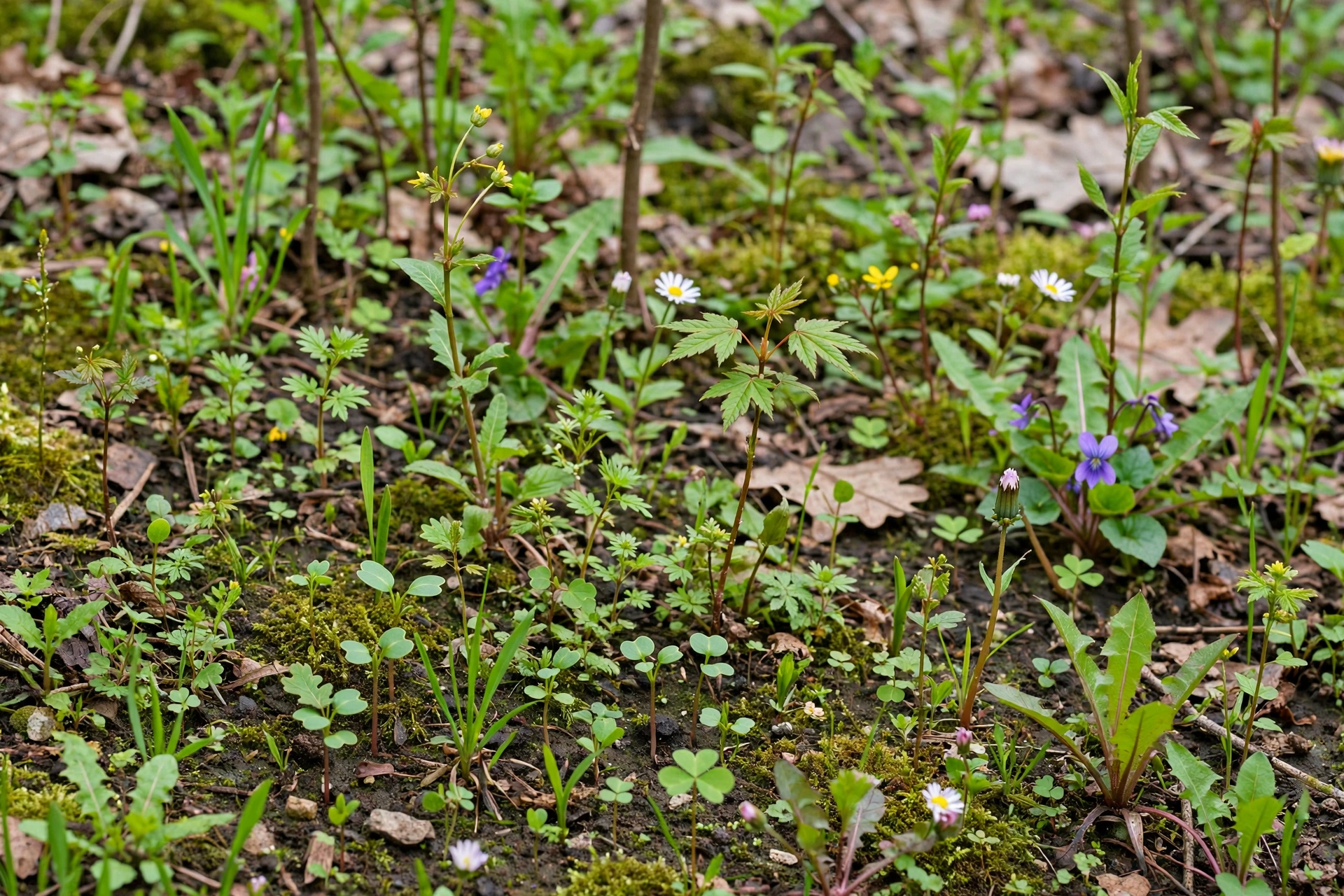
A seedling is a plant at its most mysterious. With only a few tiny leaves and a thin stem, a future oak can look almost identical to a common weed, and a prized wildflower can be mistaken for a plant you were about to pull out. Learning how to identify seedlings saves you from weeding out the plants you wanted.
Seedlings change fast. The first leaves often look nothing like the adult leaves, and a seedling can double in size within a week. This guide explains what to look for at each stage.
The key idea is patience. A seedling is not a finished plant, and trying to name it on its first day is like trying to identify a tree from a single bud. Wait for the true leaves, note where it is growing, and watch how it changes over a few days. The identification that is impossible on Monday is often obvious by Friday, once the second set of true leaves has opened.
Why Seedlings Are Hard to Identify
The main difficulty is that seedlings all start small and green, with simple shapes and few distinguishing features. Many plants begin life with a pair of smooth, oval seed leaves that reveal almost nothing about the adult plant. Even experienced gardeners wait for the first true leaves before deciding.
Context helps. A seedling growing under a mature oak is more likely to be an oak than one in a vegetable bed. A seedling in a neat row is probably something you sowed, while one on a path is more likely a weed.
Another reason seedlings are hard is that they change so quickly. A seedling can grow several centimetres in a day, and each new set of leaves looks more like the adult plant than the last. That is why a single photo is rarely enough: photograph the seedling on the day you find it, and again three or four days later, and compare the two. The change itself is a clue, because different species grow at different speeds and in different ways.
The Parts of a Seedling to Study
Cotyledons: the first seed leaves
Cotyledons are the first leaves to emerge from a seed, and they often look plain and rounded. Some plants have one cotyledon, some have two, and a few, such as pines, have several. They are useful for broad grouping, but they rarely identify a species on their own.
First true leaves
The leaves that appear after the cotyledons are called true leaves, and they are the most important clue. They usually begin to show the shape, edges, and texture of the adult plant. An oak seedling's true leaves start to show lobes, and a maple seedling's show points. Wait for at least two sets of true leaves before deciding.
Stem, colour, and texture
Look at the stem: is it thin and wiry, thick and fleshy, round or square, smooth or hairy? Note its colour too — green, red, purple, or pale. Some seedlings have distinctive stems, such as the reddish stem of a young maple.
Roots and growth habit
If you need to move a seedling, look at its roots: a young tree seedling often has a single strong taproot, while many weeds have fine, fibrous roots. Also note the growth habit — is the seedling growing upright, spreading flat, or climbing? Growth habit develops early and can separate a young tree from a weed even before the true leaves are fully formed.
Step-by-Step: Identify a Seedling
Step 1: Photograph it in place
Photograph the seedling where it is growing, including the soil and nearby plants for scale. Take one photo from above and one from the side, with a coin or your finger beside it for size.
Step 2: Count the cotyledons and check the first leaves
Look at the lowest leaves and decide whether they are cotyledons or true leaves. Count them, note their shape, then study the newest leaves at the top.
Step 3: Note the location and neighbours
Ask yourself what is growing nearby. Is there a parent tree overhead, a flower bed close by, or a compost heap that could have spread seeds? Location is one of the strongest clues for seedlings.
Step 4: Wait and watch for a few days
If the seedling is still very young, the safest step is patience. Mark its position with a small stick and check it again in three or four days. The next set of true leaves often makes the identification obvious.
Step 5: Compare with a photo tool
Use an AI identification tool to compare your photos with likely matches. Check whether the leaf shape, stem, and habitat fit.
Step 6: Decide whether to keep, move, or remove it
Once you have an identification, act on it. Keep wanted seedlings and give them space. Move a young tree seedling while it is still small, keeping as much root as possible. Remove weeds promptly, before they set seed.
Young Trees, Weeds, and Wildflowers: Telling Them Apart
Young tree seedlings often have thicker, woodier stems than weeds, and they grow more slowly at first, putting energy into roots. Maple seedlings often appear in large numbers beneath a maple, and their first true leaves already show a familiar pointed shape.
Weeds tend to appear in disturbed soil, paths, and bare patches, and many grow very fast. Wildflower seedlings are the hardest group, because many look like weeds in their first weeks, so mark any sown area and wait for true leaves before weeding.
A useful test is to look at the group, not just the single seedling. Tree seedlings often appear in clusters beneath a parent tree, with the same leaf shape repeated many times. Weeds often appear scattered across bare soil, in many different shapes. Wildflower seedlings appear where you sowed them, in the pattern you sowed them. The pattern of the group is often more informative than the shape of one seedling.
Common Mistakes Beginners Make
- Identifying from cotyledons alone. Cotyledons look similar across many species, so always wait for true leaves before deciding.
- Weeding too early. Pulling seedlings in their first week destroys wildflowers and young trees that had not yet shown their true leaves.
- Ignoring where it grows. A seedling's location and neighbours are often more informative than its shape at this stage.
- Trusting a single photo. Seedlings change daily, so photograph them over several days.
- Confusing lookalikes. Young maples and some weeds share pointed leaves, so check the stem and growth habit too.
- Moving a seedling too late. A young tree seedling is easy to move while it is small, but once its taproot grows deep, moving it becomes much harder and more likely to fail. Move it as soon as you are confident of the identification.
FAQ
How long should I wait before identifying a seedling?
Wait until it has at least two sets of true leaves, which usually takes one to three weeks.
Can I move a young tree seedling?
Yes, while it is small. Dig widely to keep the roots intact, replant it at the same depth, and water it well.
Is it safe to touch an unknown seedling?
Touching a seedling is generally fine, but wash your hands afterwards. Never taste an unknown seedling.
How do I protect seedlings I want to keep?
Mark them with a small stick or label so you do not weed them by accident, and protect them from slugs and birds with a simple cover if needed. Give them space by removing nearby weeds, and water them gently in dry weather until they are established.
What should I do with a seedling I cannot identify?
Leave it alone and keep watching it. Photograph it every few days, note where it is growing, and wait for more true leaves. If it is in the way, move it to a spare pot or a quiet corner of the garden rather than removing it, so you can identify it later when it is larger.
Conclusion
Identifying seedlings is a skill built on patience and observation. Study the cotyledons, wait for the true leaves, note the stem and location, and watch how the plant grows. With that method, you can tell a young tree from a weed before you reach for the trowel.
Try it: Try the free Plant Identifier on aitreeidentier.site — photograph a seedling for instant guidance.
Safety disclaimer: Never eat or use any plant based on AI identification alone. AI results are guidance only — consult a local expert before eating, using, or removing any plant, especially near children, pets, food crops, or waterways.