
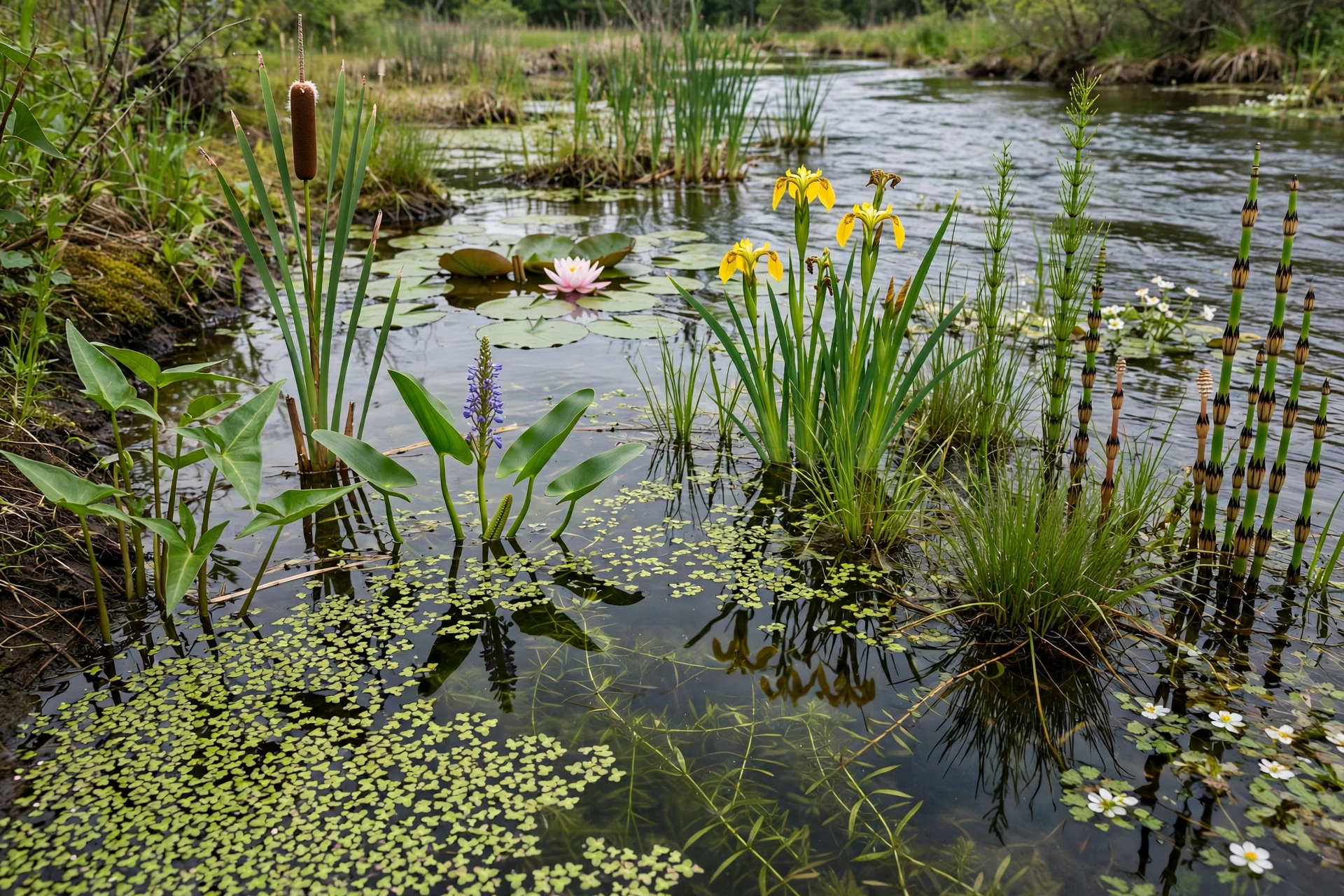
Ponds, rivers, and wetlands are full of plants that most people walk past without naming. Some float on the surface, some grow beneath the water, and some stand tall at the edge, and each group has its own clues. Learning how to identify aquatic plants opens up a habitat that is easy to overlook.
Aquatic plants are identified differently from garden plants, because water hides much of the plant and changes how it looks. Leaves above and below the water can have different shapes, flowers may appear for only a few weeks, and the habitat itself narrows the possibilities quickly. This guide shows you how to read those clues safely from the bank.
Aquatic plants also matter for the health of the water itself. They provide food and shelter for fish, insects, and birds, they oxygenate the water, and they can show whether a pond or river is healthy or out of balance. Learning to name them is therefore not only a satisfying skill, but a useful way to understand the whole wetland around you.
The Main Groups of Aquatic Plants
Floating plants
Floating plants live on the water surface, with roots dangling below and no connection to the bottom. Duckweed forms tiny green dots that can cover a pond in summer, water lilies spread broad round leaves with a notch, and water lettuce forms soft rosettes.
Submerged plants
Submerged plants grow entirely underwater, and you may only see their tips breaking the surface. Their leaves are often thin, feathery, or ribbon-like, which helps them move with the water. Pondweeds have narrow leaves along a stem, and water milfoil has finely divided feathery leaves in whorls.
Emergent plants
Emergent plants are rooted in shallow water or wet mud, with stems and leaves rising above the surface. This group includes reeds, rushes, sedges, and cattails, and their tall stems and seed heads are visible from the bank.
Marginal and bank plants
Marginal plants grow at the water's edge, in wet mud that is sometimes flooded and sometimes dry. They include many familiar wetland plants such as marsh marigold, water mint, and purple loosestrife. Note where the plant sits — in the water, at the edge, or on the bank above the waterline — because that position is itself a strong clue to its identity.
What to Look For: Leaves, Flowers, and Habitat
Leaf shape above and below water
Many aquatic plants produce two kinds of leaves: broad floating leaves and narrow, feathery submerged leaves. Arrowhead, for example, has arrow-shaped leaves above water and ribbon-like leaves below it.
Flowers and seed heads
Flowers are often the most reliable clue, though they may last only a few weeks. Water lilies have large, showy flowers, water crowfoot has small white flowers with yellow centres, and cattails have a distinctive brown, sausage-shaped seed head.
Growth habit and water conditions
Note how the plant grows: does it float freely, root in the mud, or stand in tall clumps? Record the water depth and whether the water is still or flowing. A plant in a fast stream is unlikely to be the same species as one in a still pond.
Seasonal changes
Aquatic plants change more with the seasons than most garden plants. In spring, new shoots appear and leaves are often small and pale; in summer, flowers and full-size leaves make identification easiest; in autumn, many plants die back or produce seed heads; and in winter, some disappear completely below the water. Always record the date of your visit, and if a plant is hard to identify, return in summer when it is in flower.
Step-by-Step: Identify an Aquatic Plant
Step 1: Observe from the bank first
Start from dry ground. Photograph the plant in its setting, showing the water, the bank, and nearby plants. Never wade into unknown water — deep mud and strong currents make this dangerous.
Step 2: Note the plant's position in the water
Ask whether the plant floats freely, is rooted underwater, or stands at the edge. This places it in one of the main groups and narrows the list of candidates.
Step 3: Photograph leaves, flowers, and stems
Take close-up photos of the leaves, both above and below the water if possible, and of any flowers or seed heads. Include a hand or a coin for scale.
Step 4: Record the habitat
Note the type of water body, the depth, whether the water moves, and the plants growing beside it.
Step 5: Compare with a photo tool
Use an AI identification tool to compare your photos with likely matches. Check that the growth habit, leaf shape, and habitat all fit. A match that fits only the flower but not the habitat should be treated with suspicion.
Step 6: Check again in a different season
Many aquatic plants look different in spring and summer, and some die back completely in winter. If you are unsure, photograph the same spot again a few weeks later.
Common Mistakes Beginners Make
- Wading in to get closer. Never enter unknown water for a photo. Deep mud and currents are real hazards, and most plants can be identified from the bank.
- Identifying from a flower alone. Many aquatic flowers look alike, so combine flowers with leaves and habitat.
- Ignoring submerged leaves. The leaves below the water often look completely different from those above it, and both are needed for a reliable identification.
- Confusing native and invasive species. Some invasive aquatic plants spread fast and crowd out native species. If you suspect one, report it to your local wildlife authority rather than removing it yourself.
- Assuming clear water means healthy water. A pond can look clear and still be out of balance, so judge the water by the whole plant community, not one species.
- Forgetting to note whether the water moves. Still ponds, slow rivers, and fast streams each favour different species, so a plant that fits the flower but not the water is probably the wrong identification.
FAQ
Can I identify an aquatic plant from a photo taken at the bank?
Usually, yes. A photo showing the plant's position, its leaves, and any flowers is often enough.
What is the easiest aquatic plant to recognise?
Water lilies are a good first plant: broad, round, floating leaves and large flowers in summer. Cattails are another easy one, with tall stems and a brown seed head.
Why do some aquatic plants have two different leaf shapes?
Leaves above water catch light and resist drying, while leaves below water move with currents and absorb nutrients. Many species grow a different leaf shape in each place.
How do I tell reeds, rushes, and sedges apart?
Reeds are usually tall with flat leaves and feathery seed heads, rushes have round, hollow stems and small brown flowers, and sedges have triangular stems with edges you can feel by rolling the stem between your fingers. The old saying helps: sedges have edges, rushes are round, and reeds are tall with flat leaves.
What should I do if I think I have found an invasive aquatic plant?
Do not remove it yourself, and do not move it to another pond or river. Photograph it, note the location and date, and report it to your local wildlife authority or environmental agency, who can confirm the identification and decide what to do.
Conclusion
Identifying aquatic plants means looking at the whole picture: where the plant grows, how its leaves differ above and below the surface, and what its flowers and seed heads look like. Start from the bank, photograph carefully, and return in a different season if you need confirmation.
Try it: Try the free Plant Identifier on aitreeidentier.site — photograph leaves and flowers for instant guidance.
Safety disclaimer: Never eat or use any plant based on AI identification alone. AI results are guidance only — consult a local expert before eating, using, or removing any plant, and never enter unknown or fast-moving water. Stay on the bank, especially near children, pets, and deep or muddy water.