
Try it: Different trees need different feeding — try the free Tree Identifier on aitreeidentier.site to confirm your species first.
Introduction
Many gardeners assume that trees, like vegetables or lawns, need regular feeding to grow well. In fact, most healthy, established trees in good soil need no fertiliser at all. They have extensive root systems, they recycle nutrients from their own fallen leaves, and they are adapted to the soil they grow in. Feeding a tree that does not need it can do more harm than good, encouraging soft, weak growth, making the tree more vulnerable to frost and pests, and polluting soil and water. That does not mean fertiliser never helps.
Does Your Tree Actually Need Fertiliser?
Before you feed, look at the tree. A healthy tree has good leaf colour, steady growth, and a full canopy. If your tree looks healthy, leave it alone. Mulch and good watering are usually more helpful than fertiliser. Signs that a tree may need feeding include pale or yellowing leaves, especially on new growth, very slow growth, small leaves, early leaf drop, or poor fruiting in a fruit tree that is otherwise healthy. These symptoms can also be caused by drought, waterlogging, compacted soil, pests, or disease, so check those first.
When to Fertilise — and When Not To
The best time to fertilise most trees is in early spring, just before growth starts, or in late autumn, after leaves have fallen, when nutrients can be taken up by roots and stored for spring. Avoid fertilising in late summer or autumn with a high-nitrogen fertiliser, which encourages soft new growth that will be damaged by frost. Do not fertilise a newly planted tree in its first year. The tree needs to grow roots, not top growth, and fertiliser can burn young roots.
What Fertiliser to Use
For most garden trees, a slow-release, balanced fertiliser is the safest choice. Look for a product with roughly equal amounts of nitrogen, phosphorus, and potassium, or a tree-specific fertiliser from a reputable brand. Slow-release granules feed over months, rather than giving a sudden flush of growth. Organic options include well-rotted compost, leaf mould, and well-rotted manure, applied as a mulch or dug lightly into the soil surface. These feed the soil as well as the tree, improve soil structure, and release nutrients slowly.
Reading the Signs: What Different Deficiencies Look Like
Not all yellow leaves mean the same thing, and learning to read the pattern can save you from feeding the wrong nutrient. Nitrogen deficiency usually shows as a general pale yellowing of older leaves first, with slow, weak growth overall, because the tree moves nitrogen to new growth when supplies are short. Iron deficiency, which is common on alkaline soils, shows as yellowing between the veins of young leaves while the veins stay green — a pattern called interveinal chlorosis. Magnesium deficiency also causes yellowing between veins, but usually on older leaves first, and it may be accompanied by reddish tints. Potassium deficiency often appears as scorched or brown leaf edges, especially in fruit trees, and can reduce fruit size and quality.
The key point is that these symptoms overlap with drought, waterlogging, root damage, and disease, so never diagnose from leaves alone. A soil test is the only reliable way to confirm a deficiency, and it is cheap compared with the cost of guessing wrong. If your soil test shows a specific shortage, you can target it: for example, a seaweed feed or a chelated iron treatment for iron chlorosis on alkaline soil, or a potassium-rich feed for a fruit tree with scorched leaf margins. Treating the soil pH may matter more than adding the nutrient itself, because a tree cannot absorb iron from alkaline soil no matter how much you apply.
Feeding Fruit Trees and Potted Trees in More Detail
Fruit trees are the main exception to the rule that established trees need no feeding, because every harvest carries nutrients away from the garden. An apple tree that produces 20 kilograms of fruit has exported a significant amount of potassium in particular, and that needs replacing if cropping is to stay strong year after year. Feed fruit trees in early spring with a balanced fertiliser or a potash-rich feed, and mulch with well-rotted compost, which releases nutrients slowly and improves the soil at the same time. Watch for biennial bearing — a heavy crop one year followed by almost nothing the next — which can be eased by thinning fruitlets in the heavy year and by steady, moderate feeding rather than a large dose in one go.
Potted trees are a different world again. A tree in a container has only a small volume of compost to draw on, and regular watering washes nutrients out of it. Feed container trees with a balanced liquid feed every two to four weeks from spring to midsummer, following the label rate, and stop feeding by late summer so new growth has time to harden before winter. Repot every two to three years with fresh compost, and check for roots circling the pot, which can strangle the tree if ignored. A slow-release fertiliser mixed into the compost at repotting time gives a steadier supply than liquid feeding alone.
How Much and How to Apply It
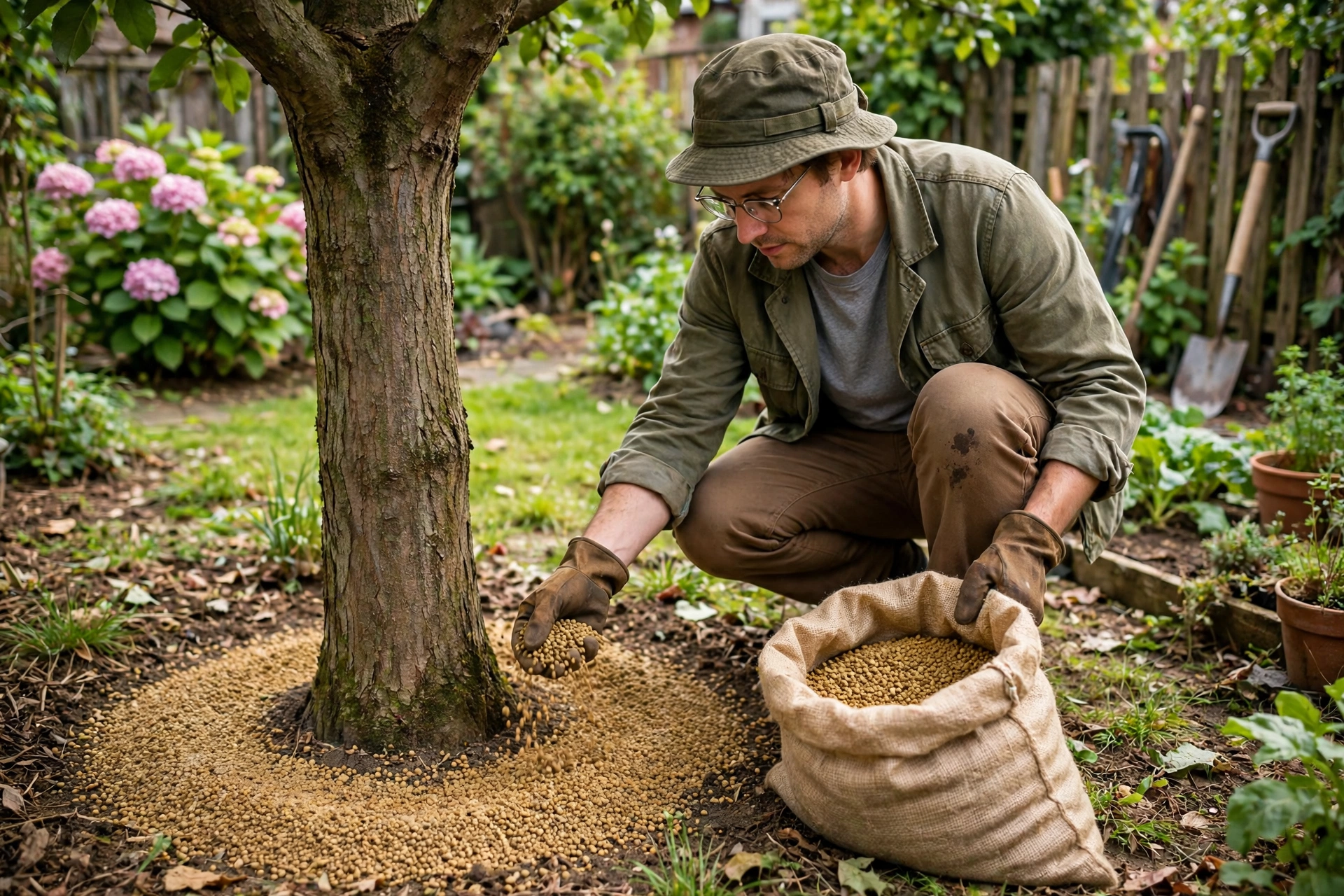
Follow the product label exactly — more is not better. As a general guide, apply fertiliser over the root zone, which extends well beyond the canopy, not just at the trunk. For a granular fertiliser, scatter it evenly over the root zone, lightly fork it into the soil surface if possible, and water it in well. For a liquid feed, apply it to moist soil, not dry soil, and water afterwards. For young trees, use a small amount — a handful of slow-release granules spread widely is often enough.
Common Mistakes to Avoid
- Feeding a healthy tree that does not need it: This wastes money and can harm the tree.
- Using too much fertiliser: Excess salts can burn roots and pollute water.
- Feeding at the wrong time: Late-summer nitrogen produces frost-tender growth.
- Feeding only at the trunk: Roots are spread out — feed the whole root zone.
- Using lawn fertiliser on trees: High nitrogen is wrong for most trees.
- Feeding a stressed tree: Fix drought, drainage, or disease first.
- Ignoring soil pH: A tree in the wrong pH soil cannot take up nutrients, however much you feed it.
FAQ
How do I know if my tree needs fertiliser? Look for pale leaves, slow growth, and poor fruiting, and get a soil test to confirm a deficiency. If the tree looks healthy and is growing well, it probably does not need feeding.
Is compost enough to feed a tree? For most garden trees, yes. A yearly mulch of well-rotted compost or leaf mould feeds the soil slowly, improves structure, and is very hard to overdo.
Can I over-fertilise a tree? Yes. Too much fertiliser can burn roots, cause leaf scorch, encourage weak growth, and wash into waterways. Always follow label rates and do not feed more than once or twice a year without a soil test.
Should I fertilise a tree in a pot? Yes, potted trees need regular feeding because they cannot reach nutrients in the wider soil. Use a balanced liquid feed during the growing season, following the label, and repot with fresh compost every few years.
When should I feed a newly planted tree? Wait until the second growing season. In the first year the tree needs to grow roots, and fertiliser encourages top growth at the expense of roots. A mulch of compost is a safer first-year treatment than any fertiliser.
Is seaweed feed good for trees? Seaweed feed is a gentle, useful tonic that supplies trace elements and can encourage root growth, but it is low in the main nutrients, so it should complement compost or a balanced fertiliser rather than replace them.
Conclusion
Fertilising trees is about restraint, not routine. Most established trees need no fertiliser at all — good soil, mulch, and water are enough. Feed only when a tree shows signs of deficiency or a soil test confirms a need, use a slow-release balanced fertiliser or well-rotted compost, apply it over the whole root zone in early spring, and follow the label. Fruit trees and young trees in poor soil are the main exceptions.
Safety note: Never eat or use any part of a tree based on an AI identification alone. Store fertilisers safely, away from children and pets, follow label instructions, and consult a local expert if you are unsure about a product or a tree's needs.