
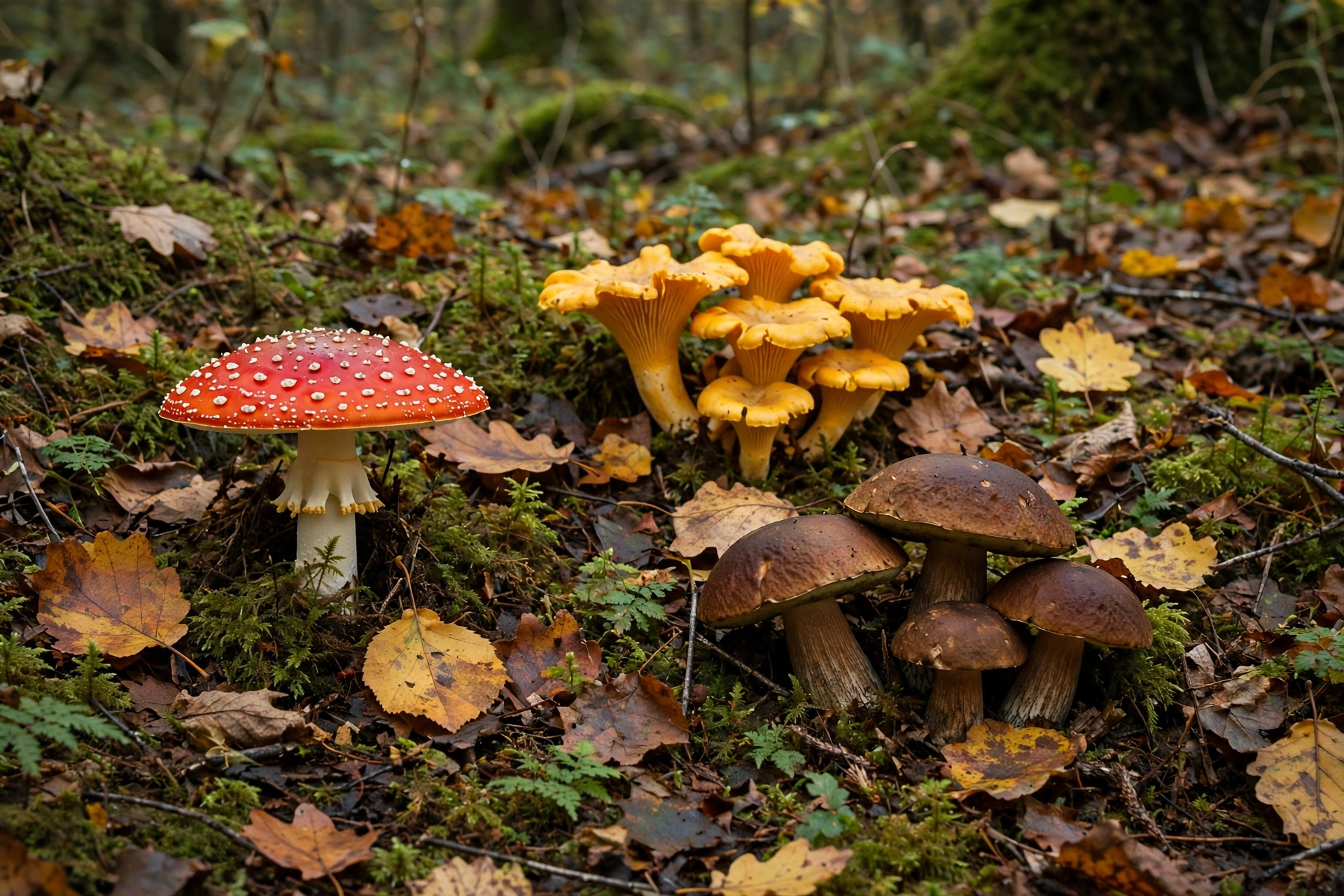
Autumn is mushroom season. After summer warmth and autumn rain, fungi appear in woods, meadows, and gardens in many shapes and colours. Identifying mushrooms is fascinating, but caution matters most, because some edible species have toxic lookalikes.
This guide explains how to identify fungi safely in fall, what features to observe, and the safety rules that should never be broken.
Try it: Use the Mushroom Identifier on aitreeidentier.site — photograph a mushroom from several angles as a first step, but never rely on AI alone.
Why Autumn Is Mushroom Season
Fungi fruit in autumn when warm soil, cool air, and rain create ideal conditions. The mushroom is only the fruiting body — the main organism lives underground or in wood year-round.
Step-by-Step: Observing a Mushroom Safely
Step 1: Photograph, do not pick unnecessarily
Photograph the mushroom in place before touching it, from the side, above, and underneath. Note its size for scale, handle unknown fungi as little as possible, and wash your hands afterwards.
Step 2: Note the cap
Record the cap's size, shape, colour, and texture — flat, domed, or wavy; smooth, scaly, or slimy — and note that features change as the mushroom matures.
Step 3: Look underneath — gills, pores, or teeth
Look underneath: does it have gills, pores as in boletes, or teeth? Note their colour, how crowded they are, and whether they attach to the stem.
Step 4: Examine the stem and base
Note the stem's length, thickness, and colour, whether there is a ring, and whether the base is swollen or in a cup-like volva — a crucial clue for some toxic species.
Step 5: Record habitat and associated trees
Note exactly where it is growing — on the ground, wood, or a living tree — and the trees nearby, as many fungi grow in partnership with specific trees such as birch, oak, or pine.
Step 6: Check the spore print if you are learning seriously
A spore print, made by placing the cap on paper overnight, reveals spore colour — a useful learning tool, but never a basis for eating a mushroom.
Common Autumn Fungi to Learn — By Observation Only
- Fly agaric: Bright red cap with white spots, common under birch and pine in autumn. Striking and well known — and toxic.
- Porcini / cep: A large bolete with a brown cap, white pores, and a thick stem, found under oak, beech, and pine. Highly prized by foragers, but with toxic lookalikes.
- Chanterelle: Golden, vase-shaped, with blunt ridges instead of true gills, often in mossy woodland. Has a dangerous lookalike, the false chanterelle.
- Shaggy inkcap: A tall, white, shaggy-capped mushroom on lawns and paths that dissolves into black ink as it ages.
- Amethyst deceiver: A small, vivid purple mushroom in woodlands, whose colour fades with age — hence its name.
The Safety Rules — Non-Negotiable
Never eat a wild mushroom based on an app or AI identification alone. AI tools can suggest a species, but they cannot confirm edibility. A single mistake can cause serious illness or death.
Never eat a mushroom unless a local expert has confirmed it in person. Join a local fungi group, go on a guided foray, and learn from experienced foragers in your area.
Do not rely on old myths. There is no simple test for edibility. Only careful, species-level identification by an expert counts.
Keep a sample and a photo. If someone eats a wild mushroom and feels unwell, seek medical help immediately and keep a sample and photo for identification.
Common Mistakes in Mushroom Identification
Relying on a single photo. One photo rarely shows cap, gills, stem, base, and habitat. Take several photos from different angles.
Confusing lookalikes. Many edible species have toxic twins that differ in small details — gill colour, spore colour, or the presence of a volva. Small differences matter enormously with fungi.
Assuming a mushroom is the same species as one you found before. Fungi vary with age, weather, and location. Identify every specimen fresh.
Eating a small taste to test it. Even a small amount of a toxic species can be harmful. Never taste an unidentified mushroom.
Frequently Asked Questions
Can an app identify a mushroom safely? An app can suggest a possible species as a learning aid, but it cannot confirm that a mushroom is safe to eat. Always have a local expert confirm in person before eating any wild fungus.
What should I do if I find a mushroom I cannot identify? Photograph it, note its features and habitat, and leave it where it is. Share the photos with a local fungi group or expert for learning — do not eat it.
Are all brightly coloured mushrooms poisonous? No — colour alone does not tell you if a mushroom is toxic. Some brightly coloured species are edible, and some plain brown or white species are deadly. Only full identification counts.
When is the best time to look for autumn mushrooms? After rain in autumn, when the ground is damp and temperatures are cool but not freezing. Early morning is best, as mushrooms are fresh.
Conclusion
Autumn mushroom season is a wonderful time to learn about fungi. Observe carefully, photograph thoroughly, record where and when you found each one, and learn from local experts. Enjoy identification as a way of understanding nature, not as a shortcut to a meal.
Safety note: Never eat or use any mushroom or fungus based on AI identification alone. Some wild mushrooms are deadly, and toxic lookalikes can be almost identical to edible species. Always consult a local expert in person, and seek medical help immediately if anyone feels unwell after eating a wild mushroom.